
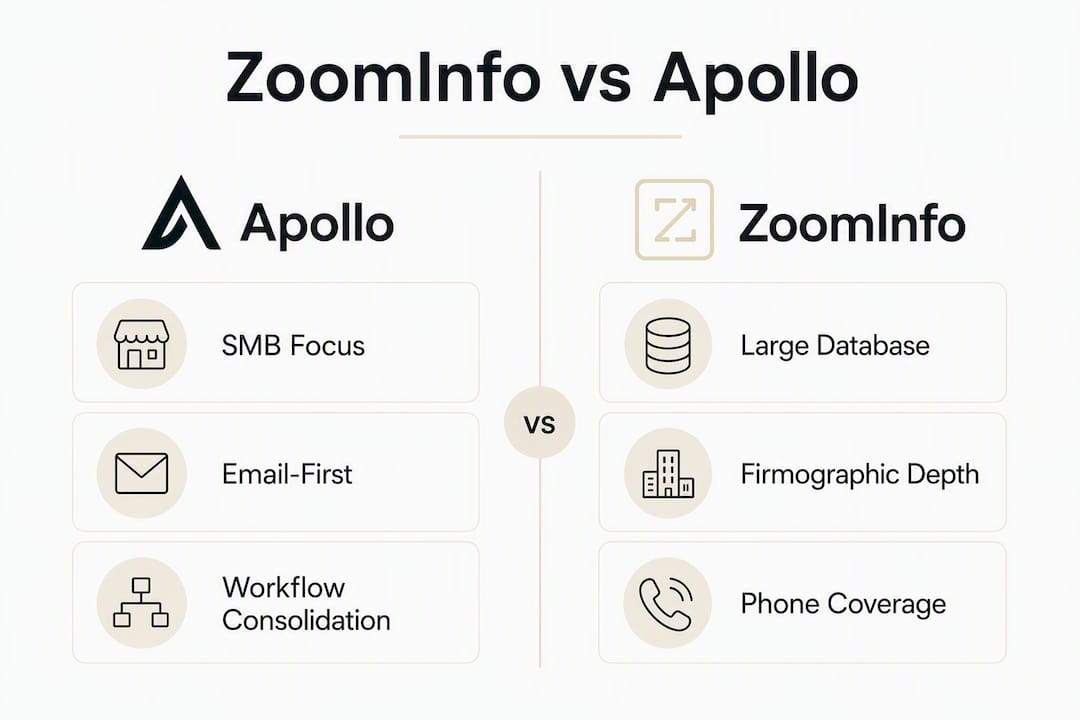
Choose Apollo for lean, email-first SMB teams that need fast time-to-value. Choose ZoomInfo for enterprise ABM and phone-first programs that require deeper firmographics and superior phone coverage. The decision is less about which platform has “better data” and more about which execution system you already run.
The biggest trade-offs in plain terms:
- Phone coverage: Independent testing found ZoomInfo’s mobile match rate significantly higher than Apollo’s, which matters for cold calling. If cold calling drives your pipeline, that gap is real money.
- Email accuracy: Both platforms have a similar email accuracy ceiling and require verification workflows for high-volume sending, so neither gives you a clean list out of the box.
- Pricing model: Apollo publishes transparent pricing with free and paid tiers, while ZoomInfo uses sales-led pricing with median contract values reported by third parties.
- Architecture: Apollo is all-in-one (data, sequencer, dialer, analytics). ZoomInfo is a core intelligence platform with engagement and AI capabilities available as add-on modules.
Quick picks:
- Best for SMB/email-first teams: Apollo
- Best for enterprise/phone-first ABM: ZoomInfo
Table of Contents
- How do ZoomInfo and Apollo actually compare?
- Key Takeaways
- What buyers consistently underestimate
- How to get more from your pipeline investment
- Useful sources for your own evaluation
How do ZoomInfo and Apollo actually compare?
The table below maps both platforms across the dimensions that drive real GTM decisions. Narrative detail follows.
| Dimension | Apollo | ZoomInfo |
|---|---|---|
| Best for / team profile | SMB and mid-market, email-first outbound | Enterprise sales and RevOps, phone-heavy ABM |
| Data depth & coverage | ~73M companies; strong email; 41% mobile match | ~104M companies; deeper firmographics, org charts, scoops; 67% mobile match |
| Intent data | Third-party signals (Bombora-sourced) | First-party intent signals; stronger for ABM prioritization |
| Engagement features | Built-in sequencer, dialer, analytics | ZoomInfo Engage (sequencer + dialer) as add-on module |
| Architecture | All-in-one platform | Core intelligence + modular add-ons (Engage, Copilot, Chorus) |
| Pricing model | Transparent; from $49/user/mo (annual) | Sales-led; median ~$32K/year |
| CRM & integrations | Salesforce, HubSpot, Pipedrive, and others | Salesforce, HubSpot, Marketo, and enterprise stack |
| Verification / deliverability | Built-in email verification; ~78% accuracy | Built-in verification; ~84% email accuracy |
| Enterprise scale | API access; limited ABM orchestration | API, custom match, territory management, ABM orchestration |
| Support & onboarding | Self-serve onboarding; chat support | Dedicated CSM for enterprise; structured onboarding |
Where Apollo wins
Apollo’s strongest argument is consolidation. For many SMB teams, it replaces a database tool, a sequencer like Outreach or Salesloft, and a dialer, all in one subscription. That matters when you’re managing three vendor contracts, three billing cycles, and three sets of login credentials. The built-in sequencer is genuinely capable, not a stripped-down afterthought, and the transparent pricing means you can evaluate it without a sales call.

The email-first workflow is tight: search a segment, build a list, push directly to a sequence, and track opens and replies in the same UI. Time from account creation to first email sent is measured in hours, not weeks.
Where ZoomInfo wins
ZoomInfo’s company database runs roughly 104 million records vs. Apollo’s ~73 million, and the firmographic depth goes further: org charts, technographics, buying signals (“scoops”), and first-party intent data that ZoomInfo collects from its own network rather than licensing from Bombora. For enterprise ABM, that first-party intent is a meaningful advantage because it reflects actual research behavior on ZoomInfo’s own publisher network.

ZoomInfo Engage adds sequencing and dialing tightly integrated with those intent signals, so a rep can prioritize accounts showing in-market behavior and reach out in the same platform. ZoomInfo Copilot layers AI-driven account prioritization and meeting prep on top, and Chorus (conversation intelligence) closes the loop on call coaching. The ecosystem is deep. It’s also expensive and takes longer to deploy.
The true cost per qualified contact
Sticker price comparisons are misleading when you don’t account for credit burn, bounce rates, and supplemental verification. Here’s the framework worth running before you sign anything:
Effective cost per valid contact = (monthly subscription + verification tool cost) ÷ (contacts exported × deliverability rate)
If Apollo delivers 78% email accuracy and ZoomInfo delivers 84%, and you’re sending 10,000 emails a month, that 6-point gap means roughly 600 extra bounces per month from Apollo. At scale, those bounces cost you sender reputation, not just wasted credits. A verification pass through a tool like ZeroBounce or NeverBounce adds cost but closes much of that gap.
The apparent price difference between the two platforms also tends to be exaggerated in comparisons that pit Apollo’s self-serve monthly plan against ZoomInfo’s enterprise contract. Real-world total spend depends on seat count, credit usage, and which ZoomInfo modules you actually activate. A mid-market team using ZoomInfo SalesOS without Engage or Copilot pays far less than the enterprise ceiling.
Pro Tip: Run a 500-contact test with both vendors before committing. Export the same ICP segment from each, run both lists through a verification tool, and calculate your effective cost per deliverable contact. That single test will tell you more than any vendor comparison page.
Integration and workflow fit
Apollo’s day-to-day motion: search a segment, build a list, push to sequence, track in Apollo, sync to CRM. The loop is self-contained. For teams already running HubSpot or Salesforce, the sync is reliable and setup is fast.
ZoomInfo’s motion is more modular: search and enrich in SalesOS, trigger intent-based alerts, push to Engage for sequencing, route to Salesforce or Marketo for campaign activation, and review call recordings in Chorus. Each step is more powerful, but each step also requires configuration. RevOps teams with bandwidth to build the workflow get a lot out of it. Lean teams often don’t.
For SMBs building their first outbound motion, a marketing automation checklist can help you map which tools belong in which stage before you commit to a platform.
When to consider alternatives
Some GTM needs fall outside what either platform handles well:
- Demandbase: Built for enterprise buying-group orchestration and ABM advertising. If your team needs to coordinate across multiple stakeholders in a single account and run targeted display alongside outbound, Demandbase is purpose-built for that.
- Cognism: The go-to for teams with international GTM requirements, particularly GDPR-sensitive markets in Europe. Its compliance tooling is more mature than either Apollo or ZoomInfo for non-US outbound.
Key Takeaways
Apollo is the stronger fit for email-first SMB teams that want fast setup and stack consolidation; ZoomInfo earns its premium for enterprise teams that depend on phone coverage, first-party intent, and deep ABM orchestration.
| Point | Details |
|---|---|
| Phone coverage gap is real | ZoomInfo’s 67% mobile match rate vs. Apollo’s 41% makes a material difference for cold-calling programs. |
| Both hit an email accuracy ceiling | Expect 78–84% accuracy from either platform; high-volume senders need a verification workflow regardless. |
| True cost beats sticker price | Model effective cost per deliverable contact (subscription + verification ÷ verified contacts) before signing. |
| Alternatives fill specific gaps | Demandbase and 6sense serve enterprise ABM; Cognism fits international/GDPR needs; Bombora is intent-only. |
| North Country Consulting | For teams pairing outbound data with paid acquisition, North Country Consulting audits how platform-sourced leads integrate with Google Ads and paid funnels. |
What buyers consistently underestimate
The ZoomInfo vs. Apollo debate gets framed as a data quality contest. It isn’t. Both platforms have real data quality issues at scale, and both will give you a list that needs verification before you send at volume. The actual question is which execution system fits your team’s motion.
Teams that buy ZoomInfo expecting the data alone to improve pipeline are usually disappointed. The platform’s value compounds when you activate intent signals, build territory logic, and use Engage or Copilot to act on those signals quickly. That requires RevOps bandwidth. If you don’t have it, you’re paying for a Ferrari and driving it in a parking lot.
Apollo’s risk runs the other direction. Many teams start on Apollo and hit a phone coverage wall within the first two months when they try to add a cold-calling motion. The realistic procurement strategy is to start with Apollo, validate your email-first motion, and budget for a phone-data supplement if calling becomes a meaningful channel. Don’t buy ZoomInfo preemptively for a calling program you haven’t built yet.
The other thing buyers underestimate: both platforms are tools, not strategies. If your ICP is poorly defined or your sequences are generic, better data won’t fix your conversion rate. Platforms like ZoomInfo Copilot and Apollo’s AI features can help with personalization at the margin, but they can’t substitute for a clear value proposition. Spend time on that before you spend money on data.
North Country Consulting works with B2B teams that want to validate how their outbound data investments connect to paid acquisition performance. A short audit can surface whether your platform-sourced leads are actually converting through your paid funnels or disappearing into a CRM black hole.
How to get more from your pipeline investment
ZoomInfo and Apollo are strong tools for outbound prospecting, but they don’t close the loop on paid acquisition. If your team is spending on Google Ads for B2B lead generation alongside an outbound data platform, the two channels need to be measured together, not in separate dashboards.
North Country Consulting manages Google Ads for B2B companies spending $25,000 or more per month, with senior-led account restructuring, attribution model rebuilding, and measurement frameworks that show you exactly which leads convert and at what cost. The average return on ad spend across managed accounts is 8.7×, across more than $40 million in managed spend. If your outbound data spend is growing but your paid pipeline isn’t keeping pace, a free Google Ads audit is the fastest way to find out where the gap is.
Useful sources for your own evaluation
The claims in this article draw from independent testing, vendor documentation, and third-party benchmarks. Before you commit to either platform, run your own proof of concept: export 500–1,000 contacts matching your ICP from each vendor, verify the list with a tool like ZeroBounce or NeverBounce, and measure email match rate, mobile match rate, and direct-dial match rate. That test takes a day and will anchor your true-cost-per-contact model.
Key sources worth reviewing:
- Apollo vs ZoomInfo: Pricing, Features & Data Compared (2026) | Apollo — vendor-side comparison with architecture and pricing detail
- 1,000 Leads Tested: Apollo vs ZoomInfo 2026 | Cleanlist — independent benchmark with phone and email match rates
- ZoomInfo vs Apollo: A Brutally Honest Guide | Spike — workflow and buyer-fit framing
- Apollo vs ZoomInfo: Honest Comparison | Leadpipe — true-cost framework and database size comparison
- 16 Best ZoomInfo Alternatives | Demandbase — situational alternatives including 6sense, Cognism, and Bombora
- Apollo vs ZoomInfo | Cognism — international and GDPR-focused perspective
- Apollo vs ZoomInfo | Gartner Peer Insights — verified user reviews across both platforms
PoC checklist for a 500-contact test:
- Define a single ICP segment (industry, headcount, title, geography) and pull the same segment from both vendors.
- Run both lists through a verification tool before any outreach.
- Record: email match rate, mobile phone match rate, direct-dial match rate, and bounce rate after verification.
- Calculate effective cost per verified contact for each vendor.
- Compare that number, not the subscription price, when making your final decision.