
Value-based bidding trains Google Ads to buy the conversions worth the most to your business, not just the most conversions. It comes in two forms: Maximize conversion value (spend your budget on the highest-value conversions available) and Target ROAS (hit a specific return on ad spend target). The short rule for when to use it: if your conversions vary meaningfully in value and you can send differentiated, accurate values to Google, value-based Smart Bidding will outperform conversion-volume strategies.
Quick checklist for whether you’re ready:
- You have at least two distinct, non-zero conversion values (e.g., a $50 order and a $500 order are not the same signal)
- You’re generating enough conversions to feed the algorithm (enough conversions to feed the algorithm, meeting practical minimums recommended by practitioners and Google guidance)
- Your business cares about revenue, margin, or lifetime value, not just lead count
- You can send values at conversion time, not just after a manual review
Primary use cases: ecommerce with wide order-value distribution, B2B lead gen with scored leads tied to CRM outcomes, and SaaS or subscription businesses where predicted LTV drives real bidding decisions. If you’re not sure your conversion values are accurate, that’s the first thing to audit.
Table of Contents
- What value-based bidding is and how it differs from other Smart Bidding strategies
- When value-based bidding makes sense for your account
- What you need in place before switching to value-based bidding
- How to define and assign conversion value: revenue, profit, LTV, and proxies
- How to activate value-based bidding in Google Ads: step by step
- Optimization best practices after launch
- Monitoring performance and fixing common failure modes
- How to design a valid experiment and know when you have enough data
- Concrete examples: ecommerce, lead gen, and SaaS
- Account audit checklist: migrating to value-based bidding safely
- Key Takeaways
- The part most teams get wrong about value-based bidding
- North Country Consulting’s approach to value-based bidding engagements
- Selected sources and further reading
What value-based bidding is and how it differs from other Smart Bidding strategies
Smart Bidding covers several automated strategies. Value-based bidding is the subset that shifts the objective function from “get more conversions” to “get more conversion value.” The difference sounds subtle. In practice, it changes which auctions Google enters aggressively and how much it’s willing to pay.
Maximize conversion value tells the algorithm to spend your full budget on the highest-value conversions it can find, with no ROAS constraint. It’s the right starting point when you want to grow volume while still prioritizing value over raw count. Target ROAS adds a constraint: hit a specific return on ad spend, and don’t spend outside that range. Use tROAS once you have enough historical data to set a realistic target and you want efficiency, not just growth.
| Strategy | What it optimizes | When to choose it | Value signal required | Expected KPI |
|---|---|---|---|---|
| Maximize conversions | Conversion count | Low data, growth phase | Not required | CPA, conversion volume |
| Target CPA | Conversion count at a cost target | Stable CPA goal, uniform value | Not required | CPA |
| Maximize conversion value | Total conversion value | Growth phase, varied values | Required (non-zero, differentiated) | Conversion value, ROAS |
| Target ROAS | Conversion value at a ROAS target | Efficiency phase, sufficient history | Required (non-zero, differentiated) | ROAS, conversion value per cost |

The behavioral difference matters. Under Target CPA, Google treats a $50 lead and a $500 lead as identical. Under Target ROAS, it bids harder for the $500 lead because the predicted value justifies a higher bid. That’s the whole point.
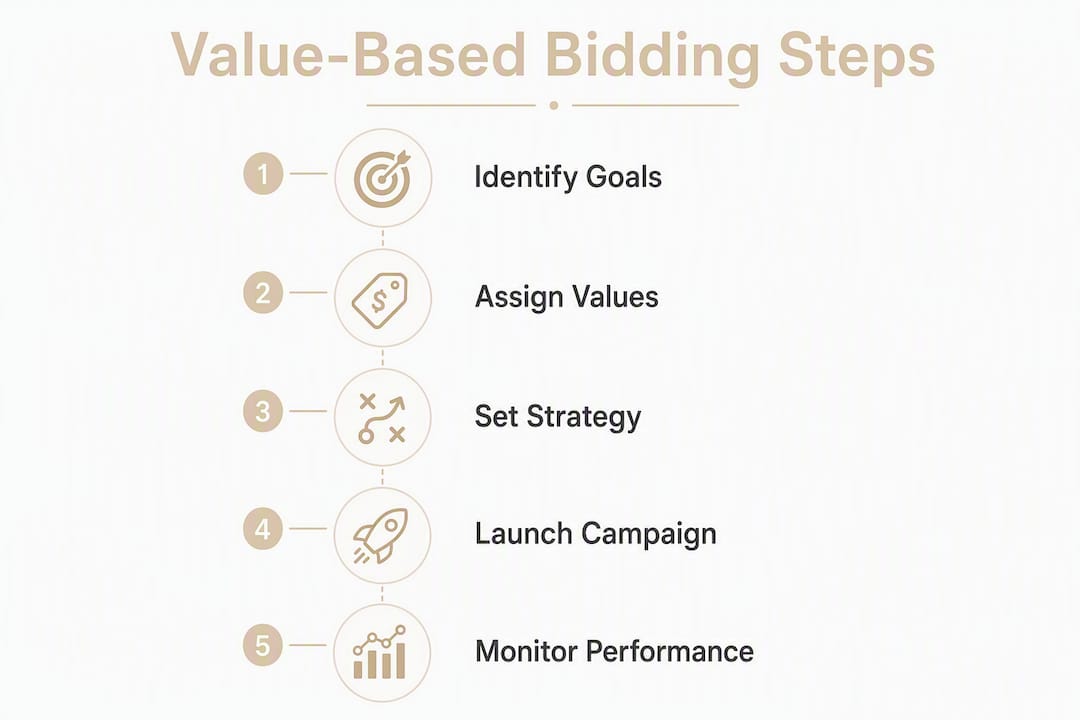
Google Ads value rules let you apply auction-time multipliers by location, device, or audience segment, which sharpens the signal without changing your base conversion values. Google Analytics 4 and enhanced conversions feed the underlying measurement layer that makes these signals reliable.
When value-based bidding makes sense for your account
The honest answer: not every account should use it. The strategy only works when the value signal is real, differentiated, and frequent enough for the algorithm to learn.
Use it when:
- Order or lead values vary by at least 2–3x across your conversion mix (a $30 product and a $3,000 product in the same campaign are a clear case)
- You’re generating enough conversions per month to sustain learning; practitioner guidance recommends a reliable minimum conversion volume for learning, with Google’s documented minimum being lower
- Your business measures success by revenue, margin, or LTV, not just conversion count
- You can send non-zero, differentiated values at conversion time or via offline import
Avoid or postpone when:
- All conversions carry the same value (a fixed-price service with one SKU, for example)
- Conversion volume is below 15–30 per month at the campaign level
- Conversion tracking is incomplete, misconfigured, or sending zero values
- You haven’t mapped CRM outcomes to conversion values yet (for lead gen)
Fragmented campaigns are a specific trap. When you split volume across too many narrow campaigns, each one sees too few conversions to learn reliably. Consolidating campaigns before switching to value-based strategies is often the prerequisite step teams skip.
What you need in place before switching to value-based bidding
The tracking and data layer is where most implementations fail. Get this right before you touch the bid strategy.
Conversion tracking requirements:
- At least one primary conversion action configured with non-zero values
- Two or more distinct value tiers (Google’s best-practices guidance explicitly cautions against zero-value conversions in value-based strategies)
- Enhanced conversions for web enabled to improve measurement accuracy and fill gaps from cookie loss
- For lead gen: enhanced conversions for leads or an offline conversion import pipeline connected to your CRM
Data plumbing:
- Offline conversion imports running on a daily or near-daily cadence
- GA4 event mapping verified against Google Ads conversion actions
- First-party data unified enough to assign a value to each conversion event
Account-level readiness:
- Sufficient conversion volume per campaign (not just account-level)
- Budget uncapped enough to let tROAS experiments run without hitting budget walls
- One primary biddable conversion action per campaign (not a mix of micro and macro conversions weighted equally)
Organizational readiness:
- Finance or operations owns the value definitions and signs off on them
- A scheduled cadence for value audits (quarterly at minimum, monthly for high-volume accounts)
- A plan for handling delayed offline revenue (conversion adjustments or regular re-uploads)
Pro Tip: Before enabling enhanced conversions, verify your GA4 event schema matches the conversion actions in Google Ads. Mismatched event names are one of the most common causes of under-reported conversion values.
How to define and assign conversion value: revenue, profit, LTV, and proxies
The algorithm optimizes for whatever signal you send. That’s the whole risk. Feed it gross revenue and it will chase high-revenue, low-margin orders. Feed it nothing and it learns nothing useful.

| Value type | Best for | Trade-offs | Latency |
|---|---|---|---|
| Transaction revenue | Ecommerce with consistent margins | Easy to implement; ignores margin variation | Low (real-time) |
| Margin-adjusted profit | Ecommerce with variable COGS | More accurate; requires product-level margin data | Low to medium |
| Predicted LTV | Subscriptions, SaaS | Best long-term signal; requires modeling | Medium to high |
| Lead score / propensity | B2B lead gen | Practical proxy; must be calibrated to closed revenue | Medium |
For ecommerce, the cleanest upgrade from raw revenue is a margin-adjusted value. If a $200 order has a 40% margin, send $80, not $200. Google then bids toward profit, not top-line revenue. High-spend accounts often need a server-side pipeline that joins order data, returns, discounts, and COGS into a single profit-adjusted value per conversion.
For lead gen, start with a simple lead-score proxy: assign a value to each lead tier based on historical close rates and average deal size. A Marketing Qualified Lead worth $150 in expected revenue and a Sales Qualified Lead worth $900 are meaningfully different signals. Iterate as you accumulate closed-won data.
One hard rule: never send a zero-value conversion into a value-based strategy. If a conversion genuinely has no value, remove it from the primary conversion action set entirely. Zeros skew the algorithm’s understanding of what a good conversion looks like.
How to activate value-based bidding in Google Ads: step by step
- Audit your conversion actions. Confirm every primary conversion action has a non-zero value assigned. Remove or demote any zero-value actions to secondary status.
- Enable enhanced conversions. Go to Tools > Conversions > Settings and turn on enhanced conversions for web. For lead gen, implement enhanced conversions for leads via your CRM or tag manager.
- Choose your strategy. Start with Maximize conversion value if you’re new to value-based bidding or your historical data is thin. Move to Target ROAS once you have 4–6 weeks of value data and a clear historical ROAS baseline.
- Set your initial tROAS target. Calculate it from your last 30 days: total conversion value divided by total ad spend. Set your target at or slightly below that number to give the algorithm room to learn.
- Configure value rules. In Google Ads, navigate to Tools > Conversions > Value rules. Add multipliers for your highest-value audience segments, locations, or devices. Note the two-condition limit per rule.
- Set up a campaign experiment. Use Google Ads Experiments (one-click experiment) to split traffic 50/50 between your current strategy and the value-based strategy. Sync all other variables: same budget, same creative, same targeting.
- Set your experiment duration. Allow 2 weeks for ramp, then run for at least 30 days before evaluating results. Google’s experiment guidance is explicit: exclude the ramp period from your performance assessment.
Pro Tip: Avoid setting hard CPC caps when launching a value-based strategy. Max CPC limits prevent the algorithm from bidding up on high-value predicted conversions, which defeats the purpose of the strategy.
For a deeper look at how value rules work in practice, the Google Ads conversion value rules guide covers auction-time adjustments in detail.
Optimization best practices after launch
Value hygiene comes first. Run a monthly audit of your value mappings. Stale values, such as lead scores that haven’t been recalibrated in six months or product margins that shifted after a supplier change, quietly degrade performance. Use conversion adjustments to update delayed offline revenue rather than waiting for the next upload cycle.
Setting and adjusting tROAS targets. Your initial target should reflect recent history, not a case study benchmark. If you want growth, set the target somewhat below your historical ROAS to give the algorithm room to learn and let volume expand. If you want efficiency, raise it gradually (no more than 10–15% at a time) and give the algorithm two weeks to stabilize after each change.
Budget alignment. A tROAS target only works if your budget isn’t the binding constraint. If your campaigns are regularly hitting budget caps, the algorithm can’t bid on the high-value conversions it identifies. Uncap budgets before tightening ROAS targets.
Creative and funnel levers. Better landing pages raise the probability that a high-value predicted conversion actually converts. Pairing conversion rate optimization improvements with value-based bidding compounds the return: the algorithm bids for the right users, and the landing page closes them.
Scaling playbook. Once a campaign proves out value-based performance, move it into a portfolio bid strategy with other proven campaigns. This pools conversion volume across campaigns, which gives the algorithm more signal and reduces the per-campaign fragmentation problem.
Pro Tip: Add micro-conversions (add-to-cart, form start, video view) as secondary conversion actions only. Never set them as primary with a value. They build signal without distorting the value optimization objective.
Monitoring performance and fixing common failure modes
Value-based bidding fails in predictable ways. Knowing the pattern cuts diagnosis time from weeks to days.
Common failure modes:
- Stale or incorrect values: The algorithm optimizes for what you send. If your lead scores haven’t been updated in months or your margin data is from last year’s COGS, you’re optimizing toward the wrong target.
- Low conversion volume: Campaigns with fewer than 15–30 conversions per month can’t sustain learning. The algorithm makes poor predictions when it has too few data points.
- Misaligned ROAS targets: A tROAS set too high starves the campaign of spend. The algorithm won’t bid on conversions it can’t hit the target for, so impression share collapses.
- Offline conversion lag: Long B2B sales cycles mean closed-won revenue arrives weeks after the click. If your import cadence is monthly, the algorithm is always working with outdated signal.
Troubleshooting checklist:
- Audit conversion values in the Google Ads conversion report: are values non-zero and differentiated?
- Check conversion volume at the campaign level, not just account level
- Review the experiment ramp period: have you waited the full 2 weeks plus 30 days before judging?
- Inspect attribution windows: are offline conversions importing within the attribution window?
- Confirm enhanced conversions coverage rate in the diagnostics tab
Remediation:
- If values are stale, update them and give the algorithm 2–3 weeks to recalibrate before assessing
- If volume is too low, consolidate campaigns or switch to Maximize conversion value without a tROAS constraint to rebuild volume
- If ROAS targets are too aggressive, moderately lower the target and hold for a period before re-evaluating
Pro Tip: If you’re troubleshooting a value-based campaign that’s spending but not hitting ROAS targets, check whether value rules are doubling up on signals the platform already has. Redundant rules can distort auction-time bids in ways that are hard to diagnose.
How to design a valid experiment and know when you have enough data
Experiments for value-based bidding need more runway than most teams expect. The core reason: both arms of the experiment (control and test) must learn independently, which means you need roughly double the conversion volume you’d normally require to reach a conclusion.
Ramp and evaluation timeline:
- Allow 2 weeks or 3 conversion cycles (whichever is longer) as a ramp period
- Run the experiment for at least 30 days after ramp before evaluating
- Google’s campaign experiment guidance is explicit that the ramp period should be excluded from performance assessment
Volume requirements:
- Google specifies minimum conversion volume requirements for some tROAS strategies
- Practitioners generally need 30–50 conversions per month for reliable learning
- For experiments, plan for conversion volume across both arms sufficient to support independent learning
Primary metrics to watch:
- Conversion value (total and per campaign)
- ROAS (conversion value / cost)
- Conversion value per cost (the direct efficiency metric)
Secondary metrics to monitor:
- CPA (to catch cases where value improves but volume collapses)
- Conversion rate (to separate bidding effects from landing page effects)
- Impression share (a drop signals the ROAS target is too restrictive)
Keep all other variables constant during the test: same creative, same targeting, same budget split. Changing landing pages or audiences mid-experiment contaminates the result. For a broader view of what to measure beyond ROAS, this measurement framework covers secondary KPIs worth tracking.
Concrete examples: ecommerce, lead gen, and SaaS
Ecommerce. A retailer with orders ranging from $40 to $800 is the textbook case. Start by sending transaction revenue as the conversion value via the purchase event. Enable enhanced conversions for web to fill measurement gaps. Launch with Maximize conversion value to let the algorithm learn the value distribution, then introduce a tROAS target once you have 6–8 weeks of data. For accounts with variable margins, build a server-side feed that adjusts the conversion value by product-level margin before sending it to Google.
B2B lead gen. A software company generates demo requests, free trials, and contact form fills. Raw conversion count treats all three equally. Instead, assign values based on historical close rates: a demo request worth $400 in expected pipeline, a free trial worth $150, a contact form worth $50. Import closed-won revenue via offline conversion import on a daily cadence. Avoid sending zero-value leads as primary conversions. As you accumulate 6–12 months of closed-won data, recalibrate the scores against actual revenue.
SaaS / subscriptions. The conversion event is often a free trial or a signup, but the real value is 12-month LTV. Build a server-side pipeline that sends an initial estimated LTV at trial start, then updates it at 30, 60, and 90 days as retention data comes in. Start with a lower tROAS target to prioritize growth, then tighten as the LTV model matures. Audience-based value rules can apply a multiplier for segments with historically higher LTV, such as enterprise-size companies or specific verticals.
Account audit checklist: migrating to value-based bidding safely
This is the operational checklist North Country Consulting runs before migrating any account to a value-based strategy.
| Audit area | Check | Pass criteria | Remediation if failing |
|---|---|---|---|
| Conversion action completeness | All primary actions have non-zero values | All primary actions have non-zero values | Assign values or demote to secondary |
| Value differentiation | At least 2 distinct value tiers | Values vary by 2x or more | Segment conversion actions by value tier |
| Enhanced conversions | Coverage rate in diagnostics | >80% coverage | Implement via tag manager or server-side |
| Offline import cadence | CRM-to-Google Ads import frequency | Daily or near-daily | Automate via API or Zapier integration |
| GA4 event mapping | GA4 events match Google Ads conversion actions | No naming mismatches | Reconcile event names in GA4 and tag manager |
| Campaign volume | Conversions per campaign per month | 30+ per campaign | Consolidate campaigns before switching |
| Budget headroom | Daily budget vs. average daily spend | Budget not capped >80% of days | Increase budget or reduce tROAS target |
| Experiment setup | One-click experiment configured | 50/50 split, ramp excluded | Set up via Google Ads Experiments tab |
| Post-launch governance | Weekly value audit cadence | Scheduled for first 8 weeks | Assign owner, add to reporting calendar |
| Escalation criteria | Defined thresholds for reverting | ROAS drop >30% for 2+ weeks | Document and share with stakeholders |
Pre-migration: Confirm conversion action completeness, verify non-zero differentiated values, and confirm your offline import is running on a daily cadence before touching the bid strategy.
Data integrity: Sample 50–100 conversions from your CRM and reconcile them against Google Ads conversion data. Discrepancies above 10–15% signal a tracking gap that will undermine the strategy.
Experiment rollout: Set up a one-click experiment with a 50/50 traffic split. Promote to full traffic only when the test arm shows statistically meaningful improvement in conversion value per cost over the full evaluation window.
Post-launch governance: Run weekly value audits for the first 8 weeks. Set escalation criteria in advance: if ROAS drops more than 30% for two consecutive weeks, revert to the prior strategy and investigate before re-launching.
Key Takeaways
Value-based bidding only works as well as the conversion values you feed it, which means data quality and value hygiene are the real levers, not bid strategy selection alone.
| Point | Details |
|---|---|
| Audit values before switching | Confirm non-zero, differentiated conversion values are in place before changing any bid strategy. |
| Meet the volume floor | Target a practical minimum conversion volume per campaign; below that, consolidate campaigns first. |
| Run a clean experiment | Use a 50/50 split, exclude the 2-week ramp, and evaluate after at least 30 days of post-ramp data. |
| Set tROAS from history | Calculate your initial target from the last 30 days of conversion value divided by spend, not from benchmarks. |
| North Country Consulting | Offers senior-led Google Ads audits covering value mapping, data integrity, and experiment design for accounts spending $25K+/mo. |
The part most teams get wrong about value-based bidding
The conventional framing treats value-based bidding as a bid strategy upgrade. Switch from Target CPA to Target ROAS, and performance improves. That’s not how it works in practice.
The strategy is only as good as the value signal. Google’s algorithm is genuinely capable of finding high-value conversions when the signal is clean. The problem is that most accounts send it a noisy, stale, or structurally wrong signal and then blame the strategy when results disappoint.
The most common version of this: an ecommerce account sends gross revenue as the conversion value, which looks fine on the surface. But 30% of their orders are in a low-margin product category that generates revenue without profit. The algorithm chases those orders because the revenue number is high. ROAS looks good. Profitability doesn’t.
The fix isn’t a different bid strategy. It’s margin-adjusted values, which requires a server-side pipeline, cooperation from finance, and a willingness to accept that the “right” conversion value is a business decision, not a technical one.
The same logic applies to lead gen. Sending all leads with equal value because “we don’t know which ones will close” is a choice to optimize for nothing. Even a rough lead score based on historical close rates by source or company size is better than uniform values. Treat value definition as iterative. Start with your best estimate, measure against actual outcomes, and recalibrate every quarter.
The accounts that get the most out of value-based bidding aren’t the ones with the most sophisticated bid strategies. They’re the ones that have done the unglamorous work of connecting ad platform data to real business outcomes.
North Country Consulting’s approach to value-based bidding engagements
Advertisers spending $25,000 or more per month on Google Ads get the most from value-based bidding when the setup is done with senior oversight, not handed off to an automated recommendation. North Country Consulting’s approach starts with a full account audit covering conversion value mapping, data pipeline integrity, and campaign structure before any bid strategy changes are made.
The audit typically surfaces three to five specific issues: zero-value conversions in primary action sets, offline import cadences that are too slow for the sales cycle, or tROAS targets set against benchmarks rather than account history. Fixing those issues before switching strategies is what separates a successful migration from a failed experiment.
North Country Consulting manages over $40 million in ad spend with an average ROAS of 8.7x across client accounts. The team handles the full migration: value modeling, server-side conversion pipelines, experiment design, and post-launch governance for the first 8 weeks. For accounts considering the move to value-based strategies, the free Google Ads audit is the right starting point. It covers value mapping, data integrity, and a clear experiment plan. To learn more about the full service model, visit the Google Ads management services page.
Selected sources and further reading
Google Ads product documentation:
- Smart Bidding overview — core definitions for Maximize conversion value and Target ROAS
- Value-based Bidding Best Practices — Google’s guidance on value assignment, enhanced conversions, and zero-value warnings
- Campaign experiments for value-based bidding — experiment setup, ramp periods, and evaluation timelines
Expert perspective and practitioner guidance:
Measurement and audience strategy:
- Conversion rate optimization tips — CRO tactics that complement bidding strategy improvements
- Audience targeting explained — practical guidance on audience-based bid adjustments and value rules