
Supermetrics wins for smaller, agile marketing teams that want direct control over their data pipelines and can tolerate visible failures. Funnel.io wins for mid-market and enterprise teams that need a managed, governed data hub with broad connector coverage and built-in transformation. The architectural gap between them is the real decision point, not the feature list.
| Dimension | Supermetrics | Funnel |
|---|---|---|
| Data sources | 128–150+ connectors | 500+ connectors |
| Data destinations | ~15 | — |
| Pricing model | Per destination + source + account | Subscription tiers, annual contracts |
| Starting price | an entry-level affordable plan | a higher-tier subscription plan |
| Built-in transformation | No | Yes |
| G2 rating | well-regarded by users | positively reviewed by users |
| Best for | Agile teams, direct control | Mid-market to enterprise, governance |
What do Supermetrics and Funnel.io actually do?
Both platforms pull marketing data from ad channels and deliver it to reporting tools or data warehouses. The similarity ends there.
Supermetrics operates as a pass-through extractor. It connects marketing data sources to destinations like Google Sheets, Looker Studio, BigQuery, and Power BI without storing data in between. The platform serves over 200,000 companies across 120 countries and has recently added integrations with Claude AI and other AI reporting tools.
Key capabilities:
- Pre-built report templates for Google Ads, Meta Ads, LinkedIn Ads, and Microsoft Ads
- Direct connector to Google Sheets and Looker Studio with daily refresh on mid-tier plans
- Hourly refresh available on Pro plans ($499/month)
- No native data transformation; custom metrics require external tools or manual work in the destination
Funnel operates as a managed data hub. Data flows into Funnel’s proprietary storage layer, gets normalized and enriched, and then gets pushed to destinations. The platform processes over 200 billion rows daily with 99.99% uptime and has raised over $100M in financing.
Key capabilities:
- No-code data transformation built directly into the platform
- Native dashboards, multi-touch attribution, and marketing mix modeling
- ISO 27001, SOC 2, and GDPR compliance certifications
- Dedicated onboarding support on business and enterprise tiers
How do their data source connectors compare?
Connector count matters less than connector reliability, and the two platforms handle failures very differently.
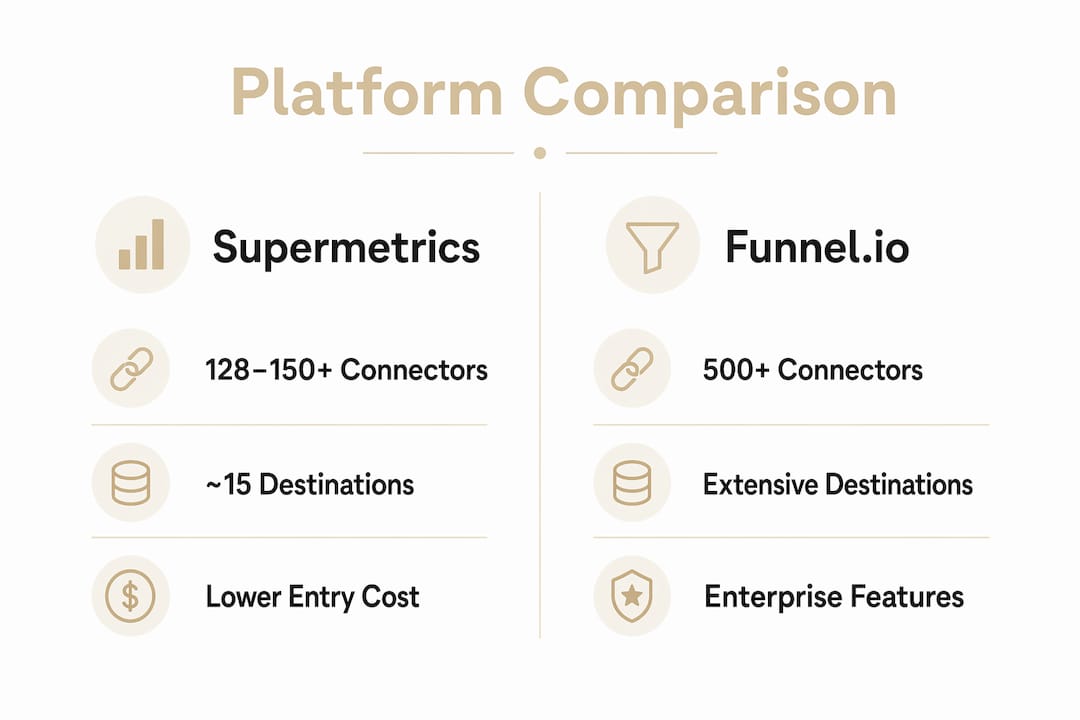
Supermetrics offers 128–150+ connectors, covering the major US marketing platforms: Google Ads, Meta Ads, LinkedIn, TikTok, Bing, HubSpot, Salesforce, and others. When a connector breaks, the failure is immediate and visible. Your report shows missing data, which tells you exactly where to look.

Funnel offers 500+ connectors and covers a far wider range of channels, including many niche ad networks and affiliate platforms that Supermetrics does not support. The tradeoff is that Funnel stores data in its own layer. When an API connection breaks quietly, Funnel may continue displaying stale data rather than an obvious error. Teams that do not actively monitor their pipelines can miss a broken connector for days.
| Source category | Supermetrics | Funnel |
|---|---|---|
| Major paid social (Meta, TikTok, LinkedIn) | Yes | Yes |
| Search (Google Ads, Microsoft Ads) | Yes | Yes |
| SEO tools (Ahrefs, SEMrush) | Yes | Yes |
| Niche ad networks | Limited | Extensive |
| CRM platforms | Yes | Yes |
| E-commerce (Shopify, Amazon) | Yes | Yes |
| Total connector count | 128–150+ | 500+ |
Pro Tip: If your team runs campaigns on niche networks or international platforms, Funnel’s connector library is the stronger choice. If you run standard US paid media channels, Supermetrics covers everything you need.
Where can each platform send your data?
Supermetrics supports multiple common data destinations, including Google Sheets, Looker Studio, BigQuery, Snowflake, Power BI, and a handful of others. Storage and data warehouse destinations are locked behind the Enterprise plan, which adds cost for teams that want to build a proper data warehouse setup.
Funnel supports an extensive list of data destinations, including all major BI tools, data warehouses, and spreadsheet platforms. Native dashboards are built in, so teams can visualize data without routing it to a separate tool. For teams already using BigQuery or Snowflake as a central warehouse, Funnel’s broader destination list gives more flexibility.
| Destination type | Supermetrics | Funnel |
|---|---|---|
| Google Sheets / Excel | Yes | Yes |
| Looker Studio / Data Studio | Yes | Yes |
| BigQuery / Snowflake | Enterprise only | Yes |
| Power BI / Tableau | Yes | Yes |
| Native dashboards | No | Yes |
| Total destinations | ~15 | — |
How do their pricing models compare?
Pricing is where both platforms frustrate buyers, but in different ways.
Supermetrics charges per destination, per data source, and per account. The Starter plan has a modest monthly cost and covers one destination, three data sources, and weekly refresh. Growth plan has an increased monthly cost for seven sources and daily refresh. Pro plan represents the highest tier pricing for ten sources and hourly refresh. Data transformations and storage are not included on any plan below Enterprise. For agencies managing multiple client accounts, costs compound quickly because each client account counts against the source and account limits.

Funnel uses subscription tiers with annual contracts. Funnel’s pricing starts at a higher monthly cost for entry tier covering 121 connectors, scaling to roughly $800/month for the Business tier with 579 connectors. Enterprise pricing requires a sales conversation. Funnel previously used a Flexpoints usage-based model; it now uses fixed tiers, but the pricing still requires a demo to sign up. No self-service option exists.
Key pricing differences:
- Supermetrics offers transparent pricing; Funnel requires consultation
- Supermetrics costs less at entry level; Funnel starts around $200/month on annual contracts and can be more cost-efficient at high client volumes
- Supermetrics adds cost per destination; Funnel bundles destinations into the tier
- Neither platform offers a free tier; both offer 14-day trials
For agencies managing more than 30 client accounts, Funnel’s centralized workspace and maintenance features often justify the higher monthly cost by reducing the operational overhead of managing per-account connections.
How do support and reliability differ between the two?
On G2, Funnel scores 9.2/10 for quality of support versus Supermetrics at 7.8/10. For reliability, Funnel scores 9.1/10 against Supermetrics at 8.1/10. These are meaningful gaps, not rounding differences.
Supermetrics users on G2 consistently flag slower response times and less effective support. The platform’s pass-through architecture means failures are loud and obvious, but resolving them often requires manual intervention without much help from the support team.
Key operational considerations:
- Funnel’s managed hub absorbs more operational complexity; your team spends less time maintaining pipelines
- Supermetrics failures are visible immediately; Funnel failures can be quiet and show stale data
- Funnel includes dedicated onboarding on higher tiers; Supermetrics support is more self-serve
- Supermetrics’ automation features score 8.6/10 on G2; Funnel scores 8.9/10
- Funnel’s custom reports and dashboards score 9.3/10 on G2; Supermetrics scores 8.7/10
How do you choose between Supermetrics and Funnel.io?
The decision comes down to four factors: team size, technical capacity, budget, and how you want to handle pipeline failures.
Choose Supermetrics if:
- Your team manages fewer than 10–15 client accounts
- You want full visibility into pipeline failures without a managed layer in between
- Your primary destinations are Google Sheets and Looker Studio
- Budget is a constraint and you can work within the per-destination pricing model
- You prefer self-service setup without a sales conversation
Choose Funnel if:
- Your team manages a large number of client accounts or runs enterprise-scale campaigns
- You need built-in data transformation without routing data through external tools
- Connector breadth matters because you run campaigns on niche or international platforms
- You want ISO 27001 and SOC 2 compliance out of the box
- You can commit to an annual contract and justify the higher monthly cost
Pro Tip: Before signing with either platform, run a test on your most problematic data source. Supermetrics will show you a broken connector immediately. Funnel may show you clean data that is actually stale. Knowing which failure mode your team can handle is the fastest way to make the right call.
Understanding marketing analytics ROI is also worth factoring in when building the business case for either platform internally.
What do industry experts say about this choice?
The Supermetrics vs. Funnel.io decision is fundamentally an architectural one, not a feature comparison.
Built-in data transformation is one of the clearest functional divides. Funnel handles normalization and enrichment inside the platform. Supermetrics pushes that work to the destination, which means your analysts spend time in Google Sheets or BigQuery building what Funnel would have done automatically. For teams where analyst time is expensive, that gap has a real dollar cost. For teams that want to own every step of the pipeline, it is a feature, not a limitation.
Final verdict: which platform wins in 2026?
| Criterion | Supermetrics | Funnel |
|---|---|---|
| Connector count | 128–150+ | 500+ |
| Destinations | ~15 | — |
| Built-in transformation | No | Yes |
| Entry price | — | ~$200/month |
| G2 support score | 7.8/10 | 9.2/10 |
| G2 reliability score | 8.1/10 | 9.1/10 |
| Best for | Agile teams, budget-conscious | Enterprise, governance-focused |
Supermetrics is the right call for marketing teams that want a direct, transparent pipeline at a lower entry cost and are comfortable managing connector failures themselves. Funnel is the right call for teams that need scale, built-in transformation, and a managed layer that reduces daily operational work. For US agencies running high-volume paid media across many clients, Funnel’s centralized workspace and compliance certifications make a strong case despite the higher price.
North Country Consulting: when the data is only part of the problem
If you are evaluating Supermetrics or Funnel.io, you are already thinking seriously about marketing data. But pulling clean data into a dashboard is different from knowing what to do with it inside your Google Ads account.
North Country Consulting works with businesses spending $25,000 or more per month on Google Ads, applying senior-level account management that most agencies delegate to junior staff. The average return on ad spend across managed accounts is 8.7×, built on account restructuring, attribution model rebuilding, and margin-based campaign architecture. No junior account managers, no templated strategies.
If your data integration is solid but your Google Ads performance is not reflecting it, a free strategy audit from North Country Consulting identifies exactly where the gap is.
Key Takeaways
Funnel.io suits enterprise teams needing managed data governance, while Supermetrics fits agile teams that want direct pipeline control at a lower entry cost.
| Point | Details |
|---|---|
| Architecture drives the decision | Supermetrics is a pass-through extractor; Funnel is a managed hub with its own storage layer. |
| Connector breadth favors Funnel | Funnel offers a wide range of connectors including niche platforms versus Supermetrics’ 128–150+, which covers fewer niche platforms. |
| Pricing model differs sharply | Supermetrics starts at an entry-level affordable plan with per-destination fees; Funnel starts around $200/month on annual contracts. |
| Support gap is real | Funnel scores 9.2/10 for support on G2; Supermetrics scores 7.8/10. |
| North Country Consulting | For teams where Google Ads performance lags despite clean data, North Country Consulting offers senior-led account management with an average 8.7× ROAS. |