
Search term mining is the process of pulling the actual queries that triggered your ads or organic listings, then sorting them into a maintenance diff of three moves: add the converters, negate the waste, move the mismatched. PPC managers use it to stop bleeding budget on irrelevant clicks; SEO teams use the same query data to spot content gaps competitors haven’t touched. Run it regularly on active accounts, and the diff becomes your standing to-do list.
TL;DR:
- Mining search terms regularly prevents wasted ad spend by identifying irrelevant clicks, which can account for up to a significant portion of poor ROAS.
- Grouping and scoring queries by intent, conversions, and cost exposure enables targeted add, negate, or move actions that improve campaign relevance and efficiency.
- Clustering large query lists by semantic similarity and intent helps manage analyses and ensures more accurate, strategic content or keyword adjustments.
- Mapping high-impression, low-organic-CTR queries to new content ideas or landing pages enhances organic visibility and covers unmet user intent.
- For accounts spending over $25,000 monthly, senior oversight ensures proper validation of negatives, meaningful cluster analysis, and avoidance of platform sampling and intent drift issues.
Table of Contents
- What Is Search Term Mining, Really?
- Why Mining Search Terms Actually Moves the Needle
- How Do You Run a Search Term Mining Workflow?
- Turning Findings Into Add, Negate, and Move Decisions
- Clustering and Prioritizing Large Query Lists
- From Mined Queries to Content Strategy and AI Query Expansion
- Metrics, Cadence, and Governance That Keep This Honest
- Common Mistakes That Undo the Whole Process
- When Search Term Mining Needs Senior-Led Help
- Sources
What Is Search Term Mining, Really?
Search term mining means extracting the literal search queries that led to an ad impression or click, then analyzing that raw text for patterns worth acting on. It’s a subset of keyword research, but a narrower and more frequent one. Traditional keyword research asks “what could people search for?” Search term mining asks “what did they actually type, and did it convert?”
The primary data source is your platform’s own search terms report, usually pulled from Google Ads, supplemented by Google Search Console for the organic side. Where keyword research is often a one-off exercise done at campaign launch, search term mining is recurring maintenance. You’re not brainstorming a keyword list; you’re auditing what already happened and correcting course. Skip this distinction and you’ll treat a Tuesday cleanup task like a quarterly strategy project, which wastes everyone’s time.
Why Mining Search Terms Actually Moves the Needle
The upside shows up first in wasted spend. Every account running broad or phrase match accumulates queries that never should have triggered an ad, and those clicks quietly eat budget that converting terms could have used instead. Mining the report on a schedule catches this before it compounds into a significant portion of poor ROAS.
The organic side benefits differently. Queries that show impressions but weak click-through in your PPC data often reveal a content gap. If “best [category] for small teams” is generating impressions but no clicks, that’s a signal nobody has written the page that phrase deserves. Feed that same signal into keyword research for Google Ads and you tighten both channels at once.
Ad relevance improves too. When you discover a cluster of queries using different vocabulary than your ad copy, you can rewrite headlines to mirror the customer’s actual language, which tends to lift quality score and lower cost per click in the same move.

How Do You Run a Search Term Mining Workflow?
Here’s the repeatable version, built to run on a weekly or monthly cadence depending on spend volume.
- Export the right scope and date range. Pull a date range of data spanning multiple weeks to months, avoiding too short a window unless troubleshooting urgently. Required columns: Query, Impressions, Clicks, Cost, Conversions, and Conversion Value. Skip conversion value and you’ll misjudge which “converting” terms are actually profitable.
- Clean and normalize. Lowercase everything, strip duplicate whitespace, collapse plural/singular variants, and flag misspellings that still match your target intent. This step is tedious and non-negotiable; skip it and your clustering step inherits the mess.
- Tag by intent and performance. Label each query as navigational, informational, or transactional, then cross-reference against cost and conversions. A query with zero conversions after 50 clicks tells a different story than one with zero conversions after three.
- Cluster related terms. Group by shared root words, n-grams, or thematic similarity so you’re evaluating patterns, not 400 individual rows.
- Prioritize the clusters. Rank by a rough formula of intent strength times conversion evidence times cost exposure. High-cost, zero-conversion clusters go to the top of the negative list. High-conversion, low-volume clusters go to the top of the “add as exact match” list.
- Produce the maintenance diff. This is the deliverable: a document listing every add, negate, and move action, with the evidence behind each one. This three-part structure is what makes the maintenance diff genuinely actionable instead of a pile of observations.
- Implement and monitor. Push the changes, then watch impression share, CTR, and CPA on the affected ad groups over the following two to three weeks before declaring victory.
Before implementing, run through this checklist:
- Did every “add” recommendation clear a minimum conversion threshold, not just a volume threshold?
- Does every negative keyword have a documented reason, not just a gut call?
- Are “move” candidates actually getting a more specific ad group, or just a different label?
- Is someone reviewing this diff before it goes live, or is it auto-applying?
Pro Tip: Keep a running spreadsheet of every negative keyword you’ve ever added, with the date and reason. Six months in, you’ll catch yourself about to re-add a term you already excluded for a documented reason, and that log will save you from undoing your own work.
Turning Findings Into Add, Negate, and Move Decisions
The diff only matters if the decision rules behind it are consistent. Here’s what separates a defensible action from a guess.
- Add: The query has clear conversion evidence (not just clicks), volume that justifies its own ad group or keyword, and a CPA that’s at or below your target once you account for the query’s actual intent.
- Negate: The term shows spend with zero or near-zero conversions across a reasonable sample, and it’s clearly outside your product or service scope. Building this list carefully matters more than building it fast. A documented negative-keyword strategy prevents the common failure mode where broad negatives block adjacent, still-relevant traffic.
- Move: The query converts, but it’s sitting in an ad group whose ad copy and landing page don’t match its specific intent. Moving it to a tighter ad group usually improves quality score and ad relevance, since the message finally matches the search.
Pro Tip: After any batch of negatives goes live, check impression share on the affected ad groups seven days later. A sudden, sharp drop usually means you over-negated and blocked traffic you actually wanted.
Verify every change against the same window length you used to justify it, and set a rollback trigger, such as a CPA increase past a fixed threshold, before you make the change, not after.
Clustering and Prioritizing Large Query Lists
Once an export runs into the thousands of rows, manual review breaks down. Clustering makes it manageable again.
- Run token and n-gram frequency counts across the full export to surface repeated words that flag a waste theme or a converting theme, even before you look at individual rows.
- Group by semantic similarity, not just shared words. “Cheap running shoes” and “affordable running shoes” belong in the same cluster even though they share no root token beyond “running shoes.”
- Score each cluster on three axes: intent strength, conversion evidence, and cost exposure. A cluster scoring high on all three goes to the top of your add list; high cost with low conversion evidence goes to negatives first.
- Tag consistently. Use a fixed taxonomy (informational, transactional, navigational, branded) so next month’s export can be compared apples to apples against this month’s.
Validate automated clusters with a manual spot check before you act on them. Terms that share tokens don’t always share meaning, and a five-minute sample review catches that before it becomes a bad negative list.
From Mined Queries to Content Strategy and AI Query Expansion
The queries sitting in your PPC export are a free content brief. High-intent transactional queries that already convert on paid should map to a dedicated landing page, not a generic category page. Informational queries with strong impressions but no landing page match are your next blog post topics.
- Map any query cluster showing consistent impressions and weak organic rank to a new supporting page, not a tweak to an existing one.
- Treat query expansion signals, the related sub-queries search engines generate around a topic, as a checklist for what that new page needs to cover to earn full topical credit.
- Pull matching queries from Google Search Console alongside your PPC export so you’re comparing paid and organic demand for the same term side by side.
Modern search engines increasingly rewrite and expand user queries with language models before matching results, using techniques like query rewriting and pseudo-answer generation. That means content built to answer the literal query and its common reformulations tends to survive this rewriting better than content built around a single exact-match phrase. Search Engine Land has documented how query expansion signals surface supporting subtopics worth covering. For a framework on matching content to what a query actually wants, see this breakdown of intent classification as an SEO foundation.
Metrics, Cadence, and Governance That Keep This Honest
Track impressions, clicks, CTR, cost, conversions, conversion value, and CPA on every reviewed segment, and record all seven every time, not just the ones that look good.
Run the review weekly on accounts spending heavily enough that a bad query can burn real budget in days, and monthly on smaller or more stable accounts. Either way, tracking wasted spend needs a consistent window, not a shifting one that makes month-over-month comparisons meaningless.
Governance matters as much as the analysis. Keep a change log for every negative keyword added, every query moved, and every new keyword launched, with the date and the evidence behind it. When a metric moves unexpectedly two weeks later, that log is how you figure out whether it was your change or something external.
Common Mistakes That Undo the Whole Process
The most frequent error is adding a query as a new keyword after two or three clicks and one lucky conversion. That’s noise, not evidence. Wait for a sample size that actually means something before promoting a term.
Match-type carelessness ruins negative lists fast. A broad match negative meant to block one irrelevant phrase can silently block dozens of relevant ones. Check the Search Terms Report impression trends after any broad negative goes live.
Watch for platform sampling and privacy thresholds too. Low-volume queries sometimes get grouped or suppressed for privacy reasons, which can make a term look dead when it isn’t. And unstructured AI-generated query rewrites, done without a template or review step, tend to introduce intent drift rather than clarity.
When Search Term Mining Needs Senior-Led Help
Most accounts can run this workflow in house with a spreadsheet and some discipline. It stops being a DIY task around a specific threshold: monthly spend north of $25,000, more than a handful of ad groups needing separate attribution logic, or a marketing team stretched too thin to review a diff every week without it slipping.
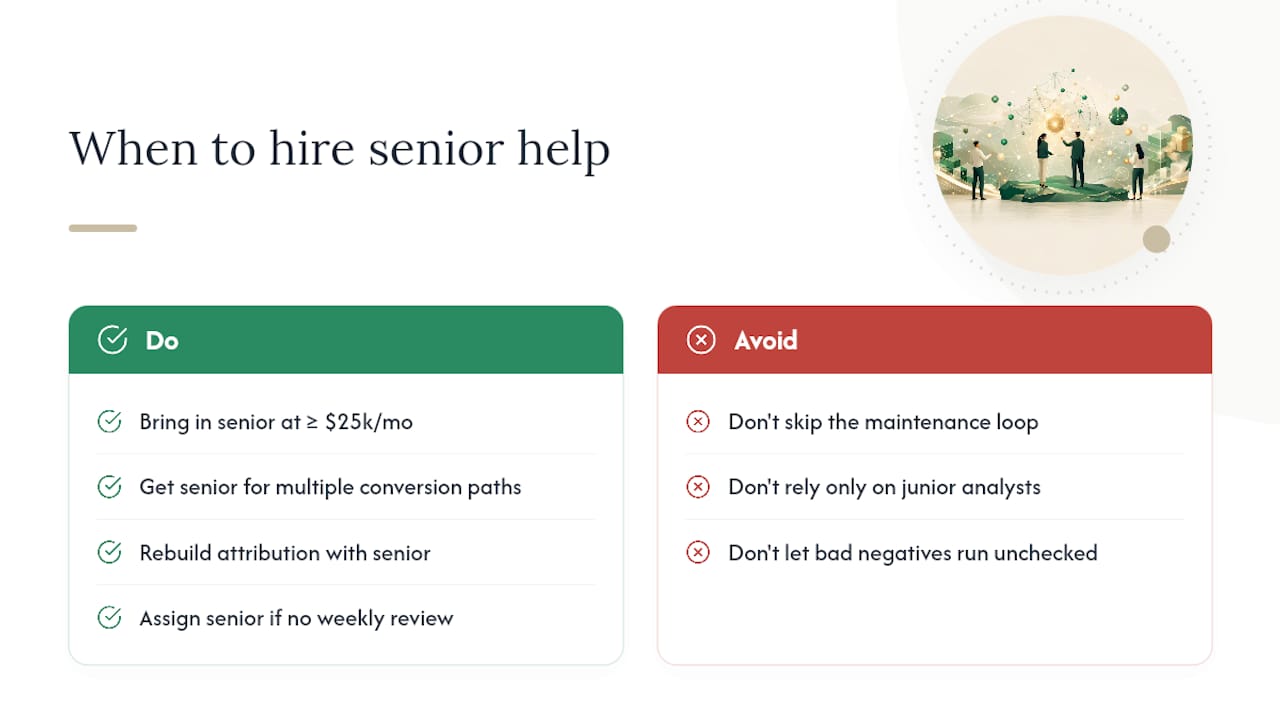
Here’s the honest checklist. If your account has multiple conversion paths that need call tracking tied back to specific query clusters, if your attribution model hasn’t been rebuilt since iOS privacy changes reshaped the data, or if nobody on staff has time to validate clusters before negatives go live, that’s when senior-led management earns its cost. What that kind of oversight typically adds isn’t more reporting, it’s the operational discipline to catch a bad negative before it costs a week of impression share, and the attribution rebuild work most in-house teams never get to.
The approach described is based around addressing that gap: full account restructuring, custom measurement frameworks, and the kind of query-level review this article describes, run continuously rather than quarterly.
— Eric
If your account is spending $25,000 or more a month and nobody’s running this maintenance loop consistently, that’s where the waste tends to hide. A free strategy audit is offered that reviews your search terms report, your account structure, and your attribution setup, with senior oversight applied directly to the account rather than handed off to a junior analyst. Clients working with this kind of expert service have seen strong average returns on ad spend across many millions in managed spend, largely by fixing the exact gaps this workflow is built to catch.
Sources
You don’t need an expensive stack to do this well. You need the right report and a place to process it.
- Mining search terms reports
- Query rewriting with LLMs to improve search
- How Google query expansion can improve content visibility