
Most US businesses pay a typical range of PPC management fees that varies depending on their agreement with agencies, either as a fixed amount or a percentage of their monthly ad spend. The percentage fee often decreases as budgets grow, with smaller accounts paying a higher percentage and larger accounts negotiating lower rates. Three pricing structures dominate the market:
- Percentage of ad spend: 10–20% of monthly ad spend, most common for growing budgets
- Flat monthly retainer: $2,000–$25,000 per month depending on account size and complexity
- Hybrid: flat base fee plus a percentage above a defined spend threshold
- Performance-based: fees tied to leads, conversions, or revenue (rare, and complex to structure fairly)
Ad spend and management fees are always separate. What you pay Google, Meta, or Microsoft goes directly to the platform. The management fee is what the agency earns on top of that.
How do the top US PPC agencies compare in 2026?
Three agencies consistently appear at the top of US PPC rankings: WebFX, AdVenture Media Group, and OuterBox. Each takes a different approach to pricing, specialization, and technology.
| Agency | Pricing Model | Services Included | Specializations | Certifications | Client Rating |
|---|---|---|---|---|---|
| AdVenture Media Group | Custom / performance-based | Google, Meta, multi-channel paid media, AI-driven strategy | AI-powered multichannel PPC | Proprietary AI technology | 4.9★ (190 reviews) |
| WebFX | Tiered / percentage of spend | SEO, PPC, AI search, content, email, web design | Full-service digital marketing | Proprietary revenue-tracking software | 4.5★ (198 reviews) |
| OuterBox | Custom / tiered | PPC, UX, analytics, AI chatbots, CRO, SEO, email | SMB and enterprise performance marketing | Google Premier Partner 2026, Inc. 5000, Forbes Advisor 2025, US Search Award | 4.9★ (106 reviews) |
AdVenture Media Group combines senior paid media strategists with proprietary AI technology across Google and Meta. Their strength is cross-platform campaign architecture, particularly for brands running simultaneous campaigns on multiple channels where attribution reconciliation adds real complexity.
OuterBox holds Google Premier Partner 2026 status, which Google awards only to agencies in the top tier of performance and spend management. They also carry Inc. 5000, Forbes Advisor 2025, and US Search Award recognition, making them a strong fit for SMBs and enterprises that want a certified, full-service team handling PPC alongside UX and conversion optimization.
WebFX brings a broad full-service model with dedicated account management and proprietary revenue-tracking software. For businesses that want PPC managed alongside SEO, content, and email under one roof, WebFX’s integrated approach reduces the coordination overhead of working with multiple vendors.

What do PPC management pricing models actually include?
The pricing model shapes not just what you pay, but what the agency is incentivized to do. That distinction matters more than most buyers realize.
Percentage of ad spend
At 15% on $50,000 in monthly ad spend, you pay $7,500 to the agency. The math is simple. The problem is structural: the agency earns more when you spend more, regardless of whether that extra spend is profitable. For stable budgets, this model works fine. For scaling accounts, it creates pressure in the wrong direction.
Flat monthly retainer
A fixed fee regardless of ad spend. Flat-fee retainers align the agency’s incentives with efficiency rather than volume. The agency has no financial reason to push your budget higher. The downside is that some agencies set retainers conservatively high to cover their worst-case workload, so you may pay for hours that don’t get used.
Hybrid model
A flat base fee plus a percentage above a spend threshold. For example, $1,500 per month flat plus 10% of ad spend over $10,000. If you spend $25,000, you pay $4,000 total. This structure balances predictability with fair compensation as accounts scale.
What’s typically included
Full-service management generally covers campaign strategy, keyword research, ad copy, bid management, A/B testing, negative keyword maintenance, and monthly reporting. What often costs extra:
- Creative production: static display ads, video, and custom graphics can add $2,000–$10,000 per month depending on volume
- Landing page work: conversion rate optimization and A/B testing often run an additional $2,000–$5,000 per month
- Multi-platform management: running Google Ads and Meta together typically commands a 20–30% premium over single-platform management
Pro Tip: Ask for a flat fee if you plan to grow your ad budget significantly. Most agencies will consider it when the retainer is fair, and it protects you from fees that scale automatically with spend.
How do agencies calculate fees, and why do costs vary so much?
The range from $500 to $50,000 per month reflects genuinely different levels of service, not just different price tags on the same work.
Agencies charging $500–$1,000 per month typically manage 30 or more accounts per strategist, which means your account gets roughly 4–5 hours of attention per month. That covers basic bid adjustments and a monthly report. It does not cover new campaign builds, competitor research, or proactive testing.
Several factors drive fees higher:
- Number of platforms: multi-platform management across Google, Meta, and LinkedIn requires separate campaign builds, creative sets, and attribution reconciliation
- Campaign count: an account with 50 campaigns needs materially more maintenance than one with 5
- Industry complexity: regulated industries like finance and healthcare require additional compliance review on every ad
- Agency overhead: larger agencies with senior strategists, analysts, and dedicated account managers carry higher costs, and those costs show up in fees
- Geographic market: US and Canadian agencies typically charge $100–$150 per hour; offshore teams in India or the Philippines charge under $25 per hour, with corresponding differences in communication and strategic depth
A useful rule of thumb: your management fee should represent 10–20% of your total ad spend for most accounts, dropping to 5–10% for very high spend levels. If it exceeds 40%, either your budget is too small for the engagement or the pricing model doesn’t fit your situation.
How to choose the right PPC management agency in 2026
Price is the wrong place to start. The right question is whether the agency’s fee structure aligns with what you actually want them to optimize for.
Start with certifications. Google Premier Partner status, which OuterBox holds for 2026, indicates Google has verified the agency’s performance across client accounts. It’s not a guarantee of results, but it’s a meaningful signal that the agency manages accounts at scale and meets Google’s performance thresholds.
Ask these questions before signing anything:
- Do you have direct access to your own ad accounts at all times?
- How is reporting structured, and how often will you receive it?
- What happens to campaign history and data if you leave?
- Is the management fee separate from ad spend in every invoice?
- What’s outside the scope of the retainer, and how are those items billed?
Verify expertise by asking for case studies in your specific industry, not just general performance claims. An agency that has managed campaigns for e-commerce brands may not have the right instincts for B2B lead generation, and vice versa.
Check Clutch ratings and Google reviews, but treat them as one signal among several. A high rating with few reviews tells you less than a mid-range rating with detailed, specific client feedback about communication and reporting.
Pro Tip: Negotiate based on scope, not budget percentage. Define the number of campaigns, platforms, reporting frequency, and testing cadence in writing. Both sides get clearer expectations, and you avoid scope creep charges later.
What does the PPC management process look like month to month?
Understanding the timeline helps you evaluate whether an agency is actually doing the work.
Weeks 1–2 (setup): Account audit, campaign restructuring, keyword research, ad copy development, conversion tracking verification, and audience segmentation. This is where most of the strategic work happens.

Weeks 3–4 (launch): Campaigns go live. The agency monitors performance daily, adjusts bids, catches early issues with tracking or ad approvals, and begins collecting baseline data.
Month 2 (early optimization): Enough data exists to start making informed decisions. Negative keywords get refined, underperforming ad groups get paused or restructured, and A/B tests on ad copy begin.
Months 3–6 (active management): Regular bid strategy adjustments, audience refinement, landing page recommendations, and ongoing creative testing. Weekly or biweekly calls with your account team should be standard at this stage.
Month 6 and beyond: Quarterly strategy reviews, budget reallocation based on performance data, and expansion into new campaign types or platforms if the core account is performing well.
What’s the real total cost of PPC, beyond the management fee?
The management fee is only part of what you’ll spend. Budget for these additional costs before you sign a contract:
- Setup fees: one-time account audit and restructuring fees typically run $500–$5,000 for new clients
- Creative assets: if the agency doesn’t include ad creative, static display ads cost $100–$500 per asset set; video production runs $500–$5,000 or more
- Landing page development: custom design and development can add $1,000–$10,000 per page
- Tool costs: some agencies pass through third-party analytics or bid management software costs; confirm upfront whether these are included
- Overage charges: some contracts charge a higher percentage when ad spend exceeds a threshold; read the fine print
- Exit fees: early termination clauses exist in many agency contracts; negotiate these out or at least understand them before signing
The total monthly investment at different budget levels looks like this: a small business spending $5,000–$15,000 per month on ads typically pays $1,500–$3,000 in management fees, for a total of $6,500–$18,000. A mid-market account at $150,000 or more in ad spend sees the percentage fee drop to 5–10% of spend.
North Country Consulting: senior-led Google Ads management without the agency markup
If the agencies above feel like more infrastructure than your account needs, North Country Consulting offers a different model for high-spend businesses.
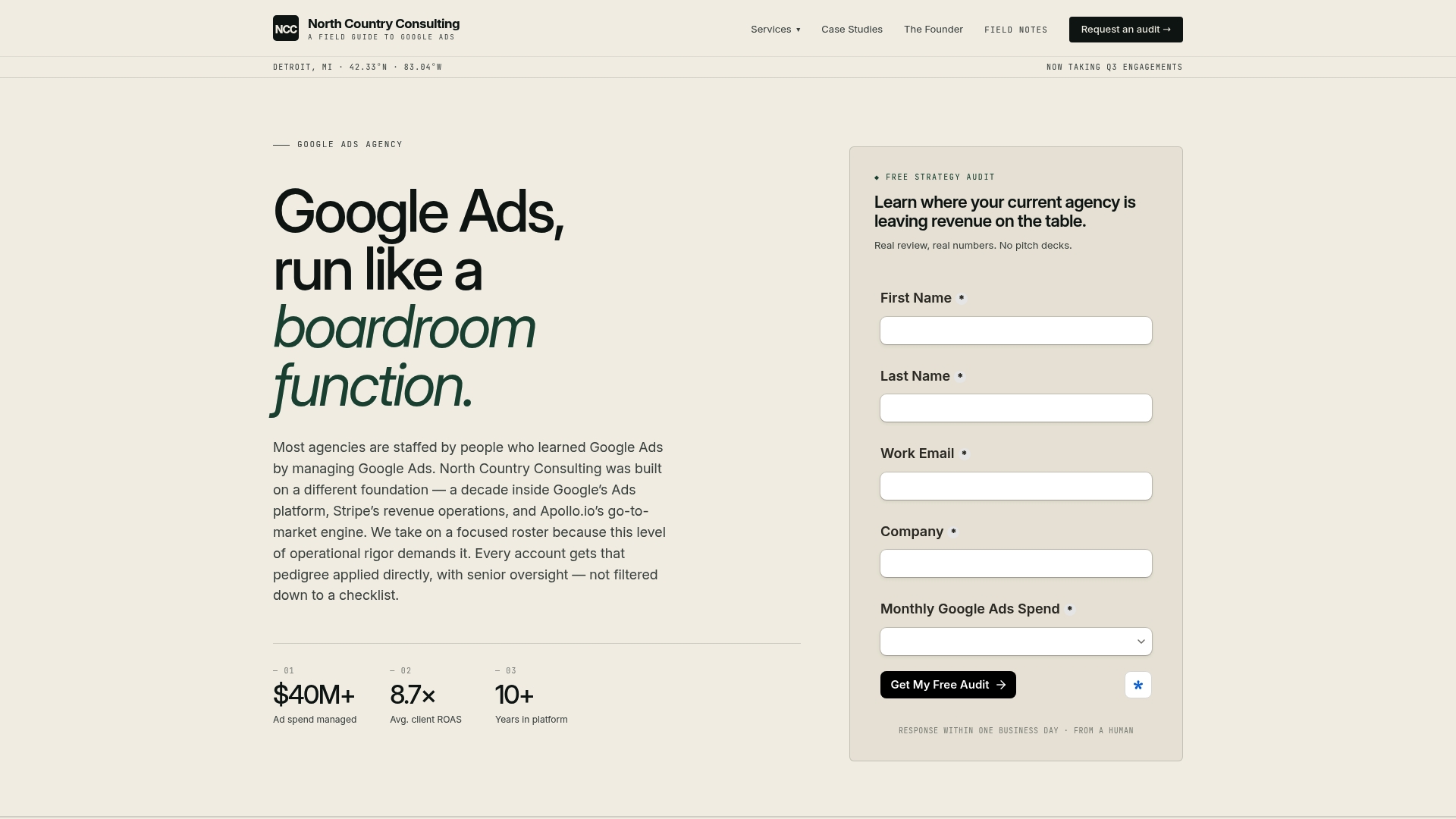
North Country Consulting manages Google Ads accounts with direct senior oversight on every account, no junior account managers, no templated campaign builds. Their flat-fee structure means they have no financial incentive to grow your budget beyond what’s profitable. With an average return on ad spend of 8.7× and over $40 million in managed ad spend, the methodology is built around account restructuring, attribution model rebuilding, and margin-based targeting rather than volume. For businesses spending $25,000 or more per month on Google Ads, their free strategy audit identifies specific revenue gaps before any commitment. Learn more about their PPC management services or see what a senior-led engagement actually covers.
Key Takeaways
Most US businesses pay $1,500–$15,000 per month in PPC management fees, with flat-fee models offering the clearest incentive alignment for accounts focused on return on ad spend rather than spend volume.
| Point | Details |
|---|---|
| Typical fee range | Most US accounts pay $1,500–$15,000/month in management fees or 10–20% of monthly ad spend, with rates decreasing for larger budgets. |
| Percentage model risk | At 15% on $50,000 in spend, the agency earns $7,500 and has an incentive to grow your budget regardless of profitability. |
| Flat fee advantage | Flat retainers align agency incentives with efficiency, not volume, making them preferable for scaling accounts. |
| Hidden costs to budget | Setup fees ($500–$5,000), creative assets, landing page development, and tool costs often sit outside the base retainer. |
| North Country Consulting | Senior-led, flat-fee Google Ads management for accounts spending $25,000+/month, with a free strategy audit available. |