
Optimizely is the right call for large enterprise product and engineering teams running server-side experimentation at scale. VWO is the better fit for marketing-led organizations that need fast time-to-value, built-in behavioral analytics, and predictable pricing without a six-figure contract. If you’re spending $25,000+ per month on Google or ChatGPT Ads and want to tie landing-page experiments directly to ROAS, the platform choice comes down to three things: how much engineering you can commit, how transparent you need pricing to be, and whether you need heatmaps and session recordings in the same tool.
- Enterprise engineering teams: Optimizely’s Stats Engine and feature flags support unlimited concurrent experiments with multi-environment governance, but expect developer ownership and a quote-only contract with significant minimum annual spend.
- Marketing-led mid-market teams: VWO’s Bayesian SmartStats, visual editor, and native behavioral analytics let marketers launch and read experiments without pulling engineers into every test cycle.
- Managed alternative: North Country Consulting runs senior-led experimentation and Google/ChatGPT Ads optimization achieving multiple times ROAS across tens of millions in managed spend, with no opaque enterprise contract required.
Table of Contents
- Optimizely vs VWO: Side-by-Side Comparison
- How each platform computes results, and why it matters
- What deployment actually costs you in engineering hours
- Pricing transparency and total cost of ownership
- Integrations, governance, and enterprise features
- When a senior-led managed service beats both platforms
- Key Takeaways
Optimizely vs VWO: Side-by-Side Comparison
| Dimension | Optimizely | VWO (Wingify) |
|---|---|---|
| Best for / target buyer | Enterprise product and data teams with dedicated engineering | Marketing-led teams and mid-market orgs prioritizing speed |
| Statistical engine & validity | Frequentist Stats Engine, always-valid sequential inference, Stats Accelerator | Bayesian SmartStats, probability-of-winning statements |
| Deployment model | Server-side SDKs, full-stack, multi-environment (dev/staging/prod) | Client-side visual editor primary; VWO FullStack for server-side |
| Ease of use / visual editor | Updated overlay editor; complex setup for full capability | Strong WYSIWYG editor; marketer self-service for most tests |
| Feature flags & environments | Industry-leading: unlimited flags, approval workflows, multi-project governance | Functional basics via VWO FullStack; not a standalone flag platform |
| Behavioral analytics | None native; requires FullStory, Contentsquare, or Microsoft Clarity | Native heatmaps, session recordings, form analytics, surveys |
| Pricing transparency | Quote-only; no public pricing | Published tiers; free starter available |
| Expected cost | ~$36K–$50K+/year entry; six figures for full enterprise | ~$198–$475/mo for mid-market tiers; enterprise custom |
| Engineering effort | High; developer ownership required for full capability | Low to moderate; most web tests need no engineering |
| Integrations & enterprise features | Native CDP, warehouse-native workflows, SSO/SCIM, audit logs | multiple integrations; GDPR, CCPA, SOC 2, ISO 27001 |
| Support & professional services | Enterprise PS teams; structured onboarding | Dedicated success teams; 45-min first response |
Red flags to watch:
- Optimizely’s opaque pricing routinely delays procurement sign-off and increases negotiation complexity.
- Without native behavioral analytics, Optimizely teams often add FullStory or Contentsquare licenses, which raises total cost of ownership and creates data silos.
- VWO FullStack is functional for basic server-side needs but shouldn’t be the primary reason you choose the platform if feature-flag governance is a core requirement.
How each platform computes results, and why it matters
VWO’s SmartStats accelerates decisions for marketing teams. Optimizely’s Stats Engine is built for programs running 20+ concurrent experiments where false positives compound across tests.
VWO’s Bayesian SmartStats gives marketers an intuitive probability-of-winning statement: “Variation B has an 87% chance of beating control.” No p-value interpretation required. That framing maps naturally to how marketing teams make rollout calls, especially when you’re trying to move fast on a landing page tied to a live Google Ads campaign.
Optimizely’s Stats Engine uses always-valid sequential inference, meaning you can check results at any point without inflating your false-positive rate. The Stats Accelerator feature automatically shifts traffic toward winning variations, which matters when you’re running a large concurrent program and can’t afford to wait for a fixed sample size.
Practical implications for paid-search and ChatGPT Ads programs:
- VWO’s probability statements are easier to act on quickly, reducing time-to-decision for campaign-level landing page tests.
- Optimizely’s always-valid inference protects against peeking bias when multiple stakeholders check results daily.
- Stats Accelerator can shorten experiment runtime on high-traffic pages, which is valuable when ad spend is burning during a test.
- Bayesian models tolerate lower traffic volumes better, which helps mid-market teams that don’t have millions of monthly visitors.
Pro Tip: Align your stopping rules to your stats model before a test launches. With SmartStats, set a minimum runtime (typically 2 weeks) even after reaching your probability threshold. With Optimizely’s Stats Engine, let the platform signal completion rather than calling winners manually at 95% confidence.
What deployment actually costs you in engineering hours
Server-side experimentation with Optimizely requires developer ownership. That’s not a criticism; it’s the architecture. Optimizely’s server-side SDKs use in-memory bucketing with microsecond-level performance, which makes feature experimentation safe for performance-critical code paths. But getting there means SDK integration, environment separation across dev, staging, and production, datafile management, and ongoing governance for flag lifecycle.
VWO’s visual editor handles the majority of web and landing-page experiments without touching a codebase. Marketers can build, launch, and analyze tests independently. VWO FullStack adds server-side capability with SDKs in 8+ languages, though product specialists note it’s positioned as a complement to client-side testing rather than a standalone feature management platform.
Engineering cost drivers to budget:
- SDK integration and initial environment setup (Optimizely: significant; VWO FullStack: moderate)
- Ongoing flag governance and approval workflows (Optimizely: requires dedicated process; VWO: lighter)
- Datafile size and CDN latency management for high-traffic deployments
- Third-party analytics integration and event mapping maintenance
Statistic callout: Community-sourced estimates and review-site data place Optimizely’s enterprise entry at a minimum of tens of thousands of dollars per year, with annual commitments and restrictive cancellation terms common in enterprise contracts. Implementation labor is additional.
Pricing transparency and total cost of ownership
VWO publishes its pricing. Optimizely does not. That single difference has real procurement consequences.
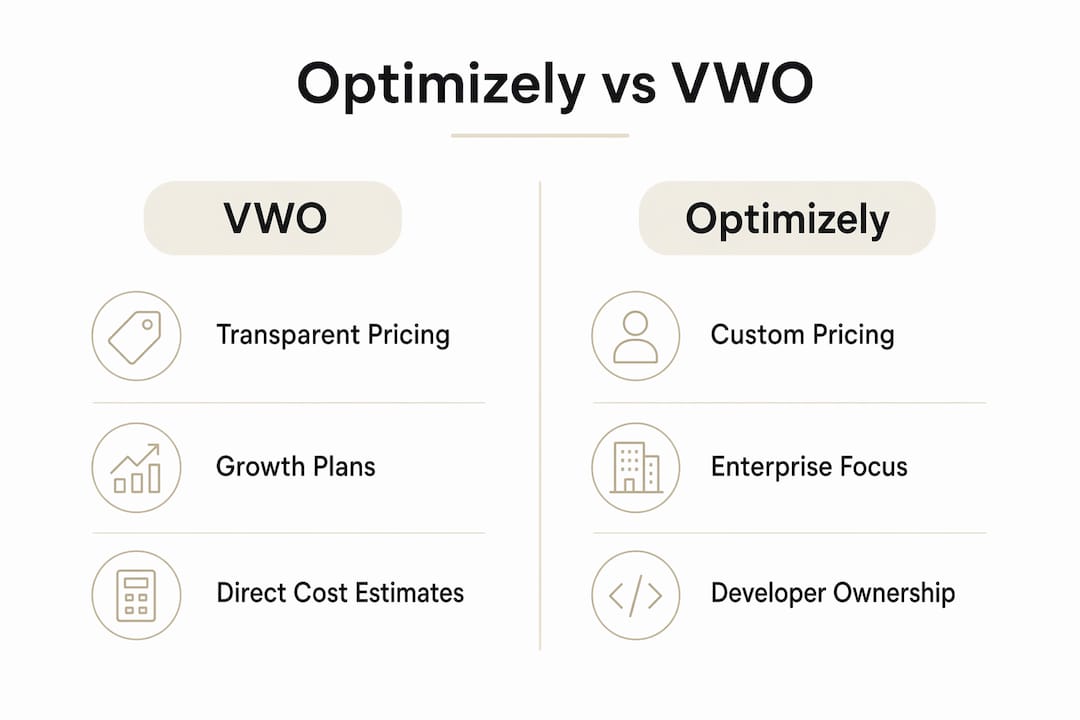
VWO’s published tiers start at a few hundred dollars per month for growth plans covering tens of thousands of monthly visitors, scaling higher for increased traffic tiers. Enterprise is custom. A 500,000-visitor site running 5–10 tests per month would likely land in the $400–$700/month range. Optimizely at that same scale runs $36,000–$50,000/year, a 6–8× cost difference for comparable core testing capability.
| Scenario | VWO estimated cost | Optimizely estimated cost |
|---|---|---|
| 30K visitors/mo, basic testing | a few hundred dollars per month | Not applicable (below entry floor) |
| increased traffic tiers | higher monthly pricing tiers | ~$36,000–$50,000/yr (entry floor) |
| 500K visitors/mo, 5–10 tests/mo | ~$400–$700/mo | ~$36,000–$50,000/yr |
| Full enterprise, governance + CDP | Custom | very high custom pricing tier |
Beyond license fees, factor in: third-party behavioral analytics for Optimizely (FullStory or Contentsquare licenses plus integration labor), engineering hours for SDK maintenance, and pro services for onboarding. For agency pricing comparisons, those hidden costs often tip the TCO calculation toward a managed service.
Procurement questions to ask both vendors:
- What is the minimum annual commitment and cancellation policy?
- Are behavioral analytics (heatmaps, session recordings) included, or separately licensed?
- What add-on costs apply for additional environments, seats, or integrations?
- How does pricing scale with traffic volume increases mid-contract?
Integrations, governance, and enterprise features
Optimizely’s native CDP is a genuine differentiator at enterprise scale. It pulls customer data from web, email, and in-store sources into unified profiles, enabling on-the-fly segmentation and AI-powered recommendations. For large organizations with data scattered across systems, that consolidation has real value. VWO simply doesn’t offer an equivalent.

Where VWO wins is behavioral analytics. Native heatmaps, session recordings, form analytics, and surveys are bundled into the platform, reducing instrumentation time and eliminating cross-tool data stitching. For Optimizely, equivalent capabilities require third-party licenses and continuous integration maintenance, which practitioners flag as a hidden speed tax on experiment setup.
Enterprise feature checklist:
- CDP and audience segmentation: Optimizely native; VWO requires third-party
- Data-warehouse export and warehouse-native workflows: Optimizely stronger
- SSO/SCIM, role-based approvals, audit logs: Optimizely advanced; VWO standard RBAC
- Behavioral analytics (heatmaps, recordings, surveys): VWO native; Optimizely third-party
- Compliance (GDPR, CCPA, SOC 2, ISO 27001): both certified
- Support SLAs: Optimizely enterprise PS; VWO dedicated success teams with 45-min first response
When vendor professional services matter: if your program involves warehouse-native workflows, multi-project governance, or backend algorithm testing, Optimizely’s PS team is worth the investment. If your program is primarily web and landing-page experimentation tied to paid channel performance, an external agency with experimentation expertise often delivers faster results at lower cost than either vendor’s PS offering.
When a senior-led managed service beats both platforms
If your team is spending $25,000+ per month on Google or ChatGPT Ads and you don’t have dedicated engineering for SDK integration or the appetite for a six-figure enterprise contract, building an internal experimentation program on either platform carries real risk. The tools are only as good as the team running them.
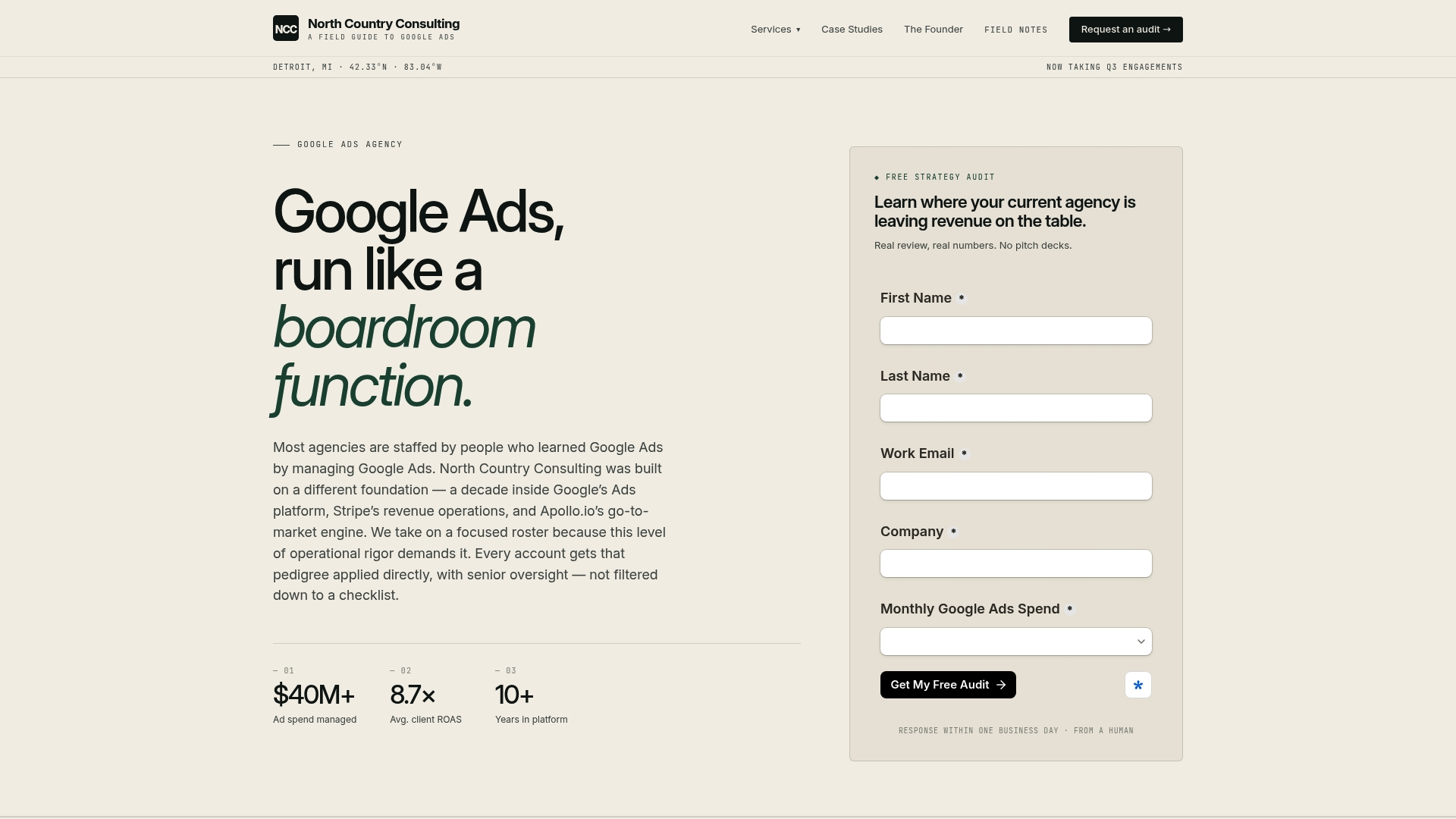
North Country Consulting manages Google Ads and ChatGPT Ads programs with senior oversight across $40M+ in managed spend, averaging 8.7× ROAS. The engagement covers test ideation, implementation, statistical review, measurement, and campaign-level optimization tied directly to your ad performance, without requiring you to hire a data engineering team or sign a multi-year platform contract. For teams evaluating in-house versus agency management, the TCO comparison almost always favors a managed engagement when engineering headcount is the alternative.
Choose a managed service when:
- Your team lacks dedicated engineering for server-side SDK deployment
- You want experiment results tied directly to Google Ads or ChatGPT Ads ROAS, not just on-site conversion rate
- Procurement timelines for enterprise contracts would delay your program by months
- You want predictable fees without usage-based scaling surprises
Start with a free Google Ads or ChatGPT Ads audit to see exactly where your current spend is leaking before committing to any platform or contract.
Key Takeaways
Optimizely suits enterprise engineering teams with large budgets; VWO delivers faster time-to-value for marketing-led programs at a fraction of the cost, and a managed service removes the platform decision entirely for high-spend advertisers.
| Point | Details |
|---|---|
| Enterprise vs mid-market fit | Optimizely serves large engineering-led teams; VWO serves marketing-led orgs needing speed and simplicity. |
| Pricing gap is significant | VWO starts around $198/month; Optimizely’s entry floor runs $36,000–$50,000/year with quote-only contracts. |
| Behavioral analytics cost | Optimizely requires third-party tools like FullStory for heatmaps and recordings, adding license and integration costs. |
| Engineering overhead | Optimizely’s server-side SDKs require developer ownership; VWO’s visual editor enables marketer self-service for most tests. |
| North Country Consulting | Senior-led managed service averaging 8.7× ROAS across $40M+ in spend, with no enterprise contract required. |