
Which platform wins: Northbeam or Triple Whale?
The short answer: Triple Whale for growing DTC brands under roughly $40M in revenue, and Northbeam for larger operations running complex, multi-channel media mixes that need statistically defensible numbers.
Here’s what separates them at a glance:
- Implementation: Triple Whale deploys in 1–3 days for Shopify stores; Northbeam requires 2–4 weeks of onboarding and model calibration.
- Attribution approach: Northbeam uses a hybrid MTA and MMM model; Triple Whale relies on pixel-based MTA with predictive gap-filling.
- Pricing: Northbeam starts around $1,000–$1,500/month targeting brands with significant media budgets; Triple Whale’s entry tier begins near $129/month, scaling by revenue.
- Data accuracy: Performance marketers report Triple Whale tends to show higher ROAS on Meta, while Northbeam’s more conservative numbers align better with geo-based holdout test results.
- Ideal user: Triple Whale suits lean, founder-led teams; Northbeam suits brands with analytical staff and finance stakeholders who need budget defense.
“Northbeam handles complex media mixes with multiple agencies and overlapping audiences, providing the statistical defensibility required by finance stakeholders.” — Ken Valledy, as cited in Ecommerce Times
Neither platform connects contribution margin or P&L data natively, so both work best as directional measurement tools rather than definitive profit scorecards.
Table of Contents
- How do Northbeam and Triple Whale actually compare?
- What practitioners actually report
- Key Takeaways
- North Country Consulting manages the ad spend these platforms measure
How do Northbeam and Triple Whale actually compare?
Implementation and onboarding
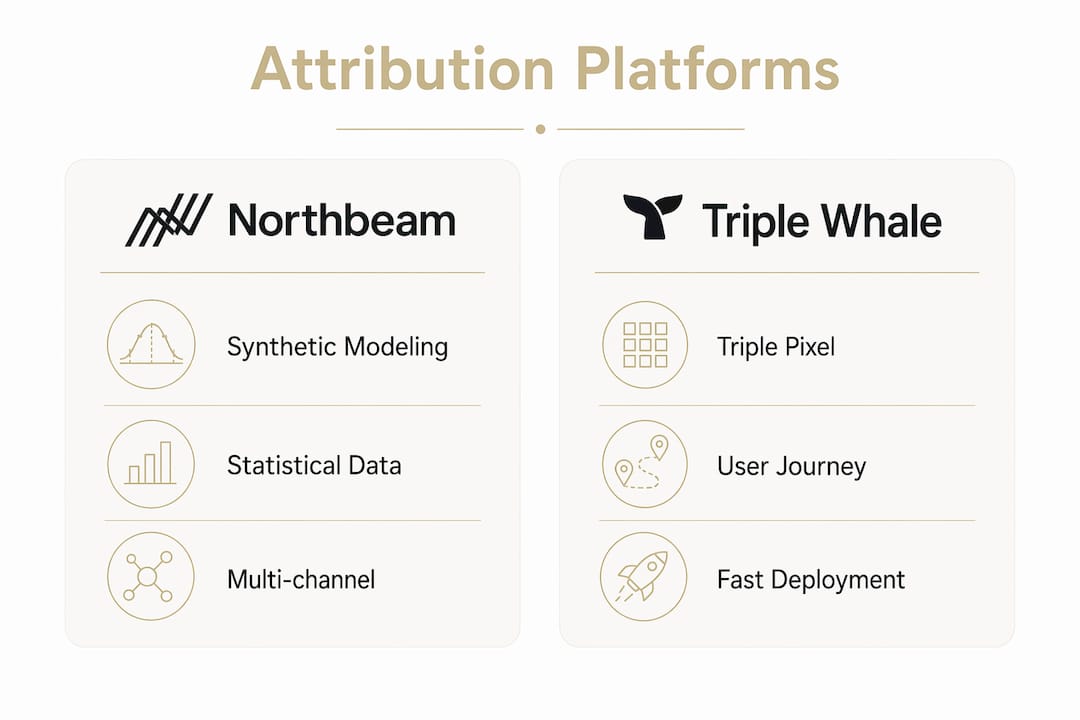
Triple Whale’s Shopify-native architecture means most brands are pulling live data within a day or two. Northbeam’s onboarding involves pixel setup, historical data ingestion, and model calibration — a process that requires substantial technical resources and typically runs 2–4 weeks before the model stabilizes.
Without a dedicated analyst on staff, Northbeam’s complexity can delay ROI realization by weeks. That gap matters when you’re making daily creative decisions.
Attribution modeling and channel coverage
Northbeam’s Synthetic modeling technique triangulates anonymized customer behavior to handle iOS signal loss, updating attribution models daily with confidence intervals. It also supports offline channels like TV, podcasts, and direct mail through media mix modeling, though offline data requires manual CSV uploads rather than automated feeds.

Triple Whale’s Triple Pixel tracks individual user journeys across touchpoints and assigns fractional credit using your choice of attribution model (linear, time-decay, first-touch, last-touch). It updates hourly and delivers creative-level granularity — genuinely useful for teams running high-volume paid social tests. The trade-off is that pixel-based tracking degrades when users block cookies or switch devices.
AI features
Triple Whale’s Moby assistant lets you query your data in plain English: ask it why ROAS dropped last Tuesday and it surfaces an answer without a SQL query. Northbeam’s AI Budget Optimizer takes a different angle, recommending autonomous budget shifts based on modeled channel contribution. One is built for operators who want answers fast; the other is built for planners who want recommendations they can defend.
Pro Tip: If your CFO regularly asks you to justify channel spend, Northbeam’s confidence intervals and MMM outputs give you something to show in a budget meeting. Triple Whale’s dashboards are better for daily creative optimization.
Ease of use and team fit
On G2, Triple Whale scores 8.7 for ease of use against Northbeam’s 7.8. Triple Whale’s mobile app and Slack threshold alerts (ROAS drops, budget pacing) are built for operators who check performance between meetings. Northbeam’s desktop-focused dashboards are designed for weekly or monthly planning reviews, not real-time monitoring.
Triple Whale also targets in-house teams that lack dedicated data scientists, aiming to replace multiple tools in the marketing stack. Northbeam’s architecture, by contrast, supports multi-client agency setups with white-labeled reporting.
Pricing and integrations
| Dimension | Northbeam | Triple Whale |
|---|---|---|
| Starting price | ~$1,500/month | ~$129/month (Founders tier) |
| Pricing model | Order volume + ad accounts; annual contract | Revenue-tiered; annual billing |
| Implementation time | 2–4 weeks | 1–3 days |
| Attribution model | Hybrid MTA + MMM | Pixel-based MTA + predictive modeling |
| Offline channel support | Yes (manual CSV upload) | No |
| AI feature | Budget Optimizer | Moby natural language assistant |
| Ease of use (G2) | 7.8 | 8.7 |
| Best for | $40M+ revenue, multi-channel, agency | Growing DTC brands, Shopify-native |
| Unique strength | Statistical defensibility, MMM | Real-time creative analytics, fast setup |
Both platforms connect natively to Meta, Google Ads, TikTok, Snapchat, Pinterest, Shopify, and Google Analytics. Triple Whale adds Klaviyo and profit margin tracking within Shopify. Neither offers native CRM or email platform integration for Northbeam, and neither connects directly to omnichannel marketing data warehouses without custom work.
Understanding Google Ads attribution models is worth doing before committing to either platform — the model you choose inside these tools shapes every budget decision downstream.
What practitioners actually report
Brands running substantial upper-funnel spend on CTV or podcasts consistently find Northbeam’s view-through attribution and MMM capabilities more useful than Triple Whale’s pixel-based approach, which simply wasn’t built for those channels.
On the Triple Whale side, the analytics impact on marketing returns is most visible for DTC teams running aggressive paid social creative tests. The hourly data refresh and creative-level attribution let media buyers kill underperforming ads the same day rather than waiting for a weekly model update.
The honest practitioner consensus: use these platforms as directional tools, not profit calculators. Neither replaces a proper incrementality test or a full P&L view.
Key Takeaways
Northbeam suits mature, multi-channel brands needing statistically defensible attribution; Triple Whale suits growing Shopify-native DTC teams prioritizing speed and ease of use.
| Point | Details |
|---|---|
| Implementation gap | Triple Whale deploys very quickly; Northbeam requires a longer calibration period. |
| Attribution philosophy | Northbeam uses hybrid MTA + MMM for statistical rigor; Triple Whale uses pixel-based MTA with hourly updates. |
| Pricing spread | Triple Whale starts at a low entry price; Northbeam starts at a significantly higher monthly cost. |
| Offline channel coverage | Only Northbeam supports TV, podcasts, and direct mail through media mix modeling. |
| North Country Consulting | For brands spending $25K+/month on Google Ads, North Country Consulting rebuilds account structure and attribution for measurable ROAS improvement. |
North Country Consulting manages the ad spend these platforms measure
Attribution platforms tell you where credit goes. North Country Consulting determines where the money should go in the first place. With an average return on ad spend of 8.7× and over $40 million in managed ad spend, North Country Consulting works directly with CEOs and CMOs at businesses spending $25,000 or more per month on Google Ads, rebuilding account structures for full-funnel performance rather than patching what’s already broken.
Where Northbeam and Triple Whale surface attribution data, North Country Consulting acts on it: senior-led restructuring, margin-based cohort targeting, non-branded campaign architecture, and custom measurement frameworks built for your specific business. No junior account managers, no templated playbooks.
If your Google Ads account hasn’t been audited by someone who has worked inside Google’s own platform, that’s the place to start. Request a free strategy audit and see exactly where your current setup is costing you revenue.