
The fastest way to raise ROAS is to fix your conversion values so they reflect real profit, then switch to value-based Smart Bidding once you clear the conversion-volume threshold, and clean up the account structure feeding it. Google’s bidding algorithm can only optimize what you tell it to optimize. Feed it gross revenue and it will chase gross revenue, refunds and all. Your move in the next 48 hours: pull one conversion action, check whether its value is actually margin or just revenue, and correct it before touching bids.
TL;DR:
- Correctly setting conversion values to reflect profit rather than revenue is crucial before implementing value-based Smart Bidding.
- Fixing inputs via negative keywords, ad copy, and landing page improvements should be done within the same week for maximum effect on Smart Bidding performance.
- Rebuilding campaign structure around themes and margins is necessary only after cleaning up conversion tracking and other inputs.
- Platform-reported ROAS often overstates true incremental impact, so conducting local or geo holdout tests provides more reliable profit estimates.
- A full account audit focusing on tracking accuracy and value setup safeguards long-term ROAS improvements.
Table of Contents
- Improve ROAS in Google Ads: The 10-Point Priority Checklist
- Why Is My ROAS Low? A Diagnosis Matrix
- How Do You Set Up Value-Based Smart Bidding Correctly?
- How Does Ad and Landing Page Quality Affect ROAS?
- How Should You Structure Audiences to Scale Without Losing ROAS?
- Platform ROAS vs. Incrementality: What Should You Actually Trust?
- What Should Be in a ROAS Measurement Audit?
- Why This Approach Works: North Country Consulting’s Method
- What Marketers Consistently Get Wrong About ROAS
- Get a Free Google Ads Audit From North Country Consulting
- Primary Sources for This Article
- Sources
- FAQ
Improve ROAS in Google Ads: The 10-Point Priority Checklist
Not every ROAS fix carries equal weight, and chasing the wrong one first wastes weeks. This checklist runs from same-day wins to structural projects that take a full quarter, in the order most accounts should tackle them.
- Mine the search terms report for waste. Pull the last 30 to 90 days of search terms and add anything irrelevant, low-intent, or converting below breakeven as a negative keyword. Expect a same-day spend reduction, often 5% to 15% of wasted budget recovered within a week.
- Pause the bottom 20% of queries by cost with zero conversions. If a search term has burned through 3x your average cost per conversion with no result, cut it. Impact shows within days.
- Rewrite ad copy for the top three spending ad groups. Weak headlines and generic CTAs quietly tax every other optimization you make. Expect a modest CTR and conversion-rate lift within one to two weeks.
- Push bids up on your highest-margin winners, not just your highest-ROAS ones. A campaign converting well on a low-margin SKU can look better than it performs. This is a same-week adjustment.
- Audit conversion tracking and fix value settings. Confirm each conversion action is set to count once, uses the right attribution window, and reports margin rather than gross revenue where possible. This takes a few days but underpins everything downstream.
- Build ad-specific landing pages for your top five ad groups. Message match between ad copy and page headline routinely lifts conversion rate more than any bid change. Expect results in two to four weeks as data accumulates.
- Add call tracking if phone leads matter to your business. Without it, you’re bidding blind on a chunk of real revenue. Setup takes one to two weeks depending on your phone system.
- Migrate to value-based Smart Bidding once you clear the conversion threshold. Target ROAS generally needs at least 15 conversions in the last 30 days at the conversion-tracking level to behave predictably. Full ramp takes two to six weeks.
- Restructure the account around themes, not habit. Split Shopping from Search, separate branded from non-branded, and group Performance Max assets by product margin tier rather than by whatever taxonomy existed three years ago. This is a four to eight-week project.
- Plan an incrementality test before you scale spend aggressively. A geo holdout tells you whether that ROAS number is even real. Budget four to six weeks for a clean read.
Pro Tip: Run items 1 through 4 in the same week. They’re cheap, fast, and they clean the signal Smart Bidding will later learn from, so everything you do after them works better.
The pattern across all ten: fix inputs before you touch the algorithm, and fix the algorithm before you restructure the account. Reversing that order is the single most common way businesses waste a quarter chasing a symptom instead of a cause.
Why Is My ROAS Low? A Diagnosis Matrix
Most ROAS problems fall into a handful of recognizable patterns. The trap is treating every low-ROAS week the same way, when the fix for mis-set conversion values looks nothing like the fix for audience leakage.
Start by separating symptoms you can see in the dashboard from the root cause underneath them. High clicks with low ROAS almost always points somewhere upstream of the ad itself. Refund-heavy categories distort ROAS in a way tracking never catches unless you specifically build for it. And a campaign that “used to work fine” but now swings wildly week to week is usually a Smart Bidding stability problem, not a targeting one.
Common symptom patterns and where to look:
- Low ROAS despite strong click volume: usually mis-set conversion values or poor landing-page match, not a targeting problem.
- High spend with few conversions: often a bidding constraint (budget capping the algorithm) or an audience that’s too broad for the creative.
- ROAS looks fine at the platform level but margin feels tight: almost always a revenue-versus-margin mismatch in what you’re feeding the bid strategy.
- Performance swings sharply week to week: frequently a Smart Bidding target changed too recently, or a Data-Driven Attribution model reshuffling credit across campaigns.
- Returns or refunds spike after big sale periods: conversion values recorded at purchase time never get corrected, so ROAS looks better than it is for weeks.
| Symptom | Probable cause | Corrective action |
|---|---|---|
| High clicks, low ROAS | Conversion value set to revenue, not margin | Send contribution-margin values via conversion adjustments |
| High spend, few conversions | Landing page mismatch or overly broad audience | Build ad-specific pages; tighten audience signals in Performance Max |
| Strong ROAS, thin real profit | Attribution crediting upper-funnel touches inflated by DDA | Reconcile with backend profit data before scaling |
| Erratic week-to-week swings | Recent tROAS or CPA target change, still in learning phase | Hold targets steady for the recommended wait period |
| Post-sale ROAS looks great, then drops | Refunds not reflected in original conversion value | Push offline conversion adjustments for returns |
Data-Driven Attribution reassigns credit across touchpoints as it learns, which can make a branded search campaign look weaker and an upper-funnel Display or Demand Gen campaign look stronger, without any real change in total revenue. If you rebuilt bids around that shift, you optimized around noise.
Escalation guidance matters here. A tweak (adjusting a negative keyword list, nudging a bid) is appropriate when the symptom is isolated to one ad group or one query cluster. A rebuild (restructuring campaigns, migrating bid strategies, re-architecting conversion tracking) is warranted when the symptom shows up across multiple campaigns simultaneously, or when you can’t explain the swing by pointing to a single recent change.
Conversion-volume thresholds matter for diagnosis, too. If a campaign is underperforming and it’s running Target ROAS with fewer than 15 conversions in 30 days, the real diagnosis might simply be “this campaign doesn’t have enough data for stable bidding yet.” Demand Gen’s value-bidding thresholds run even higher, and pushing a low-volume campaign into tROAS before it’s ready produces exactly the erratic behavior this matrix flags as a symptom of its own.
How Do You Set Up Value-Based Smart Bidding Correctly?
Three bidding strategies matter for ROAS work, and picking the wrong one for your data volume is the most common setup mistake. Maximize conversion value spends your full budget to generate the highest total value, with no ROAS constraint, which suits accounts still building conversion history. Target ROAS (tROAS) adds a value floor, but it needs data to work with. Target CPA still makes sense when your conversions carry roughly equal value; if a lead-gen business closes every lead at a similar contract size, optimizing for cost per conversion is simpler and just as effective as optimizing for value.
Google’s own guidance sets tROAS stability at roughly 15 conversions in the last 30 days at the conversion-tracking level. Demand Gen campaigns and other value-bidding formats carry higher thresholds, sometimes running toward 50 conversions with value in a 35-day window depending on account history. Launching tROAS before you clear that bar is the single most common reason businesses report the bid strategy as “broken” when it’s really just underfed.
Ramping rules that actually hold up in practice:
- Set your initial Target ROAS about 20% below your historical ROAS, not at parity or above it. Google recommends this specific buffer because an aggressive opening target starves the campaign of volume while the algorithm learns.
- Leave the campaign unchanged for about two weeks after launch or after changing targets to allow the bidding algorithm to stabilize.
- Expect the broader learning phase for Performance Max and Smart Bidding generally to run one to two weeks, sometimes extending to several weeks for lower-volume accounts.
- Use the Bid Strategy Report to watch how targets and actual performance diverge over time, rather than eyeballing daily ROAS.
- Model likely outcomes with Bid Simulator before committing to a new target, especially when you’re raising tROAS to protect margin.
The value hygiene piece is where most accounts leak profit without realizing it. If your conversion action is set to the full sale price, Smart Bidding is optimizing for revenue, not profit, and it has no way to distinguish a $200 sale with a 60% margin from a $200 sale with a 15% margin. Enhanced Conversions improve match quality on the tracking side, but the values themselves still need correcting through conversion value rules or offline conversion adjustments that reconcile true margin, refunds, and returns after the fact.
A geo holdout study across 225 tests found a median incremental ROAS of about 2.31x, while platform-reported ROAS commonly overstates incremental impact by 20% to 60%. A bid strategy optimizing perfectly against a flawed number is still optimizing against a flawed number.
For accounts with return-heavy categories or long consideration cycles, the practical workflow is an API-based conversion adjustment: send the initial value at time of sale, then push a correction 15 to 30 days later once refunds and true margin are known. Expect Smart Bidding to take another one to two weeks to re-absorb that correction into its model. Our guide to Smart Bidding strategies walks through the setup sequence in more detail if you’re migrating from Target CPA for the first time.
How Does Ad and Landing Page Quality Affect ROAS?
This is the lever most accounts under-invest in relative to how much they tinker with bids.
Start with ad group structure. A tightly themed ad group, one built around a single product line or a narrow service, lets you write ad copy that mirrors the exact language a searcher used. Broad ad groups covering a dozen loosely related keywords force generic copy, and generic copy converts worse regardless of how good your bidding strategy is underneath it.
Ad copy fundamentals worth checking on every active ad group:
- Run 3 to 5 responsive search ads per ad group, which is Google’s own recommendation for giving the algorithm enough variation to test.
- Aim for “Good” or “Excellent” Ad Strength ratings, not because the label itself matters, but because the underlying diversity it measures correlates with real performance gains.
- Lead headlines with the specific outcome or product name a searcher typed, not a generic brand tagline.
- Keep calls to action concrete: “Get a Quote,” “Check Pricing,” “See Sizes,” rather than vague prompts like “Learn More.”
- Refresh seasonal or promotional copy on a set schedule so stale offers don’t sit live for months after they expire.
Landing pages carry the other half of the equation. Message match, where the page headline echoes the ad headline and the keyword that triggered it, remains one of the more reliable conversion-rate levers available, and it costs nothing in extra ad spend. Beyond match, four things separate landing pages that convert from ones that quietly bleed clicks: page speed on mobile (anything past a few seconds of load time costs you visitors before they see the offer), a clear call to action above the fold, visible trust signals like reviews or guarantees near the decision point, and minimal form friction, meaning you ask for only what you actually need to follow up.
Pro Tip: Build one ad-specific landing page for your highest-spending ad group and run it against your general product page for three to four weeks. Measure conversion rate uplift directly rather than assuming the dedicated page performs better.
The partner resource at Baby Love Growth’s conversion optimization guide covers testing methodology in more depth if you want a structured framework for running these experiments without guessing at sample sizes.
None of this replaces fixing conversion values or bidding structure. But a campaign with clean tracking and a mediocre landing page will always underperform a campaign with clean tracking and a landing page built to match the ad. Our breakdown of ecommerce ROAS levers covers additional creative-side tactics specific to product-based accounts.
How Should You Structure Audiences to Scale Without Losing ROAS?
Segmentation decisions either protect the efficiency you’ve built or quietly destroy it, and the difference usually comes down to whether you split for a genuine reason or out of habit.
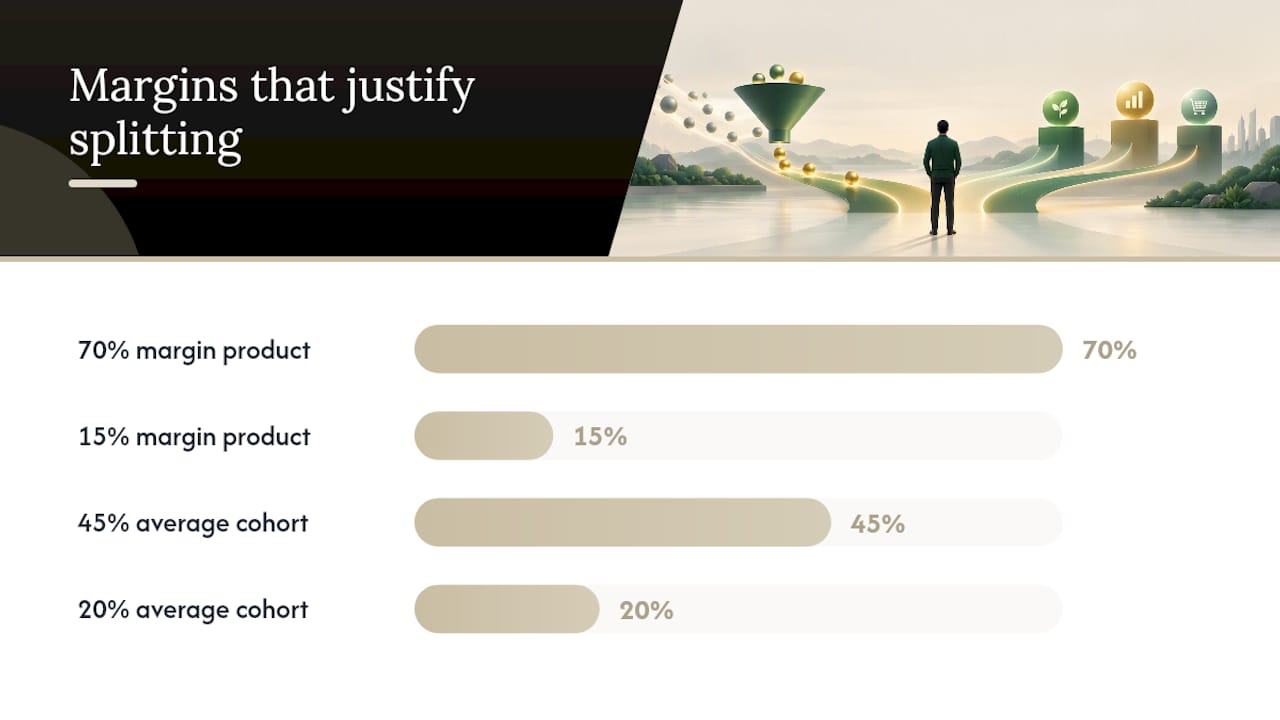
Split campaigns by region when performance genuinely diverges by geography, not because a sales team wants a dedicated dashboard per territory. Split by product when margin structures differ meaningfully, since a bid strategy optimizing across a 70% margin product and a 15% margin product under one target will underserved one of them. Split by funnel stage when your business has a real distinction between cold prospecting and warm remarketing audiences with different expected conversion rates. Outside those three cases, consolidation almost always beats fragmentation, because Smart Bidding performs better with more data feeding a single campaign than with the same data spread thin across five.
Audience-building priorities that move ROAS rather than just reach:
- Build first-party audiences from your customer list, weighted toward high-lifetime-value cohorts rather than treating every past customer the same.
- Use audience exclusions aggressively, removing recent purchasers from prospecting campaigns and excluding job applicants or support-page visitors who trigger irrelevant remarketing.
- For Performance Max, treat audience signals as a starting hint, not a hard restriction, since the system will expand beyond them once it finds a pattern that converts.
- Run an occasional no-signal or minimal-signal test on a Performance Max campaign to isolate how much your audience input is actually narrowing (or helping) targeting versus the algorithm finding its own path.
- Shift budget allocation toward whichever segment shows the strongest incremental performance, not just the strongest platform-reported ROAS, since those two numbers frequently disagree.
The margin point deserves repeating in an audience context specifically: a cohort of customers with a 45% average margin should get a different effective ROAS target than a cohort averaging 20%, even inside the same account. Blending them into one bid strategy means one group subsidizes the other, and you won’t see it in the ROAS number unless you’ve already fixed your conversion values to reflect margin in the first place.
Platform ROAS vs. Incrementality: What Should You Actually Trust?
Platform-reported ROAS tells you what Google’s attribution model credited to your ads. It does not tell you what would have happened without them, and the gap between those two numbers is often larger than marketers expect.
Across a large sample of geo holdout tests, the median incremental ROAS came in around 2.31x, while platform dashboards for the same accounts routinely reported figures 20% to 60% higher. That gap comes from customers who would have converted anyway, through organic search, direct navigation, or brand recall, getting credited to a paid click they happened to touch along the way.
Running your own incrementality read doesn’t require an enterprise measurement team. Here’s a practical sequence:
- Check native Conversion Lift eligibility first. If your account qualifies, Google’s built-in tool handles the split and reporting for you with less setup work than a manual test.
- If you’re not eligible, design a manual geo holdout. Split comparable regions into treatment and control groups, being careful to match population size, seasonality, and historical performance between them before you start.
- Run the test for two to six weeks depending on conversion volume. Lower-volume accounts need the longer end of that range to reach a result you can trust.
- Report a point estimate with a confidence interval, not a single number. A result of “2.1x, plus or minus 0.4” is more honest and more useful than a flat “2.1x.”
- Use the result as a scaling guardrail. If iROAS comes in meaningfully below platform ROAS, treat future scaling decisions as more conservative than the dashboard alone would suggest.
- Schedule a follow-up test after any major bidding or structural change. Incrementality shifts when your account changes, so a single test from a year ago doesn’t necessarily hold today.
If a full holdout isn’t feasible right now, given account size or engineering bandwidth, a lighter fallback is pausing a single well-defined campaign for one to two weeks and watching whether overall business revenue (not just platform-attributed revenue) actually drops, and by how much. It’s not statistically rigorous, but for a business making a go/no-go scaling call, it beats trusting the dashboard blind.
What Should Be in a ROAS Measurement Audit?
A ROAS figure is only as trustworthy as the tracking underneath it, and most accounts have never actually audited that plumbing.
Run through this sequence at least once a quarter, and immediately after any major site or checkout change:
- Verify tag firing and data-layer values on every key page, especially the purchase confirmation page where conversion value gets passed.
- Confirm Enhanced Conversions are active and that hashed customer data is actually populating, not just enabled in settings.
- Check whether offline or server-side conversion uploads are deduplicating correctly against the pixel-fired conversion, since double-counting inflates conversions and quietly deflates cost per conversion.
- Confirm refund and return handling flows back into conversion values through adjustments, rather than sitting permanently at the original sale price.
- Verify each conversion action’s “include in conversions” setting matches what you actually want Smart Bidding optimizing toward.
- Check conversion window settings against your actual sales cycle, since a 7-day window on a 30-day consideration purchase will systematically undercount.
Data pipeline checks that catch the errors dashboards hide:
- Confirm whether your revenue join between ad platform and backend system happens same-day or with a lag, and account for that lag before declaring a discrepancy.
- Check whether the value passed to Google reflects gross revenue, gross profit, or net contribution margin, and label it accurately in your reporting so no one downstream assumes it’s margin when it’s not.
- Run a monthly sanity check comparing platform-reported revenue against backend revenue for the same date range; a gap wider than 10% to 15% usually points to a tracking gap worth investigating.
- Calculate your back-of-envelope breakeven ROAS (fixed costs plus variable costs plus target margin, divided by revenue) at least quarterly, since margin structures shift and a breakeven number from a year ago may no longer apply.
Our conversion tracking setup guide walks through the tag and data-layer checks in more technical detail if you’re auditing this for the first time.
Why This Approach Works: North Country Consulting’s Method
The playbook above reflects how North Country Consulting handles every account it takes on: senior-led oversight rather than junior account management, a full rebuild of conversion tracking and attribution before touching bid strategy, and account architecture designed around margin, not habit. Account ownership stays with the client throughout.
North Country Consulting reports an average return on ad spend of 8.7x across more than $40 million in managed ad spend, a figure the firm states as its own client-performance claim rather than an industry benchmark. The firm’s free Google Ads audit is built specifically to surface the tracking and structural gaps this article covers.
Hiring an expert makes sense when account complexity outpaces internal bandwidth, when spend has scaled past $25,000 a month and the margin for error has scaled with it, or when a full incrementality read and conversion-value rebuild simply need more hours than a marketing team can spare in a given quarter.
What Marketers Consistently Get Wrong About ROAS
The mistake I see most often isn’t a bidding error. It’s optimizing to gross revenue and calling the resulting ROAS a win, when the actual profit behind that number tells a different story. A second common failure: changing tROAS targets three days into a learning phase because the number looked soft, which resets the clock and guarantees another two weeks of noise.
The durable principles underneath all of this are simple to state and hard to practice consistently. Optimize for margin, not revenue, every time you have the choice. Keep experiments clean, meaning don’t change five things in the same week you’re trying to read a geo holdout result. And protect ownership of your own data and account structure, because a rebuilt account with correct conversion values is worth more long-term than any single quarter’s ROAS spike.
If you’re not sure where your account currently stands on any of this, a free audit is a reasonable place to find out before you scale spend further.
— Eric
Get a Free Google Ads Audit From North Country Consulting
North Country Consulting is the alternative to guessing your way through bid strategy migrations and account rebuilds alone. Every account gets direct, senior-operator oversight, not a junior manager working from a template, and the team rebuilds the full stack, campaign architecture, conversion tracking, and reporting, so the ROAS number you’re looking at actually reflects margin instead of gross revenue.
Services include Google Ads management, Performance Max management, and full account restructuring, along with conversion tracking and attribution rebuilds for businesses spending $25,000 or more a month. Businesses running ChatGPT Ads at $10,000 or more a month can also get senior-led ChatGPT Ads management, covering pixel setup, campaign structure, and ongoing optimization.
The free Google Ads audit reviews your account structure, conversion tracking, and bidding setup, and flags the specific issues costing you ROAS right now. Most audits take about a week to complete once account access is granted. Request yours to see where your account is losing revenue before you spend another dollar scaling it.
Primary Sources for This Article
The recommendations above draw on Google’s own operational documentation and independent measurement research, not general marketing advice:
- Target ROAS requirements — Google Ads Help: sets the conversion-volume thresholds that gate stable value-based bidding.
- Value-based bidding for Demand Gen campaigns — Google Ads Help: the source for the 20%-below-historical-ROAS ramping rule and the 14-day hold period.
- Performance Max overview and best practices — Google Ads Help: defines the learning-phase window and the case against frequent mid-learning changes.
- How to conduct an incrementality study for Google Ads — Stella Hey Stella: the geo holdout methodology and the iROAS-versus-platform-ROAS data cited throughout.
Sources
- Target ROAS requirements — Google Ads Help
- Value-based bidding for Demand Gen campaigns — Google Ads Help
- Performance Max overview and best practices — Google Ads Help
- How to conduct an incrementality study for Google Ads — Stella Hey Stella
FAQ
Is a 2.5 ROAS Good for Google Ads?
It depends entirely on your margin structure. A 2.5x ROAS is comfortable for a business with 60% gross margins, since roughly $0.40 of every dollar returned still covers costs and leaves profit, but it’s a loss for a business running 20% margins. Calculate your own breakeven ROAS (total costs divided by revenue) before judging any ROAS figure in isolation.
What Counts as a Good ROAS for Google Ads?
There’s no universal number, because “good” is a function of your margin, not a fixed benchmark across industries. The more useful benchmark is your calculated breakeven ROAS, plus the target margin you want above it.
Is a ROAS of 4 Considered Strong?
A 4x ROAS is strong for most mid-margin businesses, but remember that platform-reported ROAS often overstates real incremental impact by 20% to 60% compared to incrementality-tested results.
Is $20 a Day Enough Budget for Google Ads?
A $20 daily budget can work for a narrow, local, or low-competition niche, but it’s rarely enough to clear the conversion-volume thresholds needed for value-based Smart Bidding to stabilize, since Target ROAS generally needs around 15 conversions in 30 days at the conversion level. Below that volume, Maximize Conversions or Target CPA usually performs more predictably than tROAS.
How Does North Country Consulting Help Improve ROAS?
North Country Consulting rebuilds account structure, conversion tracking, and bid strategy under senior-led oversight rather than junior account management, targeting the exact issues, mis-set conversion values, premature Smart Bidding migrations, poor account segmentation, that suppress ROAS. Current pricing and service details are available directly through the free Google Ads audit.