
If your account has stalled, most of it needs a restructure now: consolidate campaigns by objective, protect your top converters, and phase the rollout over three to four weeks so Smart Bidding never loses its footing. Skip a full rebuild if you’ve launched anything major in the last 30 days or you’re heading into a seasonal spike. Everything below covers how to audit first, what “modern structure” actually means in 2026, and how to roll changes out without torching performance.
TL;DR:
- Prioritize consolidating campaigns by objective and moving away from SKAGs to increase volume and relevance for better Smart Bidding performance.
- Export 90 days of data, validate tracking, and back up settings before restructuring to preserve valuable performance history and avoid data loss.
- Build new campaigns in parallel, gradually migrate budget, and monitor key metrics to minimize performance dips during the restructuring process.
- Expect a short performance dip of 1 to 3 weeks and ensure sharing negative keyword lists and conversion goals to prevent structural leaks.
- Seek a senior-led audit before restructuring to identify key performance assets and tailor the plan, especially for accounts spending over $25,000 monthly.
Table of Contents
- Signs It’s Time to Restructure Your Google Ads Account
- Audit First: What to Export, Preserve, and Validate
- Modern Structure Principles: Consolidate, Theme, and Feed the Algorithm
- The Phased Restructure Playbook
- Risks, Common Pitfalls, and a Rollback Plan
- North Country Consulting’s Senior-Led Take on Restructuring
- Why the “Set It and Forget It” Advice on Restructuring Is Wrong
- Get a Senior-Led Audit Before You Rebuild Anything
- Sources
Signs It’s Time to Restructure Your Google Ads Account
A restructure isn’t cosmetic. It’s a response to specific, measurable decay. Accounts don’t break overnight, they erode, and the Search Engine Land breakdown of when to restructure treats that erosion as the normal cost of running an account for years without a rebuild.
Watch for these patterns:
- CPA or ROAS has plateaued or worsened for two or more consecutive months despite budget or bid changes.
- You have dozens of ad groups each getting a handful of clicks, none reaching meaningful conversion volume.
- Search Terms reports show the same query triggering multiple campaigns, a sign of cannibalization.
- Campaigns were built around old products, seasons, or a defunct SKAG (single keyword ad group) strategy nobody’s touched since.
- Smart Bidding status shows “learning limited” on campaigns that have been live for months.
A quick check: pull your Auction Insights and Search Terms reports side by side. If two campaigns are bidding against your own queries, that’s not competition, that’s a structural leak.
Audit First: What to Export, Preserve, and Validate
Before you touch a single campaign, document what’s actually working. A rebuild without a paper trail is how agencies (and in house teams) accidentally delete their best performers.
- Export 90 days of performance data at the campaign, ad group, and keyword level, and tag anything above your account’s average ROAS as a “preserve” item.
- Pull your Search Terms report for the same window to identify winning queries hiding inside broad or phrase match groups.
- Validate conversion tracking, especially enhanced conversions, before you rebuild anything. If tracking is broken, your new structure will “learn” on bad data from day one.
- Back up the account: export campaign settings, shared negative keyword lists, and audience lists. Google’s own account structure guidance assumes you know exactly what you’re consolidating, not guessing.
- Standardize naming conventions now, before you have twice as many assets to rename later.
Preserving historical performance data matters more than most teams think. Pausing old campaigns instead of deleting them keeps that history intact for future reference, a detail worth building into your audit checklist.
Pro Tip: Screenshot your current campaign tree and budget allocation before you start. When someone asks two weeks in “wait, where did the Winter Promo campaign go,” you’ll have the answer in ten seconds instead of digging through change history.
Modern Structure Principles: Consolidate, Theme, and Feed the Algorithm
The account structure that won in 2018 actively fights you in 2026. Google’s own ad group guidance is blunt about it: bundle related keywords into themed ad groups so your ads stay relevant to what people are actually typing, rather than fragmenting everything into single-keyword silos.
A few rules that hold up across most accounts:
- Consolidate by objective, not by attribute. Splitting campaigns by device or by minor audience slices just starves each one of data. Smart Bidding wants volume, not micro-segments.
- Move away from SKAGs. Themed ad groups with several related keywords give the algorithm enough signal to work with while keeping ad copy tight, an approach AdPredictor’s account structure guide frames as a hybrid: broad structure for most keywords, tighter treatment reserved for your top several “trophy” terms.
- Favor broad match paired with Smart Bidding over exact match, where your negative keyword lists are strong enough to control what it triggers on.
- Feed the machine. Enhanced conversions, first-party audience signals, and clean conversion goals matter more to campaign outcomes than manual bid adjustments do now.
Here’s the number that should drive your consolidation decisions: Google’s own guidance on Smart Bidding puts the practical threshold at a practical target of conversions per campaign per month before a campaign reliably exits the learning phase. Below that, you’re not optimizing, you’re guessing. This is the entire argument for fewer, larger campaigns: a campaign split three ways that generates 10 conversions each will underperform one unified campaign generating 30.
The Phased Restructure Playbook
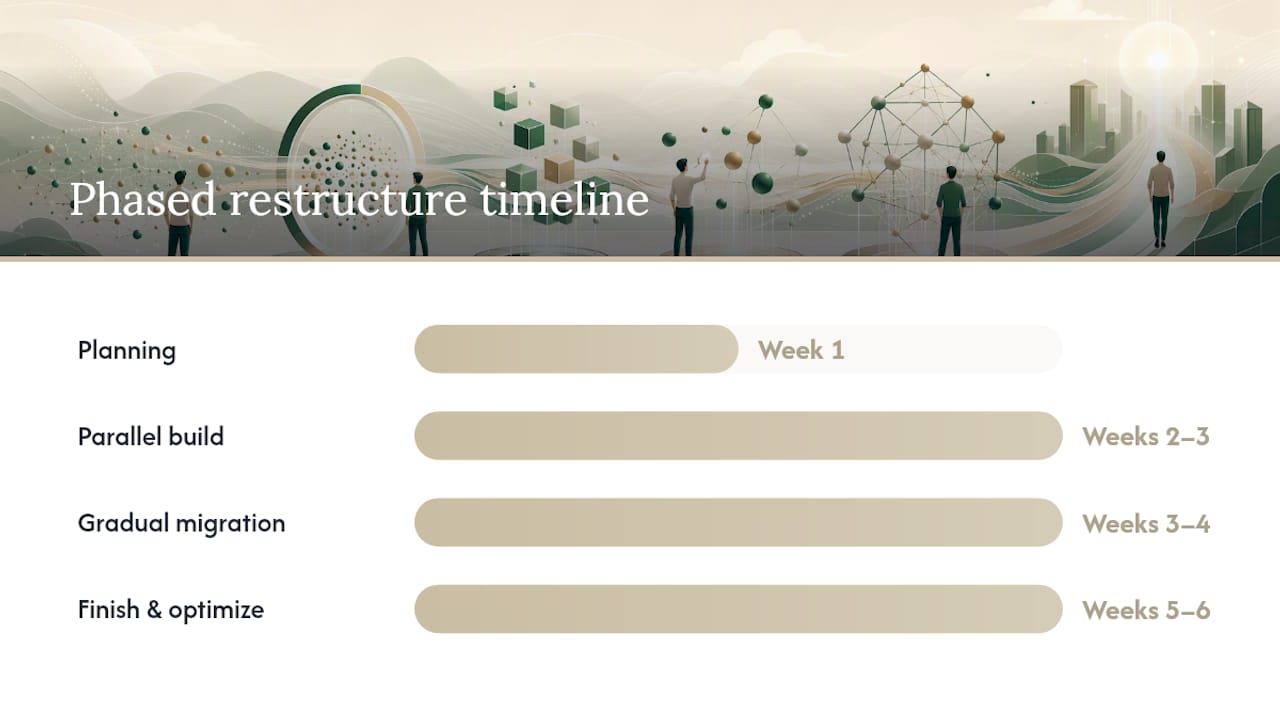
Don’t flip a switch on your whole account in one afternoon. Build the new structure in parallel, migrate budget gradually, and monitor before you commit further. The rough timeline:
- Phase 0, Planning (Week 1): Finish your audit, tag preserve-list items, draft the new campaign map, and get stakeholder sign-off on the plan and the expected dip.
- Phase 1, Parallel build (Weeks 2 to 3): Build new campaigns alongside the old ones, paused. Load enhanced conversions, audience signals, and negative lists before anything goes live.
- Phase 2, Gradual migration (Weeks 3 to 4): Shift 20 to 30% of budget into new campaigns while old ones keep running. Watch daily CPA and conversion volume; only move more budget once new campaigns show stable performance for 3 to 5 consecutive days.
- Phase 3, Finish and optimize (Weeks 5 to 6): Once new campaigns match or beat old performance, pause (don’t delete) the legacy campaigns and shift the remaining budget over.
Track these daily during migration: conversion rate, cost per conversion, and Smart Bidding status (in learning vs. stable). Weekly, check search term overlap and impression share.
Keep your top converters running untouched through Phase 1 and most of Phase 2. If Performance Max and Search are both active, define clear boundaries with negative keywords and audience exclusions, since structure directly shapes how the two compete for the same inventory. Run any risky change as an experiment first rather than a full swap.
Risks, Common Pitfalls, and a Rollback Plan
Expect a short dip, usually 1 to 3 weeks, while Smart Bidding relearns the new structure. That’s normal, not a sign of failure.
The mistakes that turn a normal dip into a real problem:
- Moving or pausing a proven top converter mid rollout instead of after parity is confirmed.
- Forgetting to carry over shared negative keyword lists into new campaigns.
- Setting new conversion goals that don’t match what the old structure was optimizing toward.
Pro Tip: Keep old campaigns paused, not deleted, for at least 60 days. If the new structure underperforms after two full weeks with no recovery trend, you can reactivate the legacy campaigns same-day and regroup.
Loop stakeholders in before the dip starts, not after someone asks why revenue looks soft.
North Country Consulting’s Senior-Led Take on Restructuring
North Country Consulting runs restructures through senior oversight, not junior account managers following a template. That’s the operational difference behind an 8.7x average return on ad spend across managed accounts. If you’re spending under $25,000 a month, a careful DIY restructure using the phases above is reasonable. Above that, the risk of a bad rollback usually outweighs the cost of a free audit.
Why the “Set It and Forget It” Advice on Restructuring Is Wrong
The conventional advice treats restructuring as a one-time event: audit, rebuild, done. That’s backwards. The Hagakure, automation-first mindset that’s reshaping account structure in 2026 treats consolidation as an ongoing discipline, not a project with an end date. Smart Bidding’s appetite for data doesn’t stop growing once you hit 30 conversions a month, it keeps rewarding accounts that keep feeding it clean signals through enhanced conversions and audience data.

Where most guidance falls short is the false confidence around timelines. Plenty of articles promise recovery in “one to two weeks” like it’s a guarantee. It’s a range, not a schedule, and it depends heavily on how much conversion history your new structure inherits versus starts from scratch.
If you take one thing from this: prioritize the audit over the rebuild. A rebuild without a documented baseline is a bet, not a strategy. Every senior operator I’d trust with a five figure monthly budget starts there, not with campaign creation.
— Eric
Get a Senior-Led Audit Before You Rebuild Anything
North Country Consulting is the alternative to trial-and-error restructuring: instead of a junior account manager applying a generic template, a senior strategist audits your actual account and tells you exactly what to preserve, consolidate, or cut before anything changes.

The free Google Ads strategy audit examines your conversion tracking setup, ad group overlap, Smart Bidding data density, and budget allocation, then flags where revenue is leaking before you commit to a rebuild. It’s built for businesses spending $25,000 or more per month on Google Ads, where a botched restructure carries real downside and a good one compounds fast. Clients get a documented plan, not a generic checklist, backed by the same senior oversight behind North Country Consulting’s managed accounts. If your account matches the signs of decay covered above, request the audit and get a specific read on what to fix first.
Sources
Before touching your account, review Google’s account structure guidance, the Smart Bidding learning documentation, and Search Engine Land’s restructure playbook. For execution, a keyword clustering tool speeds up grouping keywords by intent before you rebuild ad groups.
- The ABCs of account structure – Google Ads Help
- When to restructure your Google Ads account – and how to do it right | Search Engine Land