
Geo testing uses geographic regions as the unit of comparison to measure the causal lift of paid search spend, and it’s worth running when you have enough geo-level conversion volume and budget to power a design like a holdout, go-dark, or heavy-up test. If your campaigns target a single country and convert consistently by location, you have the raw material. If volume is thin or campaigns span many countries, check feasibility before committing a quarter of spend to it.
TL;DR:
- Geo testing requires sufficient conversion volume in each region and a comparable number of geos to ensure reliable results, especially in multi-country campaigns.
- Campaign structure must isolate spend by geo and budgets must be locked during testing to prevent Smart Bidding from redistributing spend and invalidating holdouts.
- Google’s native Conversion Lift tool covers campaigns targeting a single country and is limited to one active study per campaign, with higher budgets needed for meaningful results.
- The most common failure mode is operational, caused by automated budget reallocation, which can be mitigated with careful campaign setup and daily checks.
- Running pretest periods at least three times as long as the planned test helps ensure model stability and accurate attribution of lift.
Table of Contents
- When to use geo tests vs other measurement approaches
- Core geo experiment designs and practical trade-offs
- Google Ads native geographic Conversion Lift: eligibility and limitations
- Statistical approaches: Meridian GeoX, time-based regression, and synthetic control
- Operational checklist to prepare and run a geo test for paid search
- Analyzing and interpreting geo experiment results
- Applying geo test learnings to attribution and ongoing measurement
- Practical lessons and mitigations from senior-led PPC practice
- Author perspective: prioritizing geo testing in a measurement roadmap
- How North Country Consulting can help you run geo tests that hold up
- FAQ
- Sources
When to use geo tests vs other measurement approaches
Geo testing earns its complexity when you need a causal, privacy-safe read on incrementality that platform-reported conversions can’t give you, or when you’re calibrating a marketing mix model and need clean priors instead of guesses. It’s also the right call when cookie or device-level signal loss has made user-level holdout tests unreliable.
It’s the wrong tool when your conversion volume is too thin to power any design, or when a faster, cheaper user-based randomized experiment (a standard A/B holdout within one geography) would answer the same question with less operational overhead. User-based tests also fit better when your audience is concentrated in one metro area with no meaningful regional split to test against.
Before committing, run through a short feasibility check:
- Conversion volume: you need enough daily conversions per geo to detect a realistic lift, not just enough to hit a monthly goal.
- Geo count: most designs need a reasonable number of comparable regions to split into test and control groups.
- Budget signal: geography-based lift studies typically require higher budgets than user-based alternatives, so confirm spend can sustain a multi-week test without starving other campaigns.
- Campaign scope: single-country campaigns are easiest to test; multi-country campaigns need restructuring first.
Core geo experiment designs and practical trade-offs
Three designs cover most paid search use cases, and the choice usually comes down to how much budget risk you can tolerate against how precise an answer you need.
- Holdout (holdback): you pause or heavily reduce spend in a subset of geos while running normally everywhere else, then compare conversion trends. It’s the standard choice for measuring incrementality of an always-on campaign, and it keeps contamination risk low because the control geos simply don’t see the change. The trade-off is lost revenue in held-out markets for the test’s duration, usually several weeks depending on conversion cycle length.
- Go-dark / heavy-up: go-dark turns spend off entirely in selected geos to measure the full incremental contribution of paid search there; heavy-up does the reverse, increasing spend in selected geos to test whether more budget produces proportional lift. Go-dark tests answer “does this channel matter at all,” while heavy-up tests answer “where should the next dollar go.” Both carry real revenue risk if the wrong geos are picked.
- Multi-cell / geo split: you divide geos into more than two groups, each receiving a different budget or bid treatment, which lets you test multiple hypotheses in parallel. This design needs more geos and more budget to stay powered, but it’s efficient when you’re comparing, say, three bid strategies instead of running three sequential tests.
For paid search specifically, campaign-level architecture matters more than the statistical design: a holdout only works if the campaign structure actually isolates spend by geo, which means separate campaigns or location exclusions, not shared budgets with geo bid adjustments layered on top.
Google Ads native geographic Conversion Lift: eligibility and limitations
Google Ads includes a built-in Conversion Lift product for geography-based testing, and it’s worth understanding its constraints before building anything custom.
- Campaigns must target a single country, and you can run only one active lift study per campaign at a time, which rules out testing multiple hypotheses on the same campaign simultaneously according to Google’s eligibility rules.
- Only certain campaign types qualify, so confirm eligibility before planning a launch date around it.
- Reports surface iROAS (incremental return on ad spend), incremental conversion counts, and status labels such as “Significant positive iROAS,” “No significant lift detected,” or “Not enough data,” per Google’s Conversion Lift measurement documentation.
- Geography-based studies generally need a higher budget than user-based lift studies, so smaller advertisers may get stuck at “Not enough data” longer than expected.
- When a study stalls or returns inconclusive results repeatedly, escalating to a Google account representative is often faster than troubleshooting alone, since eligibility and data thresholds aren’t always transparent from the interface. For campaigns running across different campaign types, confirming support for lift measurement ahead of launch avoids wasted setup time.
Statistical approaches: Meridian GeoX, time-based regression, and synthetic control
Three counterfactual methods dominate modern geo testing, and each makes different assumptions about how test geos would have behaved without the campaign change.
- Time-based regression (TBR) models the relationship between test and control geos during the pretest period, then predicts what the test geos would have done during the test period absent any change, attributing the difference to the treatment.
- Synthetic control builds a weighted composite of control geos that closely tracks the test geo’s pretest trend, which works well when no single control geo is a good match on its own.
- Synthetic difference-in-differences blends both approaches, combining the weighting logic of synthetic control with the baseline-adjustment logic of difference-in-differences.
Meridian GeoX, Google’s open-source geo-experiment framework, implements all three alongside stratified sampling and design-aware placebo inference, a method that runs the analysis against historical periods with no real treatment to check how often the model would falsely detect lift. This design-aware inference approach is what Meridian GeoX uses to lower the minimum detectable effect and control false positives, which matters because a model that looks precise but isn’t calibrated against its own noise will overstate confidence in a real test.
Before trusting any readout, run three diagnostics:
- Residual checks: confirm the model’s pretest predictions track actual conversions closely, with no systematic drift.
- Placebo distribution: rerun the model on periods with no real treatment and confirm it doesn’t flag false lift at a troubling rate.
- Sensitivity to geo assignment: reshuffle which geos sit in test versus control and check whether the estimated lift holds up or swings wildly.
Operational checklist to prepare and run a geo test for paid search
Getting the statistics right means nothing if the underlying data or campaign setup is broken. Work through this sequence before launch.
- Prepare daily geo-level time series. You need date, location, gross conversions, and spend where the design requires it. Meridian’s pretest data guidance recommends a pretest period at least three times the length of the planned test, so a multi-week test needs a correspondingly longer clean pretest history.
- Use gross, not net, conversions. Net figures that reflect refunds or adjustments introduce negative or inconsistent values that corrupt the model; apply net-to-gross corrections after the analysis, not before.
- Select and stratify geos. Group geos by size and category first, then assign test and control within each stratum so you’re not comparing a major metro to a rural region.
- Run power calculations. Confirm your geo count and conversion volume can detect a realistic minimum detectable effect before committing budget; if volume is too low, consider proxy metrics like branded search volume as secondary evidence while the primary metric builds sample size.
- Lock campaign architecture. Separate campaigns by geo, lock budgets so Smart Bidding can’t reallocate spend out of test geos, and add location exclusions where needed to prevent bleed between groups. Keeping landing pages and offers constant across geos, a point covered in more depth in our guide to landing page optimization, removes one more variable that could muddy the read.
- Save the design file and audit log. Store the JSON design and analysis config so the exact geo assignments and methodology can be reproduced later for audits or MMM integration.
Pro Tip: Wait until you have enough conversions in each geo before making any bid adjustment based on early results, since early swings are usually noise, not signal.
Analyzing and interpreting geo experiment results
Once the test period ends, prioritize four readouts over everything else: the point estimate of lift, its confidence interval, the p-value, and the efficiency metric, iROAS for revenue-based campaigns or iCPD (incremental cost per driver action) for lead-gen.
- A tight confidence interval around a positive lift estimate is a usable result; a wide interval straddling zero isn’t, regardless of what the point estimate says.
- Google’s Conversion Lift reports use status labels like “Significant positive iROAS” or “No significant lift detected” to flag whether the result clears a statistical bar, and those labels are worth trusting over a raw number pulled in isolation.
- Build in a cooldown period before closing the test, especially for longer conversion cycles. Meridian’s analysis configuration supports extending the analysis end date to capture conversions that complete after the treatment period ends.
If the test shows lift, translate it into action: adjust budget allocation toward the geos or tactics that drove it, use the measured incrementality as a correction factor against platform-attributed conversions, and feed the result into MMM priors for longer-term planning.
If the test shows no lift, don’t assume the channel doesn’t work. Check for segment-level effects that a blended result might hide, fall back to proxy metrics if the primary conversion signal was too sparse to power the test properly, and consider extending the test window or rerunning with a better-powered design before concluding anything.
Applying geo test learnings to attribution and ongoing measurement
A geo test’s real value shows up after the test ends, when you use the measured lift as a correction factor rather than a one-time finding.
- Convert lift into a multiplier. If a geo test shows paid search drives meaningfully more conversions than last-click attribution credits it for, apply that ratio as a calibration factor against platform-reported numbers going forward.
- Feed the result into MMM priors. A marketing mix model calibrated with real experimental data produces tighter, more defensible budget recommendations than one built on correlational history alone.
- Set a testing cadence. Rotating geo tests on a recurring schedule, or running an always-on panel of control geos, catches drift as seasonality, competition, and creative change the underlying relationship between spend and conversions.
Treat each test as one data point feeding a longer calibration process, not a single verdict that settles the question permanently.
Practical lessons and mitigations from senior-led PPC practice
The most common way a geo test fails isn’t a statistical error, it’s an operational one. Smart Bidding reallocates budget away from suppressed geos the moment it detects a performance drop, quietly undoing the holdout within days. The fix is locked, separate campaign budgets per geo group, checked daily during the test, not just at setup.
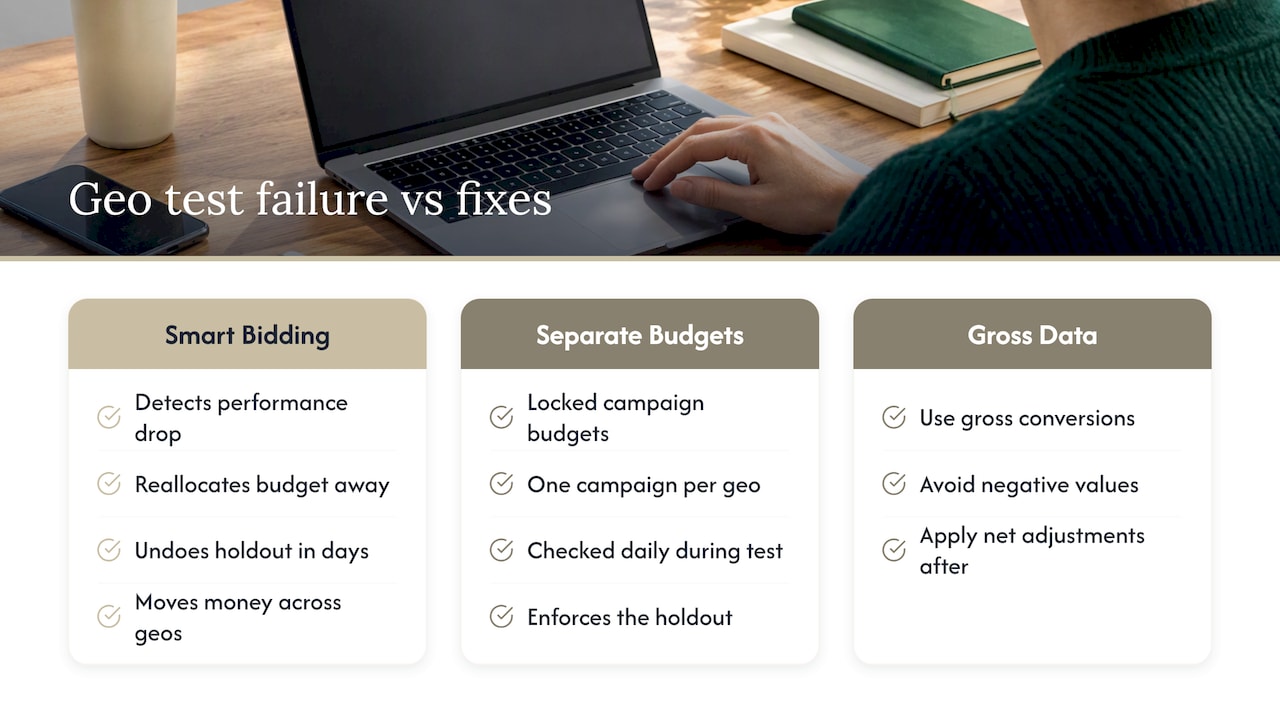
The second most common failure is using net conversion data (post-refund, post-cancellation) as the input, which introduces negative values the models aren’t built to handle. Gross figures, with net adjustments applied after analysis, keep the math clean.
When a client’s campaign structure can’t cleanly isolate geos, we recommend restructuring into separate campaigns before testing rather than layering a geo experiment on top of a shared-budget setup that was never built to support one.
A holdout is only as good as the campaign architecture enforcing it. If Smart Bidding can move money across the line you drew, you don’t have a holdout. You have a suggestion.
Author perspective: prioritizing geo testing in a measurement roadmap
Geo testing earns its place on a measurement roadmap when a budget decision is big enough that being wrong costs more than the test does. For a campaign spending a meaningful share of monthly budget, a few weeks of reduced spend in test geos is cheap insurance against scaling the wrong channel for another year.
The pitch to leadership works best framed as a trade-off, not a request: a known cost in time and short-term spend against the alternative of making permanent budget decisions on attribution data everyone already distrusts. Get finance, analytics, and the paid search team aligned on the geo split before launch, not after someone notices a region went quiet.
— Eric
How North Country Consulting can help you run geo tests that hold up
We manage Google Ads accounts for businesses spending $25,000 or more a month, and the same senior-led oversight we apply to account restructuring and attribution rebuilding is what keeps a geo test’s campaign architecture from leaking budget mid-test.

If you’re not sure your account can support a geo test yet, our free Google Ads audit checks campaign structure, conversion tracking, and budget allocation first, the same groundwork a geo test needs to produce a trustworthy result.
- Senior oversight on accounts
- Full-funnel campaign architecture designed to isolate variables
- Attribution and conversion tracking reviewed before tests launch
| Who this fits | What we offer | Where to start |
|---|---|---|
| Marketers spending $25,000+/month on Google Ads | Google Ads management, account restructure, attribution rebuild | Free Google Ads Audit |
| Teams running ChatGPT Ads at $10,000+/month | Senior-led ChatGPT Ads management and pixel setup | ChatGPT Ads agency |
FAQ
What is geo testing in paid search?
Geo testing measures the causal impact of paid search spend by comparing conversion outcomes across different geographic regions, some treated with a change and some held as controls. It answers whether a campaign is actually driving incremental conversions rather than just taking credit for ones that would have happened anyway.
How many conversions do I need before running a geo test?
There’s no universal conversion threshold since it depends on your geo count, baseline variance, and the minimum lift you need to detect. Run a power calculation against your own historical conversion data before committing budget, and if volume looks too thin, consider proxy metrics like branded search volume as a secondary signal.
Can I run Google’s native geo Conversion Lift on any campaign?
No. Google Ads requires the campaign to target a single country and allows only one active lift study per campaign, and only certain campaign types are eligible. Multi-country campaigns need restructuring before a native lift study will run.
What’s the biggest reason geo tests fail?
The most common cause is operational, not statistical: Smart Bidding or account automation reallocates budget away from held-out geos during the test, which quietly undoes the holdout. Locking budgets by campaign and checking them daily during the test window prevents this.
How long should a geo test’s pretest period be?
Meridian’s pretest data guidance recommends a pretest period at least three times the length of the planned test to ensure stable modeling, so longer tests require correspondingly longer clean historical data beforehand.
Sources
- Meridian GeoX: An open-source framework for precision and efficiency in geo experiments
- Prepare your pretest data | Meridian | Google for Developers
- Conversion Lift based on geography — Google Ads Help