
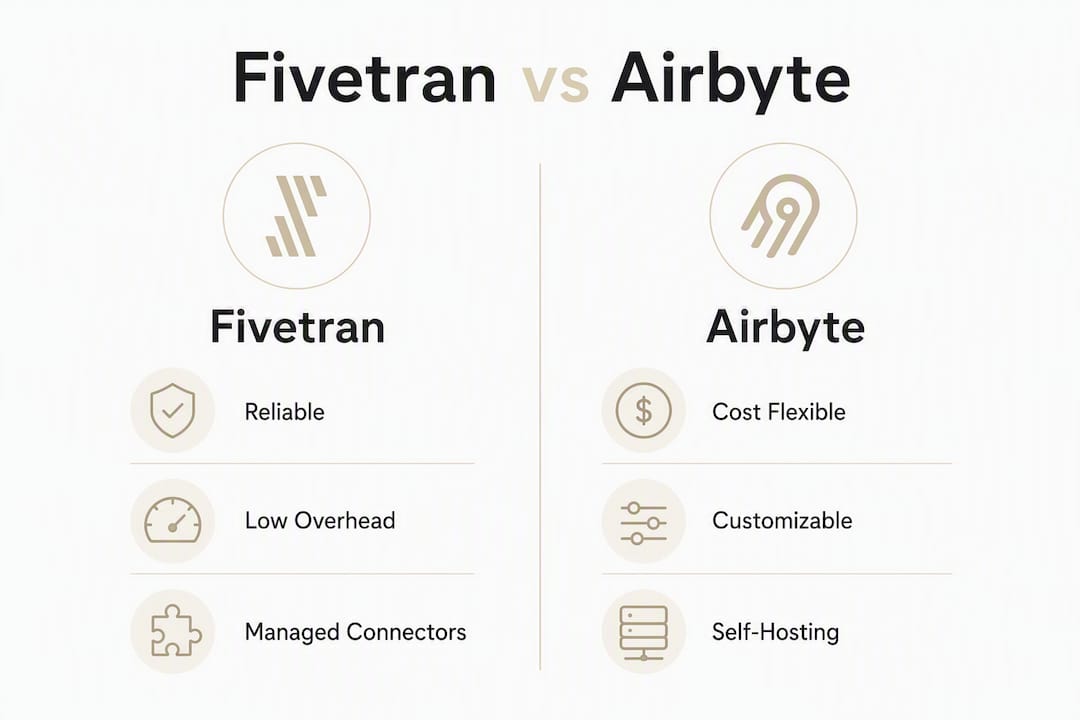
Marketing teams without dedicated data engineers should pick Fivetran. Engineering-heavy teams that need cost control at scale should pick Airbyte. That’s the short version, and it holds for the vast majority of ad-ops and growth teams.
The core trade-off, as analysts at Fairview frame it, is managed reliability vs. control. Fivetran handles connectors, schema drift, and SLAs so your team doesn’t have to. Airbyte hands you the controls and the maintenance bill. For teams running Google Ads or ChatGPT Ads measurement through Snowflake or a dbt pipeline, a broken connector isn’t a minor inconvenience. It’s a gap in conversion data that corrupts ROAS reporting until someone fixes it.
The caveat: if you have strict data residency requirements or you’re ingesting extremely high-volume event tables where Fivetran’s Monthly Active Rows (MAR) pricing would spike your bill, Airbyte’s self-hosted option deserves a serious look.
- Fivetran is best when your bottleneck is engineering time, not budget.
- Airbyte is best when your bottleneck is budget, and you have the engineers to absorb the ops work.
- SOC 2 compliance, enterprise SLAs, and automated schema handling tip the scale toward Fivetran for most ad-measurement stacks.
Table of Contents
- Key Takeaways: Fivetran vs Airbyte at a Glance
- How this pipeline choice affects your ads measurement
- What reliable pipelines mean for your ad spend
- Useful sources and further reading
Key Takeaways: Fivetran vs Airbyte at a Glance
Fivetran wins on reliability and low ops overhead; Airbyte wins on cost flexibility and customization, but only if your team can staff the maintenance.
| Point | Details |
|---|---|
| Managed reliability vs. control | Fivetran eliminates pipeline maintenance; Airbyte shifts that burden to your engineers. |
| Pricing risk | Fivetran’s MAR model can cause bill shock on event-heavy sources; Airbyte’s self-hosted core is free but carries infrastructure costs. |
| Connector quality | Fivetran’s connectors are vendor-maintained and SLA-backed; Airbyte’s community connectors vary and may need customer upkeep. |
| Engineering threshold | Teams with fewer dedicated data engineers typically benefit more from Fivetran; teams with more engineers can often recoup Airbyte’s self-host savings over time. |
| North Country Consulting | For ad-measurement stacks, North Country Consulting recommends Fivetran for most marketing teams and a hybrid approach for high-volume event sources. |
Three next steps for your evaluation:
- Run a trial with real ad-platform connectors (Google Ads, Meta, Salesforce). Connector reliability on your actual sources matters more than the total connector count.
- Pilot a parallel run for 2–4 weeks before cutting over. Small migrations typically complete in a few weeks; enterprise migrations with many connectors take longer periods.
- Audit your MAR exposure before committing to Fivetran. Pull a 90-day row count from your highest-frequency event sources and model the cost at your expected tier.
A hybrid approach is worth considering: managed connectors for mission-critical ad-platform sources, self-hosted connectors for high-volume or niche sources. That balance keeps attribution clean where it counts while controlling costs on the long tail.
For a broader look at how marketing data integration tools compare on reporting and campaign optimization, the trade-offs follow a similar pattern.
How this pipeline choice affects your ads measurement
The Fivetran vs Airbyte decision hits differently for ad-ops teams than it does for general data engineering. When a connector breaks or a schema change drops a column, you don’t just lose a table. You lose conversion attribution. Misattributed ROAS, missing click IDs, and broken UTM joins are the downstream result, and they can persist for days before anyone notices.

Connector reliability and automated schema drift handling are often more valuable for marketing measurement than marginal connector breadth, precisely because broken ingestion breaks attribution directly. Fivetran’s automated schema migration and native dbt integration address this. Airbyte’s community connectors, by contrast, should be treated as beta-quality for mission-critical flows until thoroughly tested.
Resource math for self-hosting: Self-hosting Airbyte requires ongoing DevOps for upgrades, connector fixes, and incident response, and teams routinely underestimate that maintenance work by 2–3× initially. If your ad-measurement stack runs on fewer than two dedicated data engineers, Fivetran’s managed cost is almost always cheaper than the hidden labor.
For teams measuring ChatGPT Ads ROI or running full-funnel Google Ads attribution, the evaluation checklist should include: column-level lineage confirmation, dbt integration, SLA coverage for your ad-platform connectors, and a realistic model of engineering hours vs. vendor spend.
What reliable pipelines mean for your ad spend
Fivetran and Airbyte solve the ingestion layer. What you do with clean data is where the real return lives.
North Country Consulting manages substantial ad spend with a high average ROAS, and a significant share of that performance comes from measurement infrastructure that actually works. Schema drift, broken connectors, and unvalidated attribution models are among the most common sources of wasted spend North Country Consulting finds during free audits. The free Google Ads or ChatGPT Ads audit surfaces those gaps directly, with a concrete estimate of incremental ROAS potential. Senior-led teams handle attribution model rebuilding, call tracking integration, and data quality checks as part of every engagement. If your pipeline decision is still in progress, that audit is a practical starting point.
Useful sources and further reading
The sources below are worth bookmarking for different stages of your evaluation.
| Source | What it covers | Best for |
|---|---|---|
| Gartner Peer Insights: Airbyte vs Fivetran | Verified user reviews (Airbyte: 4.6★/65 reviews; Fivetran: 4.6★/295 reviews) | CMOs validating vendor credibility |
| DataStackGuide: Fivetran vs Airbyte | Pricing risk, MAR modeling, migration timelines | Data leads scoping TCO |
| Fairview: Managed vs Open-Source ETL | Analyst framing of the managed reliability vs. control trade-off | Anyone starting the evaluation |
| Fivetran blog comparison | Fivetran’s own feature and pricing breakdown, MAR model detail | Teams auditing bill-shock risk |
| Airbyte comparison page | Airbyte’s CDK, self-hosting options, and connector library | DevOps leads evaluating infra requirements |
Reading order by role:
- CMO: Start with Gartner Peer Insights for social proof, then Fairview for the strategic framing.
- Data lead: Go directly to DataStackGuide for TCO modeling and migration timeline estimates.
- DevOps: Airbyte’s comparison page covers deployment architecture; pair it with the Valiotti write-up on self-hosting ops burden.
On trials and parity testing: both platforms offer trial access. Run them against the same source connector simultaneously, compare row counts and schema fidelity, and track any drift events over a two-week window. That test alone will tell you more than any feature matrix. Analytics-driven measurement consistently produces better outcomes when the ingestion layer is validated before campaigns scale.