
First-party data ads are advertising programs built on customer data you collect and control, used to seed, optimize, and measure paid campaigns without relying on third-party cookies. The payoff shows up in tighter targeting, better match rates, and steadier performance as platform signals keep getting noisier. Three things to do this week:
- Unify identity first. Merge CRM, checkout, and website behavioral data into one clean customer record before you send anything to an ad platform.
- Segment your top-LTV customers. Build seed audiences from your highest-value buyers, and separate suppression lists for anyone who shouldn’t see prospecting ads.
- Connect hashed audiences to your platforms. Use Customer Match, server-side events, or Ads Data Hub joins to get that data working inside Google Ads.
Pro Tip: Algorithmic bidding systems learn fastest from a small, high-quality seed list. A tight 500-customer list of your best buyers usually outperforms a messy 50,000-row export.
Key Takeaways
First-party data ads work because clean, consented customer signals produce better match rates, better algorithmic optimization, and revenue that platform-reported metrics alone can’t fully explain.
| Point | Details |
|---|---|
| Unify identity first | Merge CRM, web, and POS records into one profile before uploading anything to an ad platform. |
| Seed with your best customers | Build lookalike audiences from your top-LTV segment rather than your full customer list. |
| Set match-rate expectations | Plan for modest match rates on hashed uploads, not perfect matching. |
| Triangulate measurement | Combine platform metrics, post-purchase surveys, and MMM instead of trusting one attribution source. |
| Audit before scaling | Check event-match quality and audience freshness monthly, not once at setup. |
Where to Learn More About First-Party Data Advertising
Start with the platform documentation itself before turning to secondary guides. Google’s Ads Data Hub join guide covers join keys and match-rate realities in more technical detail than any third-party summary. Google’s own privacy strategy playbook lays out the business case for first-party data at the platform level.
- What Is First-Party Data? Definition & Examples — Braze
- First-party data: Definition, examples & guide — HubSpot
- Identity resolution — Braze
- Babylovegrowth
For identity-resolution best practices specifically, the Braze guide above breaks down why resolving touchpoints into a single profile before syndication improves match quality more than any single ad-platform setting.
Table of Contents
- What Is First-Party Data in Advertising?
- Why Does First-Party Data Matter for Ads Now?
- How Do You Collect First-Party Data Effectively?
- How Do You Activate First-Party Data in Ad Platforms?
- What Measurement Methods Work Best With First-Party Data?
- What Does Good Consent and Governance Look Like?
- Which Tools Handle Collection, Unification, and Activation?
- How North Country Consulting Builds First-Party Data Into Ad Accounts
- Sources
What Is First-Party Data in Advertising?
First-party data is information you collect directly from customers, with their consent, through channels you own: your website, your app, your point-of-sale system, your loyalty program. It’s exclusive to your brand and reflects what people actually did, not a modeled guess about what they might do.
The formats you’re working with are more varied than most teams realize:
- CRM records (contact details, purchase history, service tickets)
- Website behavioral events (page views, add-to-cart, form fills)
- In-app events (installs, in-app purchases, feature usage)
- POS transactions from physical retail locations
- Loyalty program data (points activity, redemption patterns)
- Zero-party data from surveys and preference centers (customers telling you directly what they want)
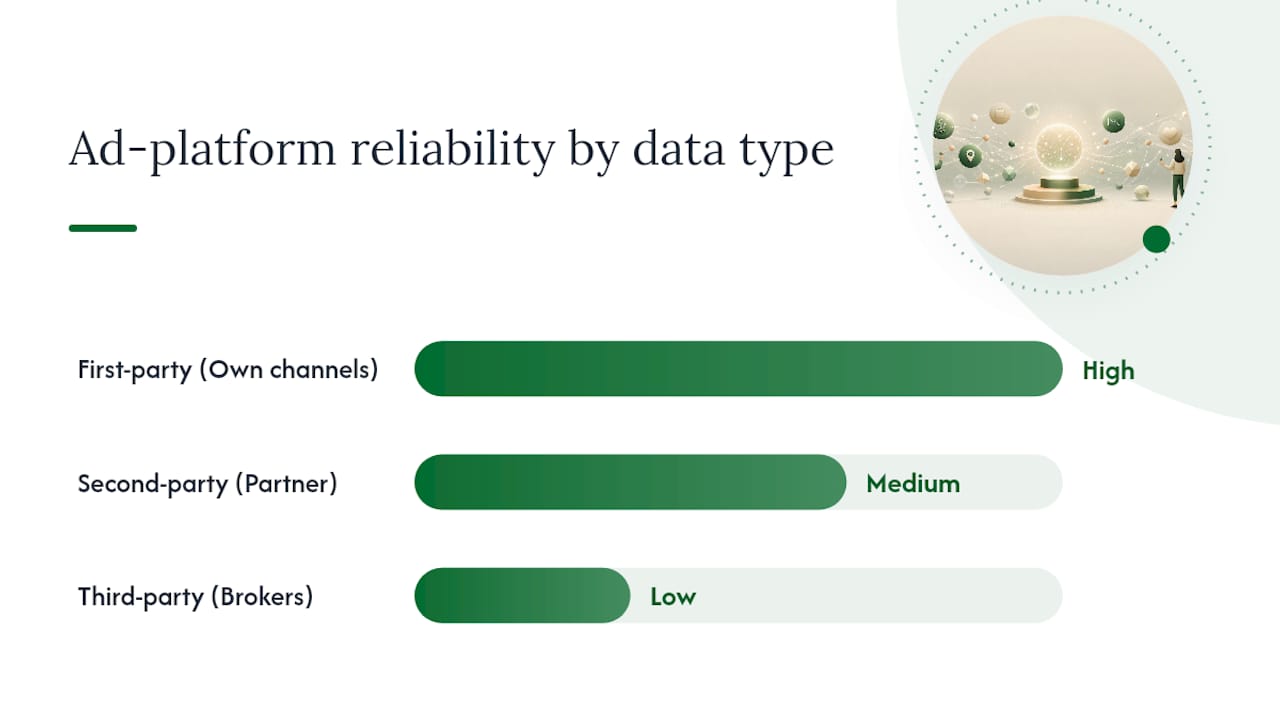
Here’s how the three data types stack up for advertising use:
| Data Type | Source | Ad-Platform Reliability |
|---|---|---|
| First-party | Your own channels, consented | High. Verified behavior, brand-owned |
| Second-party | Another company’s first-party data, shared directly | Medium. Depends on partner data quality |
| Third-party | Aggregated from many sources by data brokers | Low. Modeled, increasingly restricted |
Third-party data was never yours to begin with, which is exactly why it’s disappearing as browsers and regulators clamp down on it.
Why Does First-Party Data Matter for Ads Now?
Signal loss changed the math. As cookies get restricted and platforms compress the targeting signals available to advertisers, the accounts that keep winning are the ones feeding clean, verified customer data back into the system. Google’s own guidance is blunt about the payoff: advertisers who use first-party data effectively can generate double the incremental revenue from a single ad placement compared to those who don’t.
That’s not a marginal edge. It’s the difference between an account that degrades every time a browser update ships and one that gets more efficient over time because it’s optimizing against real purchase and LTV data instead of a proxy.
A few reasons this compounds:
- Competitors can buy media, but they can’t buy your customer list. That makes first-party data one of the few durable assets left in paid media strategy.
- Automated bidding systems (Performance Max, Smart Bidding) need clean conversion signals to optimize correctly. Feed them noise, and you get noisy results.
- First-party signals let you optimize toward margin and lifetime value instead of just last-click conversions, which changes who your campaigns actually target.
How Do You Collect First-Party Data Effectively?
Collection happens at every point a customer touches your business, but most teams only instrument two or three of them. Here’s the fuller list:
- Web forms and gated content
- Logged-in website and app sessions
- Checkout email capture
- App install and device identifiers (RDIDs)
- Point-of-sale transactions in physical locations
- Loyalty program enrollment and activity
- Post-purchase surveys and preference centers
Getting people to actually opt in is the harder problem. Value exchange is what moves the needle:
- Offer early access to new products or sales for subscribers.
- Give loyalty members tangible perks (points, free shipping, birthday discounts).
- Send back-in-stock alerts that require an email or phone number.
- Use progressive profiling. Ask for one more data point at each interaction instead of a 12-field form up front.
None of this matters if the data underneath is dirty. Data hygiene has to be routine, not a once-a-year cleanup project:
- Deduplicate customer records across systems before uploading anything to an ad platform.
- Strip hard bounces and invalid emails on a regular cadence.
- Segment by behavior and LTV, not just demographics.
- Refresh audience lists on a schedule (weekly or biweekly for active campaigns) so platforms aren’t matching against stale data.
Pro Tip: A loyalty program with a clear points ledger tends to produce your cleanest first-party dataset because customers self-correct their own contact info to keep earning rewards.
How Do You Activate First-Party Data in Ad Platforms?
Activation is where most of the value gets lost, usually because the handoff from CRM to ad platform is sloppy. The flow that works:
- Segment your customer list by value and recency (top 10% LTV, recent purchasers, lapsed customers).
- Hash the identifiers (email, phone) using SHA-256 before upload. Never send raw PII.
- Upload to Customer Match in Google Ads or the equivalent Custom Audiences feature on other platforms.
- Build lookalike or “similar” seed audiences from your top-LTV segment.
- Create suppression lists so existing customers don’t see cold prospecting creative.
Server-side event forwarding matters just as much as the list upload. Tools like Conversions API on Meta or Enhanced Conversions on Google Ads let you pass hashed identifiers directly from your server, which sidesteps a lot of the tracking loss that happens client-side in a browser. Higher event-match quality translates directly into better optimization, because the platform’s bidding algorithm has more real signal to learn from.
For deeper measurement joins, Ads Data Hub lets you connect your first-party data with Google ad data inside BigQuery, using join keys like RDIDs, Custom Floodlight variables, cookies, or LiveRamp RampIDs. PayPal Ads takes a similar approach on its own network, letting merchants upload customer lists to build matched audiences and lookalikes for targeting.

Pro Tip: *Set match-rate expectations before you scale.
Choosing the right join key depends on your setup. App-heavy businesses lean on RDIDs, offline retail leans on Custom Floodlight variables or POS-linked identifiers, and brands using a data onboarding partner often route through LiveRamp for the cleanest cross-platform match. This kind of audience targeting work is exactly where a clean first-party foundation starts paying for itself in Performance Max and Shopping campaigns.
What Measurement Methods Work Best With First-Party Data?
No single attribution source tells the whole truth in a cookieless environment, which is why a three-layer measurement approach holds up better than chasing one perfect number:
- Platform-reported metrics. Useful for day-to-day optimization, but increasingly modeled rather than directly observed.
- Post-purchase surveys. A simple “how did you hear about us” question at checkout catches attribution that pixels miss entirely.
- Media mix modeling (MMM). Aggregated, privacy-safe, and good for validating whether platform-reported numbers match actual revenue trends.
Ads Data Hub and BigQuery are the right tools when you need privacy-preserving, aggregated measurement that goes beyond what the Google Ads interface shows you. But go in with realistic expectations. Match rates vary by join key and data quality, and ADH enforces aggregation thresholds that block query results below a minimum user count, specifically to prevent re-identification.
Match rates when joining first-party datasets with platform data are often lower than advertisers expect. Planning for that gap, rather than being surprised by it, is what separates teams that trust their numbers from teams that don’t.
Before scaling spend on any first-party segment, run a short diagnostic pass: check event-match quality (EMQ) scores, confirm audience freshness, and look for attribution gaps between what the platform reports and what your CRM shows in actual revenue.
Pro Tip: Run these diagnostics monthly, not once. Audiences decay, and a segment that matched well in January can quietly degrade by April if the underlying list hasn’t been refreshed.
What Does Good Consent and Governance Look Like?
The whole system falls apart without customer trust, so consent design isn’t a legal formality. It’s infrastructure.
Three principles anchor it:
- Transparent privacy notices that explain what data you collect and why, in plain language, not legal boilerplate.
- Purpose-limited use. Data collected for order fulfillment shouldn’t quietly get repurposed for ad targeting without disclosure.
- Easy, one-click opt-outs that actually get honored across every system, not just the one where the customer clicked unsubscribe.
Operationally, governance means:
- Setting clear data retention windows and deleting stale records on schedule.
- Restricting access to raw PII to the smallest team that needs it.
- Standardizing hashing methods (SHA-256 is the common baseline) before any data leaves your systems.
- Building automated suppression for anyone who revokes consent, so they drop out of ad audiences immediately.
Preference centers and progressive profiling tend to produce your highest-quality opt-ins, because customers who choose their own communication cadence stay engaged longer than people swept into a list by a pop-up discount.
Which Tools Handle Collection, Unification, and Activation?
Most first-party data stacks break into five categories, and you don’t need every tool in every category on day one:
- CDP/identity resolution: platforms that unify web, email, and CRM touchpoints into one profile. This is the step that most determines your eventual match rate.
- Server-side event collectors: infrastructure that forwards conversion events directly from your server to ad platforms.
- Analytics/warehouse: BigQuery is the standard destination for teams doing custom joins with Ads Data Hub.
- Audience onboarding: LiveRamp is the common layer for matching offline and CRM data to ad-platform identifiers at scale.
- Ad platform features: Customer Match, Enhanced Conversions, and Performance Max asset groups inside Google Ads.
- CRM-driven activation: Klaviyo is a common example, positioning first-party profiles as a real-time asset you can push into email and ad syndication simultaneously.
Smaller advertisers can often skip a full CDP and get most of the benefit from clean CRM exports plus server-side event tracking. Larger accounts spending well into six figures a month usually need the identity resolution layer, because manual list management stops scaling long before the ad spend does.
How North Country Consulting Builds First-Party Data Into Ad Accounts
A senior-led rebuild starts with an audit: what’s actually being collected, where identity resolution is breaking down, and which segments are worth seeding first. From there, the sequence is consistent: resolve identity, build LTV-based seed segments, connect them through Customer Match or server-side events, then run weekly data reviews alongside a recurring MMM check.
- Diagnostic checks before scaling: event-match quality, audience freshness, and suppression list accuracy.
- Client accounts typically see this pay off fastest in Performance Max and Shopping, where clean signals directly shape algorithmic bidding.
If your account is spending $25,000 or more a month and you’re not sure your first-party signals are actually reaching the platform cleanly, a free strategy audit is the fastest way to find out.
Pro Tip: Ask any agency managing your account for their event-match quality score before you ask about ROAS. A low EMQ score explains a lot of “unexplainable” performance dips.
What Marketers Get Wrong About First-Party Data Ads
The most common mistake is pushing raw, unlinked customer data straight into an ad platform and expecting the algorithm to sort it out. It won’t. The second is ignoring suppression lists, which wastes budget showing prospecting ads to people who already bought. The third is underinvesting in server-side events while over-investing in audience size.
Fix identity resolution first, build small segmented seed audiences second, and audit event-match quality before you scale spend. If there’s one strategic call to make, it’s this: build measurement governance and small-scale holdout tests into your process before you trust any single attribution number.
Sources
- What Is First-Party Data? Definition & Examples — Braze
- Power Your Ad Privacy Strategy with First-Party Data – Google Ads
- Join first-party data | ADH for Marketers | Google for Developers