
ROAS measures revenue returned per dollar of ad spend, but “good” is not a fixed number. It is whatever exceeds your breakeven ROAS, calculated as 1 divided by your gross margin. Skip the industry averages first: pull your last 60 to 90 days of Google Ads data, compute breakeven from your actual margin, and compare the two before touching your Target ROAS setting.
TL;DR:
- A breakeven ROAS depends on gross margin, so a 4x ROAS may be profitable for a 25% margin but not for lower margins.
- Portfolio bidding can help stabilize performance for low-volume accounts, but a minimum of a few dozen conversions per campaign is necessary for reliable data.
- Shopping campaigns generally outperform Search, averaging around 5.1x, while Performance Max results vary based on feed quality and content accuracy.
- Starting Target ROAS too high risks volume collapse; a recommended approach involves setting targets 10% to 20% below the initial baseline and adjusting gradually.
- Accurate conversion value tracking, including margin adjustments and deduplication, is crucial for effective Smart Bidding and realistic ROAS goals.
Table of Contents
- What Is Ecommerce ROAS in Google Ads, and How Does Target ROAS Work?
- What ROAS Benchmarks Should You Expect, and How Do You Calculate Breakeven?
- How Does Campaign Type Change Your ROAS Expectations?
- How Do You Set an Initial Target ROAS Without Killing Volume?
- Which Optimization Levers Move ROAS the Fastest?
- How Do You Keep Conversion Values Accurate for ROAS Reporting?
- How Does North Country Consulting Approach Ecommerce ROAS?
- Is a Higher ROAS Target Always the Right Call?
- Get a Free Audit of Your Google Ads Account
- Sources
- FAQ
What Is Ecommerce ROAS in Google Ads, and How Does Target ROAS Work?
ROAS is a ratio: revenue generated divided by ad spend. That distinction trips up more accounts than any other single misunderstanding in ecommerce advertising, because revenue-based ROAS ignores product cost, shipping, payment processing, and returns entirely.
Target ROAS, or tROAS, is a value-based Smart Bidding strategy. According to Google’s own documentation on Target ROAS bidding, the algorithm uses historical conversion values combined with real-time auction signals, device, location, time of day, audience behavior, to set a unique bid for every auction. It is not one bid for a campaign; it is thousands of micro-decisions per day.
A few mechanics determine whether tROAS will work in your account:
- Conversion minimums matter. Google recommends a baseline volume of recent conversions before trusting a target; portfolios pooling conversions across campaigns often qualify sooner than a single thin campaign.
- Portfolio vs. single-campaign bidding changes how fast the algorithm learns; portfolio strategies share signal across campaigns, which helps low-volume accounts.
- Learning phase behavior means performance often looks worse for one to two weeks after any target change before it stabilizes.
- Conversion-value accuracy is the single input the algorithm trusts most. If you pass gross revenue instead of margin-adjusted values, or if duplicate conversions inflate the numbers, Smart Bidding optimizes toward the wrong outcome with total confidence.
What ROAS Benchmarks Should You Expect, and How Do You Calculate Breakeven?
Blended Google Ads ROAS across ecommerce accounts averaged roughly 4.2x according to a 2026 benchmarks analysis of over 500 Shopify and DTC accounts.
The number that actually matters: breakeven ROAS = 1 ÷ gross margin. A store running a 40% gross margin needs 2.5x just to cover ad costs. That same store hitting a 4x ROAS is banking real profit on every incremental sale, not just clearing the bar.
Run the math for your own account:
The breakeven ROAS depends on your gross margin; for example, a lower gross margin requires a higher ROAS to break even, while a higher margin lowers that threshold.
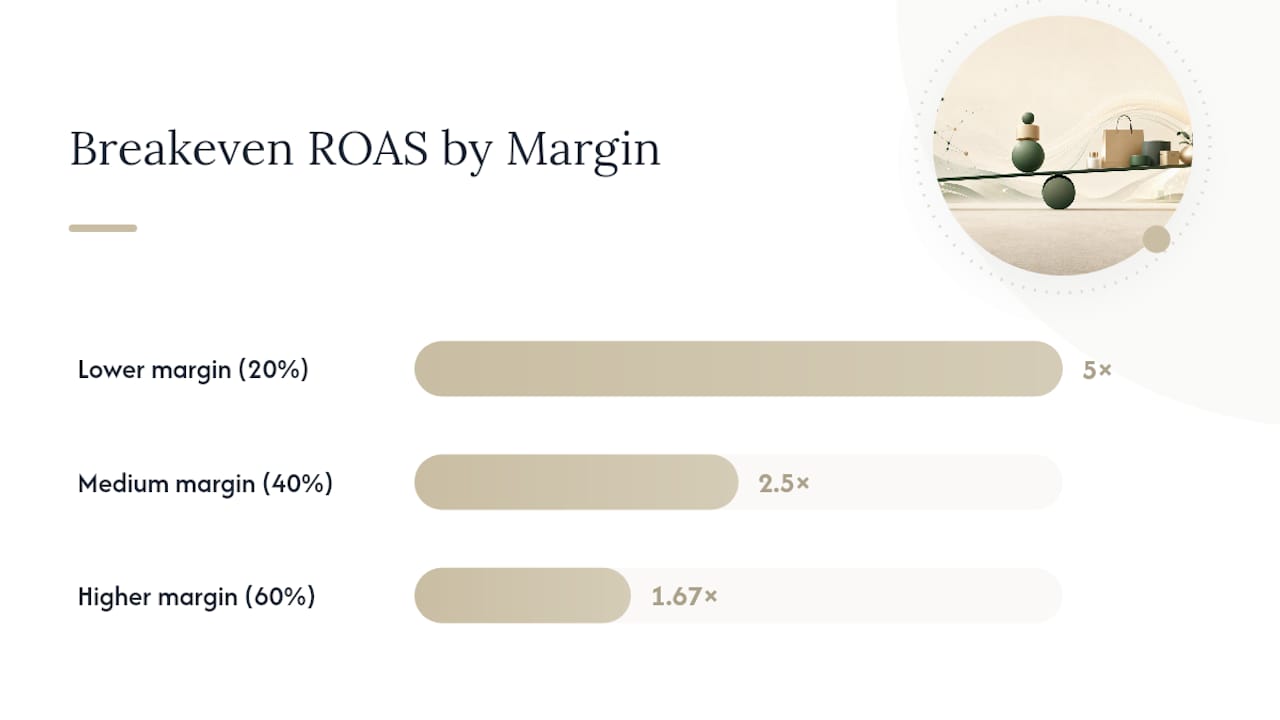
This is why the common question “is a 2.5 ROAS good?” has no universal answer.
Platform-reported ROAS also tends to run hotter than your bank account agrees with. Attribution overlap, view-through conversions, and modeled conversions all inflate the number Google Ads shows you relative to what actually lands in your Shopify order ledger. Treat published benchmarks as a sanity check for whether your account is in the right neighborhood, never as a target to chase blindly.
How Does Campaign Type Change Your ROAS Expectations?
Search, Shopping, and Performance Max play different roles, and expecting identical ROAS from each misreads the funnel.
Shopping campaigns sit in between and often outperform Search overall, averaging 5.1x per the same benchmark data, largely because product images and pricing pre-qualify clicks before they land.
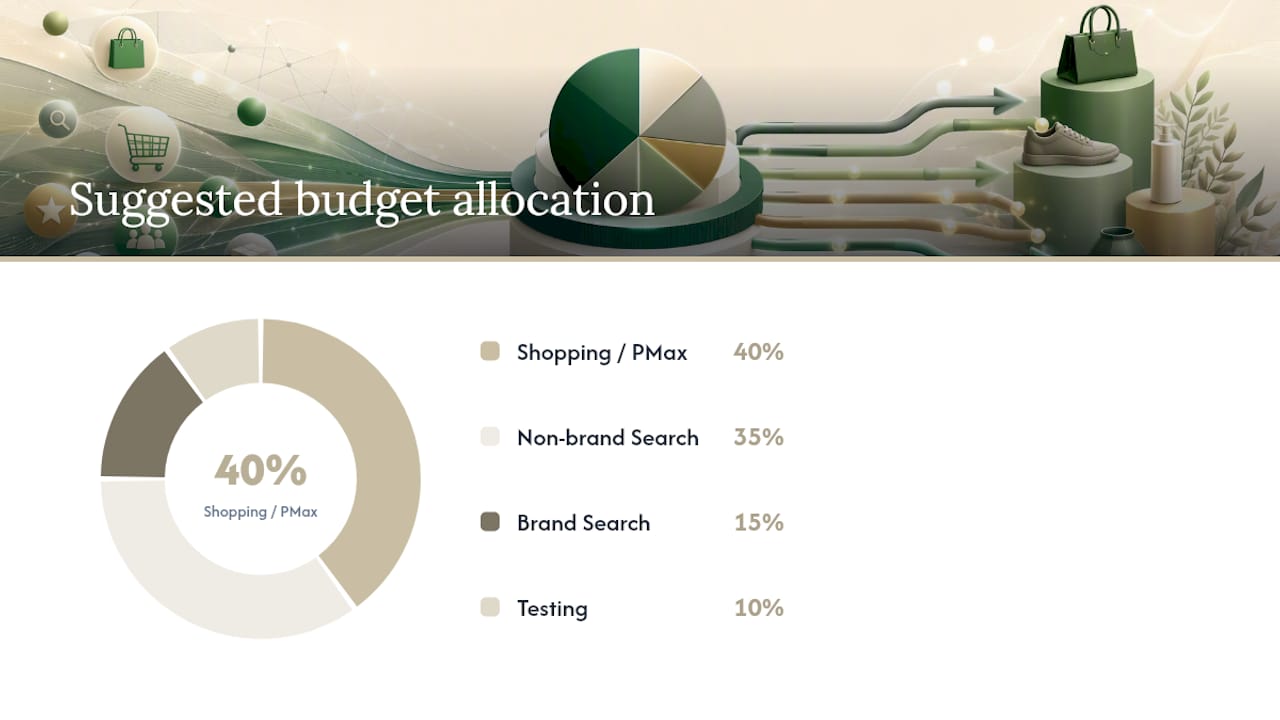
Performance Max blends Search, Display, YouTube, and Shopping inventory into one campaign, and it typically reports ROAS somewhere between standard Search and Shopping. Feed quality drives most of its variance: complete GTINs, keyword-rich titles, and accurate pricing feeds determine whether PMax finds profitable inventory or burns budget on mismatched queries. Our guide to structuring ecommerce campaigns covers the split in more detail.
A directional starting allocation for a mature account:
- 40% Shopping / PMax for harvest and prospecting combined
- 35% Non-brand Search for demand generation
- 15% Brand Search to protect existing demand
- 10% held for testing new campaign structures or audiences
Deviate when your catalog is small (lean more Search), or when your feed is strong and margins support aggressive prospecting (lean more PMax).
How Do You Set an Initial Target ROAS Without Killing Volume?
Setting tROAS too aggressively out of the gate is the fastest way to strangle a campaign that was otherwise performing fine. The fix is a data-first sequence, not a guess.
- Collect a clean baseline. Run Maximize Conversion Value, or Maximize Conversions if value tracking isn’t live yet, for enough time to reach a meaningful conversion count. Most accounts need at least a few dozen conversions per campaign before the resulting ROAS number is trustworthy rather than noise.
- Watch for volume collapse. If conversions drop sharply after a change, check budget caps first, then consider temporarily relaxing the target rather than abandoning tROAS entirely.
Pro Tip: *Starting too aggressively is the single most common tROAS mistake North Country Consulting sees in account audits.
Which Optimization Levers Move ROAS the Fastest?
Improving ROAS for ecommerce rarely comes from one heroic change. A systems approach grouping 15 levers into four categories, targeting, creatives, CRO, and account hygiene, tends to outperform single-lever tinkering, and testing three or more levers at once accelerates results compared with isolated changes.
Targeting fixes, usually the fastest wins:
- Separate brand from non-brand campaigns and exclude brand terms from prospecting, since blended reporting hides which side is actually unprofitable.
- Layer audience signals onto PMax rather than relying on automatic targeting alone.
Creative and message-match fixes:
- Align ad headlines with landing page copy word for word; mismatched promises spike bounce rate before conversion tracking even fires.
- Test lifestyle imagery against plain product shots in Shopping and PMax asset groups.
CRO fixes, slower but often highest-leverage:
- Improve landing page load speed, specifically Largest Contentful Paint, since slow LCP quietly taxes every paid channel sending traffic to that page.
- Test bundles or free-shipping thresholds to lift average order value, which raises ROAS without touching a single bid.
- Review conversion rate optimization fundamentals on your top five landing pages quarterly.
Account hygiene:
- Run negative-keyword audits monthly; wasted spend on zero-conversion search terms is one of the most recoverable margins in any account.
- Re-run your bid simulator after changes using the same attribution window each time, so you’re comparing apples to apples.
Pro Tip: *Order matters.
How Do You Keep Conversion Values Accurate for ROAS Reporting?
Smart Bidding is only as smart as the numbers you feed it. Three fixes protect real ROAS from cosmetic ROAS.
- Deduplicate between GA4 and Google Ads using a shared transaction ID. Without this, the same sale can register twice, once from each platform’s own attribution logic, inflating reported conversions and reported ROAS simultaneously. Our conversion tracking guide walks through the setup.
- Reconcile monthly against your store’s actual order ledger. Pull Shopify or your finance system’s revenue for the same date range and compare it to Google Ads’ reported conversion value; a gap wider than 10% to 15% usually points to duplicate tracking, view-through inflation, or a broken UTM.
Audit this quarterly at minimum, monthly if you’re running frequent site or tracking changes. A 7-step measurement template can help formalize the review cadence across a marketing team.
How Does North Country Consulting Approach Ecommerce ROAS?
Every audit checks the same three things first: conversion-value accuracy, account architecture (brand versus non-brand separation, PMax feed quality), and whether the current Target ROAS reflects an actual breakeven calculation or a guess. Accounts spending $25,000 or more per month with flat or declining ROAS despite in-house effort are the clearest candidates for senior-led management, since the fixes above usually require structural rebuilding, not another round of bid adjustments.
Is a Higher ROAS Target Always the Right Call?
Not always, and this is where I see the most senior marketers get it backward. The most common client mistake I see is setting targets too tight out of fear, then blending brand and non-brand performance so nobody notices which campaign is actually dragging efficiency down. If you take one thing from this: optimize for total profit dollars, and let ROAS be the diagnostic, not the goal.
— Eric
Get a Free Audit of Your Google Ads Account
Expert account review and direct oversight from experienced professionals replace the guesswork of DIY tROAS tuning, avoiding management by junior account handlers. The free Google Ads audit checks your conversion-value setup, campaign architecture, and flags the quick wins most accounts are leaving on the table, no obligation attached.

This fits best if you’re spending $25,000 or more per month and your ROAS has plateaued despite regular in-house adjustments. Rather than another round of tweaking targets by feel, the audit gives you a prioritized list of what to fix first and why. For accounts ready to hand off management entirely, Google Ads management services rebuild the account structure, conversion tracking, and reporting from the ground up. Request your free audit and see exactly where your current setup is leaving revenue on the table.
Sources
- Google Ads Ecommerce Benchmarks 2026 | COREPPC
- Improve ROAS: 15 levers grouped into Targeting, Creatives, CRO, Account Hygiene
- What Is a Good ROAS for Ecommerce? 2026 Benchmarks
FAQ
What Is a Good ROAS for Google Ads?
A good ROAS is anything meaningfully above your breakeven point, calculated as 1 divided by your gross margin. Blended ecommerce accounts average around 4.2x, but a store’s breakeven ROAS depends on its actual gross margin, so context matters more than the raw number.
What Is a Good ROAS for Ecommerce Specifically?
For ecommerce, benchmark ranges run roughly 3.4x for Search and 5.1x for Shopping, with Performance Max typically landing between the two. Compare those figures against your own breakeven ROAS rather than treating them as universal targets.
Is a 2.5 ROAS Good?
It depends entirely on your gross margin.
What Does ROAS Mean in Google Ads?
It measures revenue efficiency, not profit, which is why pairing it with your breakeven calculation matters more than watching the raw number alone.
How Do I Know if My Google Ads ROAS Target Is Too Aggressive?
If conversion volume drops sharply within a week or two of tightening your Target ROAS, the target is likely too aggressive for what the algorithm can bid competitively on. The recommended fix is starting 10% to 20% below your baseline ROAS and adjusting in small 10% to 15% increments from there.