
OpenAI’s ChatGPT ads policy centers on privacy-first, contextual targeting: ads are shown only to eligible users, kept visually separate from ChatGPT’s responses, and matched to conversations through descriptive context hints rather than keywords or chat history. Advertisers never see individual conversations. They receive only aggregated performance metrics, and anyone on a paid subscription tier never sees ads at all.
TL;DR:
- Write context hints as broad intent statements, not keyword lists; geography is the main refinement lever unless your customer list reaches roughly 25,000 matched users.
- Because reporting stops at campaign and ad group level, create one ad group per conversational angle; individual prompts never receive performance data.
- Qualifying advertisers can request Negative Phrases for narrow conversation exclusions, while DoubleVerify and Integral Ad Science pilots assess placement suitability without accessing chats.
- Before launch, check current category rules and the changelog, prepare licensing documents for regulated offers, and appeal dashboard rejections against the specific cited rule.
Table of Contents
- OpenAI’s Official Policy Claims, Summarized
- Who Sees Ads and Where They Show Up
- Advertiser Restrictions and Prohibited Categories
- How Targeting and Measurement Actually Work
- Brand Safety: Negative Phrases and Independent Measurement
- Setting Up Campaigns That Actually Comply and Measure Well
- How the Ads Policy Has Evolved Since Launch
- How ChatGPT Ads Policy Lines Up With Google Ads
- What Happens When an Ad Gets Flagged or Rejected
- What This Policy Really Means for Advertisers
- How North Country Consulting Supports ChatGPT Ads Compliance
- FAQ
- Sources
OpenAI’s Official Policy Claims, Summarized
OpenAI built its advertising system around a single promise: the ads layer never touches the model’s reasoning or a user’s private data. According to the OpenAI Help Center, advertisers never receive a user’s chat history, memories, name, email, precise location, IP address, or any sensitive information. What they get instead is aggregated, non-identifying performance data such as views and clicks.
That separation extends to how ads behave inside the product. Ads are labeled as sponsored, visually distinct from ChatGPT’s answers, and structurally incapable of influencing what the model says, according to the OpenAI Help Center. The system picks an ad after a response is generated, not before, which keeps the advertising layer from shaping the conversation itself.
A few policy points matter most for anyone planning a campaign or just trying to understand what they are seeing:
- Users can turn off ad personalization entirely without losing access to ChatGPT.
- Ads never appear for people on Plus, Pro, Business, Enterprise, or Edu plans, per the OpenAI Help Center.
- Advertisers receive summary metrics, never conversation-level detail.
- Sponsored placements carry a visible label so users always know they are looking at an ad.
This structure sets ChatGPT Ads apart from a lot of digital advertising, where targeting often leans on behavioral history. Here, the product is deliberately designed so that privacy protection and ad delivery do not compete with each other.
Who Sees Ads and Where They Show Up
Eligibility runs along account tier and age, not browsing history. Free and Go tier users, along with logged-out visitors, are the ones eligible to see ads, while Plus, Pro, Business, Enterprise, and Edu subscribers never see them, according to the OpenAI Help Center. That means the ad-supported experience and the paid experience are genuinely different products from a privacy and interface standpoint.
Age gating adds another layer. OpenAI withholds ads from users it predicts or who have declared themselves to be under 18, which keeps the sponsored layer out of the product for minors regardless of which tier they technically use.
In practice, ad placement tends to follow a consistent pattern:
- Ads appear below a ChatGPT response, never embedded inside it.
- Sponsored content carries a clear label distinguishing it from the model’s answer.
- Certain tools and specialized modes are kept ad-free by design.
- Logged-out sessions are built to default toward age-appropriate placement before any personalization occurs.
That consistency matters for brand safety. An ad never masquerades as part of the answer, and the layout gives users an easy visual cue for what is paid and what is not.
Advertiser Restrictions and Prohibited Categories
Not every business can run ads on ChatGPT, and the restricted list looks similar to what you would expect from any major ad platform. Categories commonly restricted or disallowed include political advertising, certain regulated financial and legal offerings, adult content, and gambling. Some categories sit in a gray zone where eligibility depends on licensing, region, or additional review, which is why OpenAI maintains a changelog alongside its policy pages rather than a single static list.
That changelog matters more than it might seem. Ad platforms update restricted categories as they learn how their systems get used, and a category that was fine last quarter can require new disclosures or verification today. Checking the changelog before launching, not just the top-level policy, is the difference between a smooth approval and a rejected campaign.
If your business operates near a restricted category, a few steps reduce friction:
- Review the current help-center policy pages before building creative, not after.
- Check whether your category requires additional certification or regional restrictions.
- Prepare documentation (licensing, compliance credentials) in advance if your vertical is commonly flagged.
- Use the appeal path in the advertiser dashboard if a campaign is rejected and you believe it qualifies.
Categories near the edge of eligibility benefit from a conservative first submission. Testing with a narrower, clearly compliant version of your offer before scaling spend tends to save time compared to appealing a broad rejection.
How Targeting and Measurement Actually Work
Context hints replace keywords as the core targeting mechanism. Rather than bidding on search terms, advertisers supply descriptive prompts that describe the kind of conversation where their ad is relevant, and OpenAI’s system matches ads to conversations based on that context rather than an exact-match query, according to Martech. There are no traditional keyword lists, no demographic targeting, and no in-market audience segments the way search and social platforms offer them.
Two additional levers exist beyond context hints: geography and first-party matching. First-party matching lets advertisers connect their own customer lists to the platform, but the minimum list size sits around 25,000 matched users, which puts this lever mostly out of reach for small and mid-sized advertisers, per Martech.
On the reporting side, advertisers see impressions, clicks, spend, click-through rate, average cost per click, and average cost per thousand impressions, according to Martech. What they do not see is which specific conversation or prompt triggered a given ad. That’s a deliberate tradeoff: the aggregation protects user privacy, but it also means advertisers cannot optimize context hints the way they would optimize keyword bids.
A few practical consequences follow from this setup:
- Build context hints that describe intent broadly enough to match real conversations, not narrow phrases.
- Treat geography as your main refinement lever unless you have a large enough customer list for first-party matching.
- Expect reporting at the campaign and ad group level, not the individual trigger level.
- Landing page relevance still matters: auction dynamics reward ads that lead to a coherent, matching experience after the click.
Brand Safety: Negative Phrases and Independent Measurement
OpenAI gives qualifying advertisers a tool called Negative Phrases, which lets them exclude their ads from narrowly defined categories of conversation, according to OpenAI Ads. Access to this control isn’t universal. It is positioned for advertisers who need tighter placement guarantees, which usually means larger or more risk-sensitive accounts.
Beyond self-service controls, OpenAI is running measurement and suitability pilots with DoubleVerify and Integral Ad Science, giving advertisers an independent, third-party way to evaluate where their ads land without those partners gaining access to private conversations, according to OpenAI Ads. That distinction matters: the pilots are about verifying the suitability of placements, not about handing conversation data to measurement vendors.
Underneath both of these controls sits a layer of automated filtering and human review. The system screens contexts before an ad is served, and ongoing monitoring catches issues that automated rules alone might miss. For brand-safety-conscious advertisers, the combination of Negative Phrases, third-party pilots, and continuous review is closer to what mature programmatic environments already offer than a stripped-down beta feature set.
- Negative Phrases: self-service exclusion for qualifying advertiser accounts.
- DoubleVerify and Integral Ad Science pilots: independent suitability verification without conversation access.
- Automated filtering: screens context before ad delivery.
- Human review and monitoring: ongoing oversight layered on top of automation.
Setting Up Campaigns That Actually Comply and Measure Well
Getting a ChatGPT Ads campaign both compliant and measurable takes a different structure than a typical search campaign. Because context hints are not reported individually, the ad group becomes your real experimental unit, and that single fact should drive most of your setup decisions, according to Search Engine Land.
- Build one ad group per conversational angle so performance differences are visible at the only level OpenAI reports.
- Write creative that mirrors how people actually phrase requests in a conversation, favoring native, benefit-led language over hard-sell copy, per Search Engine Land.
- Verify tracking end to end: confirm full-path destination links, validate UTM parameters, and add server-side event capture where the in-app browser might strip parameters.
- Launch with a modest budget, lean on aggregated metrics plus your own cross-channel attribution, and plan ahead for DV or IAS pilot measurement if brand safety reporting matters to your category.
- Confirm account access, review the current policy and changelog, and request Negative Phrases if your category benefits from narrower exclusions.
Pro Tip: Treat each ad group as a single hypothesis about what a user is trying to accomplish, since that’s the only level where you’ll actually see the data to confirm or kill it.
Our targeting guide for marketers walks through building context hints that hold up across ad groups.
How the Ads Policy Has Evolved Since Launch
OpenAI has treated its ads policy as a living document rather than a fixed ruleset, adding features and refining restrictions as the platform scales past its initial rollout. Negative Phrases and the DoubleVerify and Integral Ad Science measurement pilots are both additions that arrived after the core ads product launched, introduced specifically to answer advertiser demand for better brand-safety assurances, according to OpenAI Ads.
That pattern (ship a conservative baseline, then add advertiser-facing controls once trust and scale justify them) mirrors how other ad platforms have matured, just compressed into a much shorter timeline. For advertisers, the practical implication is that today’s eligibility rules, reporting fields, and brand-safety tools are a snapshot, not a permanent spec.
The help-center changelog and the OpenAI Ads blog are the two places where these changes show up first, often before broader industry coverage catches up. Checking both before a major campaign launch, not just once at account setup, catches category restrictions or reporting changes that could otherwise surprise you mid-flight. Given how recently measurement partnerships and placement controls have expanded, treating the policy as static is probably the single most common mistake advertisers make.
How ChatGPT Ads Policy Lines Up With Google Ads
Advertisers running budgets across both platforms will notice real overlap and real divergence. Both OpenAI and Google restrict similar sensitive categories: political advertising, regulated financial products, gambling, and adult content all face scrutiny on both platforms, though the specific documentation and appeal mechanics differ.
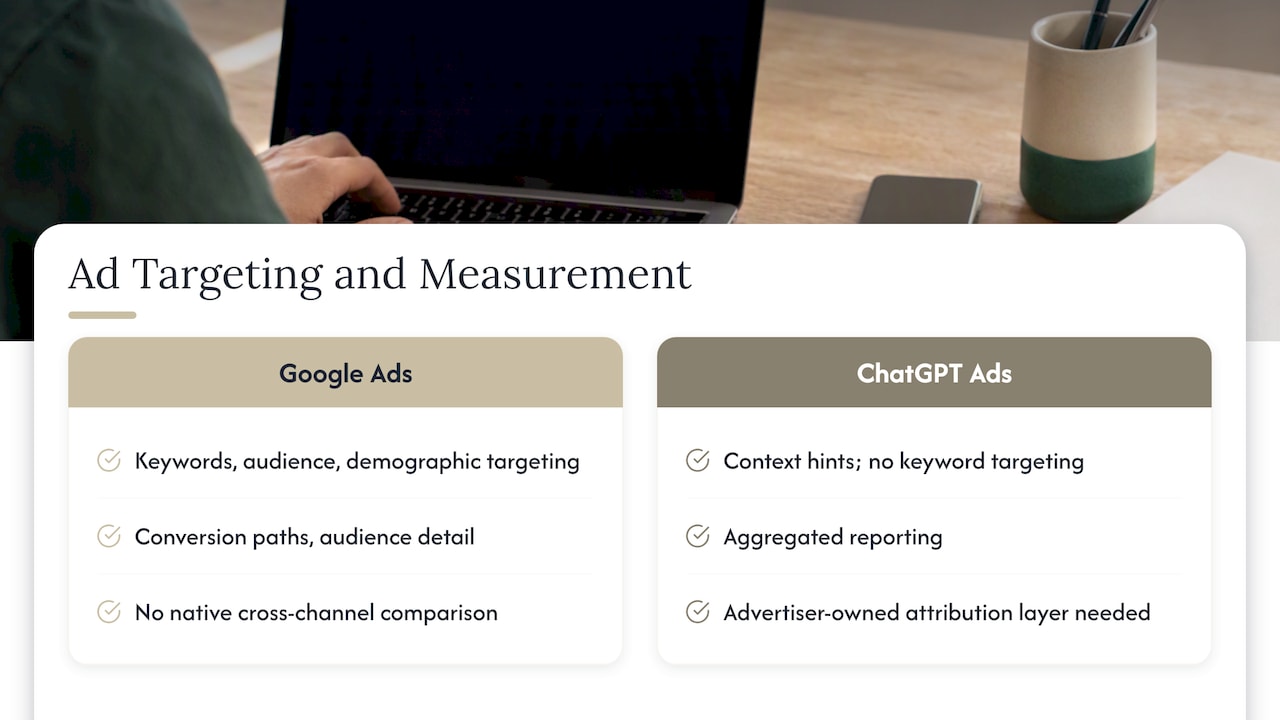
Where the two diverge most is targeting philosophy. Google Ads still supports keyword-level targeting, audience segments, and demographic layers that ChatGPT’s context-hint model deliberately avoids. That means a keyword strategy built for Google doesn’t transfer directly. Context hints have to be written as descriptive intent statements, not keyword variants, which is a real adjustment for teams used to Google’s exact-match and phrase-match logic.
Measurement is the other gap worth planning around. Google Ads reporting goes deep into conversion paths and audience-level detail, while ChatGPT’s aggregated reporting intentionally stops short of that. Advertisers running both channels typically need a unified attribution layer on their own side, since neither platform’s native dashboard will give you an apples-to-apples comparison out of the box. Our breakdown of ChatGPT Ads versus Google Ads covers how to think about budget allocation once both channels are live, and for teams estimating spend, what ChatGPT Ads cost in 2026 is worth reviewing before setting a test budget.
What Happens When an Ad Gets Flagged or Rejected
Policy violations on ChatGPT Ads typically surface at one of two points: during initial review, before a campaign goes live, or after launch, if monitoring flags a placement issue. Pre-launch rejections are the more common scenario for new advertisers, usually tied to a prohibited category, missing documentation, or creative that reads as a hard sell rather than a native, helpful response to a likely conversation.
When a campaign is rejected, the advertiser dashboard is the starting point for understanding why and for filing an appeal. Reviewing the specific policy language cited in the rejection, rather than assuming it is a blanket category ban, often reveals a narrower fix: adjusted creative language, additional licensing documentation, or a tighter context hint that avoids an ambiguous match.
Post-launch issues work a little differently. Because automated filtering and human review continue after a campaign goes live, a placement that passed initial review can still get flagged later if it starts matching unintended contexts. That’s part of why ongoing monitoring, not just a one-time approval, protects both the advertiser’s brand and the user experience. Advertisers who keep their context hints narrow and well-documented tend to have an easier time resolving flags quickly, since the review team can see exactly what was intended versus what triggered the match.
What This Policy Really Means for Advertisers
Privacy-first design doesn’t just protect users. It resets expectations for what “good measurement” looks like. Brands used to granular, identity-based tracking will find aggregated reporting frustrating at first, but it also rewards the kind of disciplined, hypothesis-driven testing that search advertising abandoned years ago in favor of automation.
Contextual targeting punishes lazy creative. A context hint that reads like a keyword list won’t match real conversations, while one written as an actual intent statement will. That favors advertisers willing to test angles deliberately rather than scale broad match and hope.
The practical posture that follows is senior oversight paired with rigorous measurement, not a set-and-forget campaign.
— Eric
How North Country Consulting Supports ChatGPT Ads Compliance
We bring senior-led oversight to ChatGPT Ads management, handling pixel setup and verification, campaign architecture, and ongoing optimization so your account stays compliant while you focus on the offer, not the policy fine print.

Our free strategy audit surfaces tracking gaps and policy risk before they cost you spend. Reach out for an audit and we’ll show you exactly where your setup stands.
FAQ
Can advertisers see my ChatGPT chat history?
No. OpenAI’s policy explicitly bars advertisers from receiving chat history, memories, name, email, location, IP address, or other sensitive data, according to the OpenAI Help Center. Advertisers only receive aggregated performance metrics like views and clicks.
How do I turn off personalized ads in ChatGPT?
Ad personalization can be disabled directly in account settings without losing access to ChatGPT itself, per the OpenAI Help Center. Subscribing to a paid tier such as Plus, Pro, Business, Enterprise, or Edu removes ads from the experience entirely.
Does ChatGPT Ads support keyword targeting like Google Ads?
No. Targeting runs on descriptive context hints that match conversation intent, not exact-match keywords, according to Martech. Geography and large first-party customer lists are the main additional targeting levers available.
What metrics will I actually receive as an advertiser?
Advertisers receive impressions, clicks, spend, click-through rate, average cost per click, and average cost per thousand impressions, according to Martech. These figures are aggregated and never tied to an individual conversation or prompt.
Can I restrict where my ChatGPT ads appear?
Qualifying advertisers can use Negative Phrases to exclude their ads from narrowly defined conversation types, and OpenAI also runs measurement pilots with DoubleVerify and Integral Ad Science for independent suitability review, according to OpenAI Ads. Neither mechanism grants outside parties access to private chats.
Sources
- Ads in ChatGPT | OpenAI Help Center
- More ways to measure ChatGPT Ads | OpenAI Ads
- A 7-step guide to running ads on ChatGPT | Martech
- How to run ChatGPT ads: A step-by-step guide from early campaigns | Search Engine Land