
ChatGPT ads targeting runs on conversation context, not keywords. The platform converts your plain-language “context hints” into embeddings and matches them against live chat threads — so your ad surfaces when the conversation semantically fits your brief, not when someone types a specific phrase. Formats include Sponsored recommendation cards shown below the model’s response, companion/display placements, and native content cards in early rollout. Pricing runs on CPC in self-serve and CPM through managed or partner paths; the platform has removed high minimum spend requirements as it moved from pilot to general availability in 2026.
- Formats at a glance: Sponsored cards (below the response), companion/display, native content cards
- Pricing signals: CPC self-serve, CPM managed/partner; early B2B CPCs in the mid-single digits
- Privacy constraint: No cross-site behavioral tracking; context hints and in-product signals only
- Immediate action: Build 3–5 intent-mapped ad groups, write context hints like creative briefs, create one dedicated landing page per intent cluster, and install your pixel or Conversions API before you spend a dollar
Microsoft Advertising’s infrastructure parallels inform how the Ads Manager auction behaves, and OpenAI’s Ads documentation governs what advertisers can and cannot do. North Country Consulting’s implementation path — audit, pilot, scale — is covered in detail later in this guide.
Table of Contents
- What are ChatGPT ads and who actually sees them?
- How ChatGPT ads targeting actually works
- What do ChatGPT ad formats look like?
- Pricing, auction mechanics, and what to budget
- How do you measure ChatGPT ad performance?
- Writing creative that fits a conversational UI
- Privacy, brand safety, and policy constraints
- How to set up your first ChatGPT ad campaign
- Which advertisers should prioritize ChatGPT ads right now?
- How North Country Consulting runs ChatGPT ads for clients
- Key Takeaways
- Where ChatGPT ads are headed: an agency perspective
- North Country Consulting’s ChatGPT Ads audit and managed setup
- Useful sources for campaign teams
What are ChatGPT ads and who actually sees them?
ChatGPT ads are sponsored placements that appear inside ChatGPT conversations. They are kept strictly separate from the model’s organic response: visually distinct, clearly labeled as “Sponsored,” and governed by a policy that prevents advertisers from shaping, ranking, or altering what the model says. The ad sits below the answer, not inside it.
OpenAI’s policy is unambiguous: “Showing an ad doesn’t mean OpenAI endorses the advertiser.” Ads run on separate systems, and information used to show an ad stays within ChatGPT — it is not shared with advertisers.
Which account types see ads? Free and Go plan users see ads in many test regions. Plus, Pro, Business, Enterprise, and Edu subscribers do not. That distinction matters for audience planning: the ad-eligible population skews toward casual and early-stage users rather than power users on paid plans.
Three paths to buy inventory: self-serve Ads Manager, partner integrations (Criteo’s commerce media pipeline is the named example), and direct enterprise deals. Each path differs on pricing, minimum spend, and feature access. Self-serve opened for early access on April 10, 2026, and reached general availability on May 5 with no minimum spend requirement. Enterprise direct buys and managed partner paths still carry higher entry points and CPM-based pricing.
Practical placement note. Because the ad appears below the model’s answer, it functions as a continuation of the conversation, not an interruption mid-sentence. That placement logic should drive how you design creative and landing-page flow: the reader just got an answer and is deciding what to do next.
How ChatGPT ads targeting actually works
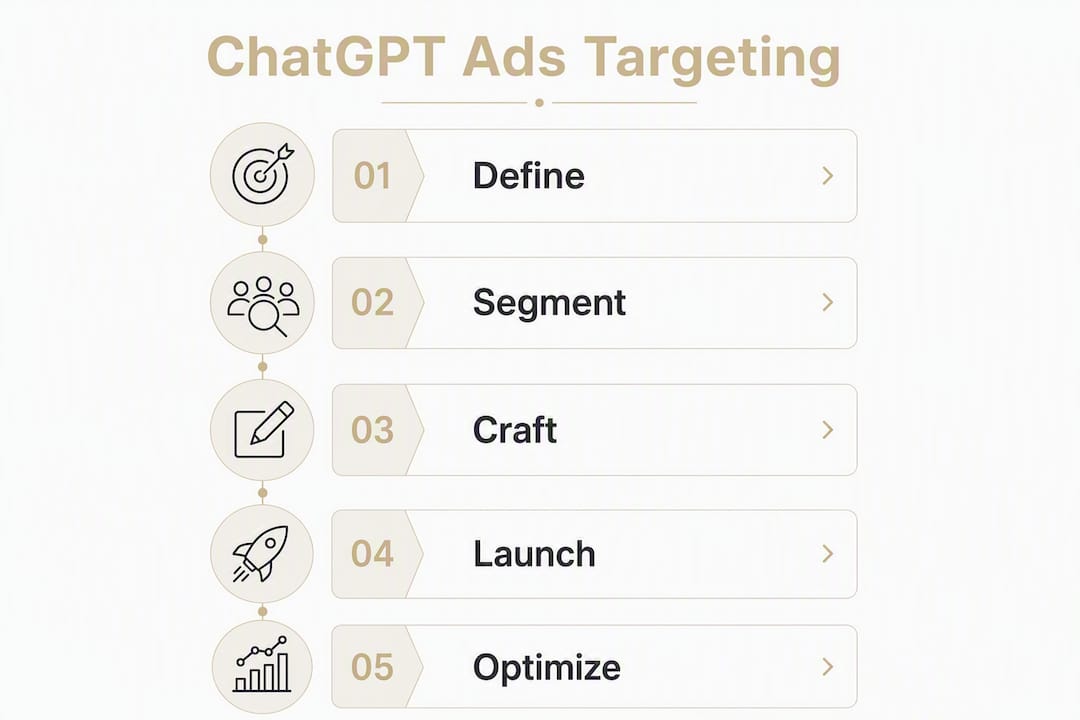
The core primitive is the context hint: a plain-language, paragraph-length description you write to tell the system which conversations your ad is eligible for. OpenAI converts that hint into an embedding and matches it against the conversation embedding in real time. Keywords exist as a fallback input, but semantic matching is the primary mechanism.
What the auction considers:
- Conversation content and intent at the moment of matching
- Your context hint (the richer and more specific, the better the match quality)
- Landing page relevance to the conversation
- Your bid
- Optional personalization signals when the user has enabled them — past chats or saved memories can affect ad relevance, but users can opt out via personalization toggles or an ads-free plan
Personalization limits matter. ChatGPT’s ad personalization is deliberately constrained. There is no cross-site behavioral tracking. No third-party cookie signals. The system works with in-product signals and memory controls the user manages. That is a feature for privacy-conscious buyers, but it means you cannot rely on retargeting lists the way you would in display advertising.
Ad group architecture. Map each ad group to a situation or intention cluster rather than a product feature. Useful clusters for B2B: solution-aware (user knows the problem category), comparison (user is evaluating options), and high-commercial-intent (user is asking about pricing, timelines, or integrations). For ecommerce, cluster by purchase stage and product category.

Pro Tip: Write context hints like a creative brief for a human copywriter, not like a keyword list. Include the buyer’s role, the problem they are solving, constraints they have mentioned (budget range, team size, tools they already use), and alternatives they are likely considering. The embedding model matches semantically — specificity wins.
Later turns in a multi-turn conversation often surface the highest-intent signals. A user who starts by asking “what is project management software” and by turn three is asking “which tools integrate with Salesforce for a 50-person team” has revealed purchase parameters that a well-written context hint can target by conversation stage.
What do ChatGPT ad formats look like?
| Format | Placement | Best for | Creative notes |
|---|---|---|---|
| Sponsored recommendation card | Below the model’s response | Clicks, conversions, lead gen | Short headline, one-line value prop, clear CTA; reads as a natural next step |
| Companion / display | Adjacent to the conversation pane | Brand reach, retargeting via partner paths | Visual-forward; standard display specs apply |
| Native content card | Inline, early rollout | Awareness, content offers | Longer copy permitted; must not mimic the model’s voice |
Sponsored recommendation cards are the primary format most self-serve advertisers will use first. The card sits immediately below the answer, so the reader’s attention is already engaged. Keep the headline under 10 words, lead with the specific benefit (not the product name), and make the CTA a logical continuation: “See pricing for 50-seat teams” beats “Learn more.”
Companion and display placements follow more conventional display logic. They are available primarily through managed and partner paths, which means CPM pricing and higher entry points. Use them for brand campaigns where reach matters more than immediate click-through.
Native content cards are in early rollout and carry more copy flexibility. The critical constraint: your ad must not look or sound like the model’s response. OpenAI’s labeling requirement is non-negotiable, and creative that blurs the line between ad and answer will be rejected.
Creative testing cadence. Run at least two variants per ad group from day one. Rotate after 500–1,000 impressions per variant, not by calendar week. Test one variable at a time: headline tone, CTA phrasing, or context hint wording. Landing page alignment is the variable most teams undertest.
- Write in the second person, active voice
- Match the register of the conversation (technical for developer audiences, plain for general consumers)
- Avoid clickbait; the reader just got a thoughtful answer from an AI and will notice the tonal whiplash
- One CTA per ad unit; multiple options dilute click intent
Pricing, auction mechanics, and what to budget
The auction combines relevance and bid to determine placement, similar to other programmatic auctions but with conversation relevance as an explicit weighting factor. CPC is available in self-serve; CPM is the standard model for managed and partner paths.
Observed pricing in 2026: Early beta reports indicated B2B intent CPCs at competitive levels, reflecting the channel’s initial pricing for advertisers. Those figures will shift as more advertisers enter the auction — early-mover advantage is real here, and rates will not stay at beta levels once the channel scales.
Budget reality check: Managed paths ran early pilots with higher minimum spend requirements. Self-serve general availability removed that floor entirely. If you are on self-serve, you can start with a modest learning budget — but expect higher CPL early if your landing pages are not intent-matched.
Which bidding model to choose:
- CPC for performance teams optimizing to leads or purchases; gives you direct cost-per-click control and pairs naturally with conversion-based optimization
- CPM for brand or reach campaigns where impressions matter more than immediate action; typically accessed through managed or partner paths
Budgeting for the learning phase. Allocate a defined learning budget before you expect stable CPL data. Without intent-matched landing pages and conversion instrumentation, the algorithm has no signal to optimize against. Plan for 4–6 weeks of learning spend before drawing conclusions. Set time-based budget controls so you do not burn through the learning budget in the first week.
Bid strategy should align directly with your conversion instrumentation. If you have not installed the pixel or Conversions API, CPC optimization has no downstream signal and you are effectively paying for clicks with no feedback loop.
How do you measure ChatGPT ad performance?
Primary KPIs to track:
- Click-through rate by ad group and format
- CPC and cost trends week over week
- Landing page conversion rate (form fill, purchase, or trial start)
- Cost per qualified lead (CPL) or cost per acquisition (CPA)
- Downstream pipeline influence and revenue attribution via CRM
Instrumentation requirements. Install the JavaScript pixel for standard conversion events. For deeper funnel events — demo requests, contract signings, high-value purchases — use the Conversions API (server-side) to avoid browser-side signal loss. Map each server-side event to a CRM stage so you can tie a chat click to a closed deal.
| Metric | Target range | Remediation if below target |
|---|---|---|
| CTR (Sponsored card) | Varies by intent; watch relative trends | Rewrite headline; tighten context hint specificity |
| CPC | Benchmark against early B2B rates of $5–7 per click | Improve landing page relevance; refine context hint |
| Landing page CVR | 5% for high-intent B2B; higher for ecommerce | Align landing page copy to the conversation thread |
| CPL | Set against your historical channel benchmarks | Tighten ad group intent mapping; add negative context signals |
| Pipeline influence | Track via CRM UTM attribution | Add server-side events; improve CRM tagging |
Cross-channel attribution. ChatGPT tends to appear later in the decision path — a user who has already done initial research and is now asking specific comparison or configuration questions. Treat it as a high-intent touch rather than a top-of-funnel awareness channel. Combine CRM events and first-party data to give it proper credit rather than letting last-click models undervalue it.
Avoid relying on third-party behavioral signals for attribution. Use hashed first-party lists and conversion APIs where possible. Data hygiene at the event level — consistent UTM parameters, matched CRM identifiers — determines whether your attribution model reflects reality.
Writing creative that fits a conversational UI
The single biggest creative mistake on ChatGPT is writing an ad that sounds like a banner. The reader just had a conversation with an AI. Your ad needs to feel like a logical next step, not a non-sequitur.
Templates by intent type:
High-commercial-intent (user is comparing or pricing):
“[Product] for [team size/use case] — see how it fits your stack. [CTA: Get pricing for 50-seat teams]”
Comparison intent (user is evaluating options):
“[Product] vs. [category alternative] — here is what teams like yours chose and why. [CTA: See the comparison]”
Solution-aware (user knows the problem, exploring solutions):
“[Problem] solved for [role/industry] — [specific outcome, no fluff]. [CTA: See how it works]”
Creative testing matrix:
- Context hint wording: broad situation vs. specific buyer constraints
- Headline tone: direct/functional vs. outcome-led
- CTA phrasing: action-oriented (“Get pricing”) vs. curiosity-led (“See how teams like yours use it”)
- Landing page alignment: does the page pick up the conversation thread or restart from scratch?
Copy checklist before launch:
- Does the ad read as a continuation of the chat, not a pivot to a new topic?
- Is the offer explicit — no vague “learn more” without context?
- Is there a trust signal (customer count, outcome metric, named integration)?
- Does the CTA anchor to the buyer’s specific situation?
Pro Tip: Use the conversation thread to anticipate later-turn qualifiers. If your product serves 50–200 seat teams, say so in the ad. If it integrates with Salesforce, name it. Buyers who have reached the comparison stage in a chat have already revealed their constraints — your ad should reflect that you know them.
Optimizing for ChatGPT as a channel means treating the conversation as the targeting unit, not the keyword. Creative that acknowledges the buyer’s situation outperforms generic product ads consistently.

Privacy, brand safety, and policy constraints
OpenAI’s architecture keeps ads and model responses on separate systems. Advertisers cannot influence what the model says, how it ranks information, or which sources it cites. That separation is both a policy requirement and a technical reality.
From OpenAI’s Ads documentation: “Ads run on separate systems and showing an ad doesn’t mean OpenAI endorses the advertiser.” Information used to show an ad stays within ChatGPT and is not shared with advertisers.
Privacy architecture for advertisers. The available primitives are: context hints, in-product signals (when the user enables personalization), hashed first-party lists, and Conversions API. Cross-site behavioral tracking is not available. Users who toggle off personalization or subscribe to an ads-free plan will not see your ads regardless of bid.
Content restrictions and policy rules:
- Political advertising is currently disallowed
- Sensitive health and financial content is restricted and subject to eligibility review
- Regulated verticals (pharmaceuticals, financial services, alcohol) require additional compliance steps
- Ads must not mimic the model’s voice or imply OpenAI endorsement
Operational brand safety steps. During the first 100,000 impressions, review creative manually against placement context. Set up exclusion lists for sensitive topic categories. Monitor for creative drift if you are running AI-generated variants. Document your policy review process internally: a brief sign-off template, an escalation path for edge cases, and a record of creative approvals.
Compliance documentation does not need to be elaborate. A one-page checklist covering content category, eligibility confirmation, and creative sign-off is enough for most teams. The goal is a paper trail that shows intent-to-comply, not a legal brief.
How to set up your first ChatGPT ad campaign
Pre-launch checklist:
- Request Ads Manager access at ads.openai.com and complete onboarding; confirm your access path (self-serve, partner, or enterprise)
- Define one use case for your pilot — do not try to cover your full product in campaign one
- Build 3–5 ad groups, each mapped to a distinct conversation intent cluster
- Write a context hint for each ad group (paragraph-length, situation-based, specific)
- Create 2–3 ad variants per group with different headline tones or CTA phrasing
- Build one dedicated landing page per intent cluster — not your homepage
- Install the JavaScript pixel and test event firing before launching traffic
- Set up Conversions API for server-side events tied to your CRM pipeline stages
- Define your CPL or ROAS guardrail before you start spending
Context hint examples:
- B2B SaaS (comparison intent): “A marketing operations manager at a 100–500 person B2B company is comparing CRM integrations. They have used HubSpot for two years and are evaluating whether to switch or add a point solution. Budget is a concern; they want to see ROI evidence before a demo.”
- Ecommerce (high-intent): “A consumer is comparing running shoes for trail use, has a budget of $120–$160, and has already ruled out one major brand based on fit issues. They are asking about durability and return policies.”
Six-week learning cadence:
- Weeks 1–2: Launch, monitor event firing, check for tracking gaps, no optimization changes
- Weeks 3–4: First creative rotation based on CTR and landing CVR data; refine context hints
- Weeks 5–6: Bid adjustments based on CPL data; pause underperforming ad groups; plan scale decisions
For a more detailed setup walkthrough, North Country Consulting’s beginner guide covers account structure and creative decisions for teams new to the channel.
Which advertisers should prioritize ChatGPT ads right now?
Not every advertiser belongs on this channel in 2026. The fit depends on your buyer journey, your ability to instrument conversions, and whether your category benefits from conversation-level context.
Best-fit profiles:
- B2B SaaS with evaluating buyers mid-decision: the conversation context reveals purchase parameters (team size, integrations, budget) that make mid-funnel ads highly relevant
- Higher-ticket services (consulting, financial services with eligible categories, professional software) where a single conversation can surface a qualified buyer
- Ecommerce categories with comparison intent — running shoes, electronics, home improvement — where buyers ask specific questions before purchasing
The channel is not a fit for every budget or objective. Strictly awareness-only campaigns with no landing experience, advertisers without conversion tracking, and categories restricted by OpenAI policy should not prioritize ChatGPT ads in the near term. The channel rewards instrumentation and intent clarity; without both, you are paying for clicks with no optimization path.
Decision checklist:
- Do you have clear intent clusters you can map to ad groups?
- Do you have dedicated landing pages (not your homepage) for each intent?
- Is your pixel or Conversions API installed and tested?
- Can you commit to a 6-week learning budget without pulling the plug early?
- Is your category eligible under OpenAI’s current policy?
Funnel-stage fit matrix: Reach and awareness campaigns map to CPM on managed paths. Click and conversion campaigns map to CPC on self-serve with Conversions API. The channel is strongest at the mid-to-lower funnel where conversation context reveals buyer intent. For B2B lead generation, the combination of intent-mapped ad groups and server-side conversion tracking is what separates campaigns that scale from ones that stall.
How North Country Consulting runs ChatGPT ads for clients
North Country Consulting’s approach to ChatGPT Ads follows a structured sequence: senior-led audit, intent mapping, context-hint design, instrumented pilot, and scale decisions tied to defined ROI thresholds.
Methodology in practice:
- Senior audit of existing ad accounts and conversion infrastructure before any spend
- Intent mapping session: identify 3–5 conversation clusters that match the client’s buyer journey
- Context-hint design: write situation-based briefs for each ad group, reviewed against landing page copy
- Pixel and Conversions API installation with CRM event mapping
- Pilot launch with CPC bidding, CPL guardrails, and weekly reporting
- Scale decisions at week 6 based on CPL vs. target and pipeline influence data
North Country Consulting has managed significant ad spend with strong average ROAS results. The free strategy audit identifies revenue opportunities in existing account structures and conversion setups before recommending a pilot budget.
The agency’s implementation principle: AI handles research, variant generation, and signal detection. Humans set offer strategy, write the context hints, and gate creative quality. That division of labor — described in operator guides for AI marketing campaigns — is what separates campaigns that learn from ones that just spend.
What improved CPL looks like in practice. When intent-aligned landing pages replace generic homepages and server-side events replace pixel-only tracking, CPL typically drops in the first 4–6 weeks of a properly structured pilot. The mechanism is straightforward: the algorithm gets a real conversion signal, bid optimization kicks in, and irrelevant traffic falls away.
Key Takeaways
ChatGPT ads targeting rewards advertisers who invest in precise context hints, intent-matched landing pages, and server-side conversion instrumentation — not those who simply port keyword campaigns from search.
| Point | Details |
|---|---|
| Context hints drive targeting | Write situation-based briefs (role, problem, constraints) — semantic matching beats keyword lists every time. |
| Pricing is volatile but accessible | Self-serve opened in May 2026 with no minimum spend; early B2B CPCs clustered around $5–7 per click. |
| Measurement requires server-side setup | Install Conversions API alongside the pixel to tie chat clicks to CRM pipeline and get real optimization signal. |
| Best fit is mid-to-lower funnel | B2B SaaS, higher-ticket services, and comparison-intent ecommerce get the most from conversation-level context. |
| North Country Consulting | Offers a free ChatGPT Ads audit covering intent mapping, context-hint review, and tracking assessment before any pilot spend. |
Where ChatGPT ads are headed: an agency perspective
The conventional wisdom right now is that ChatGPT ads are just another programmatic channel with a new targeting layer. That framing misses what makes this surface different — and what will determine who wins on it over the next 18 months.
The conversation is the targeting unit. Not the keyword, not the audience segment, not the device. A user who has spent three turns in a chat describing their problem, their constraints, and their alternatives has handed you more purchase-intent signal than a single search query ever could. Advertisers who treat context hints as a keyword substitute will underperform. Those who write them as genuine situation briefs — specific enough to match a real buyer mid-conversation — will see CPLs that justify the channel’s place in a serious media mix.
Near-term signals worth watching: the rollout of new access paths (more partner integrations beyond Criteo are likely), shifts in the CPC/CPM balance as self-serve scales, and whether OpenAI introduces richer ad objectives beyond the current click-and-conversion model. Retargeting via hashed first-party lists is the most logical next primitive, and teams that build clean first-party data infrastructure now will have a structural advantage when it arrives.
What to prepare for: creative that reads like a conversation, not a banner. Instrumentation that connects a chat click to a closed deal. And a test governance process for brand safety that does not slow you down but does keep you out of policy trouble. The privacy-first architecture is not a temporary constraint — it is the design. Build your campaigns around it rather than waiting for behavioral targeting to appear.
North Country Consulting’s ChatGPT Ads audit and managed setup
If you are spending $10,000 or more per month on paid channels and have not yet run a structured ChatGPT Ads pilot, the gap between where your campaigns are and where they could be is measurable.
North Country Consulting’s free ChatGPT Ads audit covers intent mapping, context-hint review, tracking assessment, and quick-win landing page fixes — delivered with senior oversight, not a junior account team. The managed setup includes pilot launch, creative rotation, Conversions API instrumentation, and a weekly reporting cadence tied to your CPL and ROAS targets. Most clients see their first qualified leads within the six-week learning window.
The audit takes one conversation and produces a prioritized action plan. If the channel fits your buyer journey, you leave with a pilot structure ready to launch. If it does not, you know that before you spend. Book your free ChatGPT Ads audit and get a clear picture of what a properly instrumented pilot looks like for your account. Or review North Country Consulting’s full ChatGPT Ads management services to see what senior-led oversight includes from day one.
Useful sources for campaign teams
OpenAI product documentation:
- Ads in ChatGPT — policy, privacy architecture, separation of ads and model responses
- Ads in ChatGPT: The Basics — context hints, targeting mechanics, and Ads Manager overview
Platform explainers and pricing:
- How ChatGPT Ads Work (Updated July 2026) — access paths, pricing history, self-serve vs. managed, Criteo partnership
- How to Set Up ChatGPT Ads (CPC Guide) — step-by-step setup, CPC guidance, early performance signals
Practitioner and operator resources:
- AI Marketing Campaigns: The 2026 Operator’s Guide — AI/human workflow division, creative scaling, and quality gating
- Ways to Optimize for ChatGPT: A Marketer’s Guide — content and creative alignment for conversational surfaces
- Why Optimize for ChatGPT — brand visibility and privacy-first optimization principles
North Country Consulting resources:
- ChatGPT Ads targeting: audience selection — deeper guidance on context hints and ad group architecture
- What we learned from ChatGPT Ads in 2026 — agency results and campaign benchmarks
- ChatGPT Ads for B2B companies — intent mapping and pilot structuring for B2B advertisers
- ChatGPT Ads vs. Google Ads — channel comparison and multi-channel strategy positioning