
Good ChatGPT ad creative reads like a helpful reply: a concise, benefit-focused title, a description that adds something new, a simple image that matches, and a landing page that finishes the job. Launch many distinct variations, use context hints to clarify when each ad should appear, and wire up the pixel, Conversions API, and partner integrations so you can attribute results from launch.
TL;DR:
- For conversational cards, make the title state a benefit and the description add new detail; use clear product images for shopping or discovery placements.
- Build genuinely different variations around time savings, cost, audience, or an existing problem; changing one synonym for another does not create a useful test.
- Write context hints around buyer moments, naming what the product does, whom it helps, and when it fits; they guide relevance, not delivery guarantees.
- Use UTMs, verify pixel events beyond page views, add the Conversions API where possible, and connect AppsFlyer, Triple Whale, Northbeam, or Measured if already used.
- Compare conversions, not clicks, and run a holdout test when feasible; last click can credit branded Google searches that ChatGPT ads helped initiate.
Table of Contents
- Which ChatGPT ad formats should your creative be built for?
- How do you write titles and descriptions that read like helpful replies?
- What images and visuals work in ChatGPT ads?
- How do you match the landing page and set up tracking that proves value?
- How should you group ads and write context hints?
- What does a practical testing roadmap look like?
- Which policy rules and brand-safety guardrails keep creatives approved?
- What measurement partners and tracking options does OpenAI support?
- How do you build a creative strategy for ChatGPT ad campaigns?
- What do strong ChatGPT ad creative examples look like?
- How can you use audience data to personalize ChatGPT ad creative?
- How does ChatGPT creative fit with your Google Ads campaign goals?
- What automation and AI tools help generate and scale ChatGPT ad creative?
- Why does senior-led testing change creative decisions?
- Get senior-led help launching and measuring ChatGPT ads
- FAQ
- Sources
Which ChatGPT ad formats should your creative be built for?
OpenAI has described a new visual ad format meant to help people imagine products and services, alongside its expanded measurement and brand suitability work. That means your creative now lives in more than one kind of moment, and each one rewards a different kind of asset. Think of the formats in terms of what the person is doing when they see you.
- Chat and answer cards: these appear while someone is working through a question. The creative has to extend the conversation, so the title and description do most of the work and the image is optional.
- Contextual sidebar placements: these sit beside an exchange without interrupting it. Short, benefit-first text that mirrors the user’s task performs best here.
- Product spotlight placements: these suit shopping and comparison moments, where a literal product image and a clear price or feature cue help someone decide.
- Image-associated placements: these are the visual-first moments, where someone is browsing for ideas and inspiration. A strong, simple image carries the message and the copy supports it.
The practical signal is simple. If you are extending a conversation, write text-first and treat any image as a bonus. If you are inspiring discovery, go visual-first and make sure the copy still reads cleanly without the picture.
Text-first formats leave little room for decoration, so every word has to justify itself. Visual formats give you more room to show, but they also raise the stakes on clutter and relevance. A mismatched image in a conversational placement feels like an interruption, while a vague headline in a visual placement wastes the one chance to stop a scroll.
Build a small asset kit for each offering before you launch: several text-only variants, several text-plus-image variants, and a clear note on which format each one is meant for. Our piece on how ChatGPT ads differ from traditional search ads explains why search-style keyword thinking breaks down here, which is the main reason format choice should come first.
How do you write titles and descriptions that read like helpful replies?
OpenAI’s own guidance says ads should be benefit-focused, clear, and relevant to the user’s task. In practice, that means writing as if you were answering the question rather than announcing a product.
Lead with the benefit and the context: who it helps and when. “Reconcile your books in an afternoon” works harder than a brand slogan because it names an outcome and a moment. Keep the title concise, since titles should be concise and informative so the description can add new detail instead of repeating it.
- Title: one clear benefit, written in plain words, ideally under a short line of text. Skip superlatives and punctuation tricks.
- Description: add something the title did not say, such as who it suits, a feature that backs the claim, or the next step.
- Voice: conversational and specific, like a knowledgeable colleague answering a question. Avoid shouting, urgency theater, and stacked adjectives.
- Accuracy: describe the offering as it really is. Ads that overpromise lose the click you earned and invite review trouble.
The biggest mistake we see is writing five versions of the same message and calling it a test. Swapping “fast” for “quick” tells you nothing. Instead, create several distinct angles for each offering: one built on a time saving, one on cost, one on a specific audience, one on a problem the buyer already feels. OpenAI’s guidance points the same way: build for coverage with many distinct creative variations.
A simple pattern to adapt: “[Outcome] for [who], when [situation].” Then write the description as the proof or the how. For example, a payroll tool might run “Run payroll for growing teams” with a description about automatic tax filing. A second angle might lead with the cost of mistakes, and a third with switching from spreadsheets.
Pro Tip: Frame each test by buyer intent, not by wording. Two headlines that answer the same question are one test; two headlines that answer different questions are two.
What images and visuals work in ChatGPT ads?
OpenAI’s help guidance says images should be simple and aligned to the message. That one line rules out most of the stock-photo habits advertisers carry over from other channels.
- Show the product in use or a clear inspiration tied to the copy. If the headline promises a tidier desk, show a tidy desk, not an abstract gradient.
- Keep one focal point. Visual placements often render small, so a single subject reads better than a collage.
- Use minimal or no text overlay. The title and description already carry the words, and heavy overlay text becomes unreadable at small sizes.
- Choose high contrast. Strong separation between subject and background survives compression and small thumbnails.
- Avoid clutter and irrelevant art. Decorative or abstract imagery that does not connect to the offer weakens relevance.
- Do not mimic the ChatGPT interface. Screenshots or mockups that look like chat bubbles or product UI can trigger policy problems, which we cover in the policy section below.
Sometimes the right call is no image at all. When your placement is conversational and the copy already answers the question, a weak image only adds risk. Save visuals for moments where seeing the product genuinely helps, such as apparel, home goods, food, travel, and anything where the look is part of the decision.
If you are planning for product spotlight and discovery-style placements, the Ecentic is a useful read on how visual discovery works inside ChatGPT. Before upload, view each image at thumbnail size. If you cannot tell what it shows at a glance, simplify it.
How do you match the landing page and set up tracking that proves value?
The ad earns the click, but the landing page decides whether it was worth earning. Send people to the most relevant destination, whether that is a product page, a collection, or a piece of contextual content, and keep the path to action short. A visitor who asked a specific question should land on the specific answer, not your homepage.
Measurement needs to be in place before spend begins. OpenAI has announced that it integrated with leading attribution and measurement partners including AppsFlyer, Triple Whale, Northbeam, and Measured, with pixel and Conversions API options used for conversion tracking.
OpenAI has integrated with measurement partners including AppsFlyer, Triple Whale, Northbeam, and Measured, so advertisers can connect ChatGPT ad engagement to conversions and run incrementality experiments, as OpenAI describes.
Run this QA checklist before launch:
- Confirm the URL is reachable. Make sure your robots rules and firewall do not block OAI-AdsBot or OAI-SearchBot, or the page may fail review.
- Add UTMs. Tag every ad so analytics can separate ChatGPT traffic from everything else.
- Install the pixel and confirm it fires on the key conversion events, not just page views.
- Add the Conversions API where you can, so server-side events back up browser signals that blockers may drop.
- Connect a measurement partner if you already use one, and agree in advance on how incrementality will be judged.
- Test the full path on mobile and desktop, from ad click to confirmed conversion.
For the technical details of pixel and server-side setup, see our guide to ChatGPT Ads conversion tracking. If you need to tie those events back to revenue, our walkthrough on how to measure ROI from ChatGPT ads covers the reporting side.
How should you group ads and write context hints?
An ad group is where your creative meets buyer intent. OpenAI explains that ad groups organize campaigns and carry context hints describing what the product offers, who it helps, and when it may be useful. Keep each group focused on a single product theme or buyer moment, not a broad product label like “software” or “shoes.”
A good context hint answers three questions: what does it do, who does it help, and when is it useful? OpenAI notes that hints are semantic descriptions of conversations, intent, or scenarios where an ad adds value, and they work best when grouped by buyer moments rather than product categories.
- Weak: “Accounting software.” It names a category and says nothing about the situation.
- Strong: “Helps freelancers who are behind on bookkeeping catch up before tax season.” It describes who, what, and when.
- Strong: “Useful for small retailers comparing inventory tools after outgrowing spreadsheets.” It names a trigger moment.
- Strong: “For managers onboarding a remote hire who need a checklist of accounts to set up.” It matches how someone would actually phrase the problem.
Remember that hints are not hard targeting. They clarify when your ad is a good fit, but they do not guarantee or restrict delivery the way an exact-match keyword once did. Write them to be accurate and descriptive, and expect to refine them with data. Our article on ChatGPT Ads targeting goes deeper on how signals and intent interact.
Build the structure by mapping buyer journeys first: list the moments when someone would benefit from your product, then create one ad group per moment. Aim for distinct creative variations in each group so the system has real choices.
Pro Tip: Write your hints before your ads. If you cannot describe the moment in one sentence, the ad will not land in it either.
What does a practical testing roadmap look like?
Start wide, then narrow. OpenAI’s guidance to build for coverage is the right opening move: many distinct angles across your ad groups, each tied to a buyer moment. Then let conversions, and incrementality where you can measure it, tell you which angles deserve more budget.
- Launch broad. Put distinct variations in each ad group and avoid near-duplicates that split data without teaching anything.
- Set guardrails before you look at results. Decide the primary conversion event, the minimum number of conversions you need before judging an ad, and the date you will review.
- Wait for enough data. Early clicks flatter weak ads. Judge on conversions, not click-through rate alone, and resist cutting variants in the first few days.
- Run a holdout test where feasible. Comparing exposed and unexposed audiences shows whether ChatGPT ads create demand or just collect conversions that would have happened anyway.
- Narrow and refresh. Pause the clear losers, give the winners more budget, and write new variations that explore the angles your winners suggest.
- Watch for fatigue. Falling conversion rates with stable traffic usually mean the message has worn out, so rotate in fresh angles on a regular cadence.
For senior-led teams, the speed advantage comes from reviewing creative-level diagnostics weekly and feeding what you learn straight back into ad group structure and context hints. See what we have seen in practice in what we’ve learned from ChatGPT ads.
Which policy rules and brand-safety guardrails keep creatives approved?
Approval trouble is almost always avoidable. OpenAI’s ad policies say creative and landing pages must comply with brand safety guardrails, and that ads imitating the ChatGPT product experience may be removed or sent back for changes. The policies also limit placement in sensitive or brand-unsafe contexts.
- Do not imitate the interface. No fake chat bubbles, no copy that suggests the ad is part of the assistant’s own reply.
- Respect category limits. Some categories need manual approval or are restricted, so check the policy page before building creative for them.
- Keep landing pages clean. A compliant ad pointing to a page with disallowed content will still be rejected.
- Stay accurate. Claims in the ad must match what the page delivers.
- Avoid sensitive placements. Do not write context hints that steer an ad toward conversations the policies treat as unsafe.
Run a quick pre-upload check: read the title and description aloud and ask whether anyone could mistake it for the assistant speaking. Open the landing page and ask whether every claim in the ad is supported on it. Confirm the images contain no interface mockups. Review the current policy text rather than relying on memory, because rules change.
What measurement partners and tracking options does OpenAI support?
OpenAI says it has integrated with AppsFlyer, Triple Whale, Northbeam, and Measured, alongside pixel and Conversions API options. For you, that means conversion linking and incrementality experiments are possible without exposing conversation content, since the announcement ties these tools to measuring campaign impact while protecting privacy.
How do you build a creative strategy for ChatGPT ad campaigns?
Start from the question, not the product. Each strategy begins with a list of the real questions and situations that lead someone toward what you sell, then maps one angle of creative to each. A project management tool might own “how do I stop missing deadlines on a small team” as one angle and “how do I hand work to a freelancer cleanly” as another.
Next, assign formats. Moments that sound like a question in progress go to text-first creative. Moments that sound like browsing or comparing go to visual-first creative, supported by a clean product image. This keeps format choices tied to behavior rather than habit.
Then set a clear definition of success before launch. Decide the conversion event that matters, the cost you can accept, and how you will judge incrementality. A strategy without a measurement plan is only a hunch with a budget.
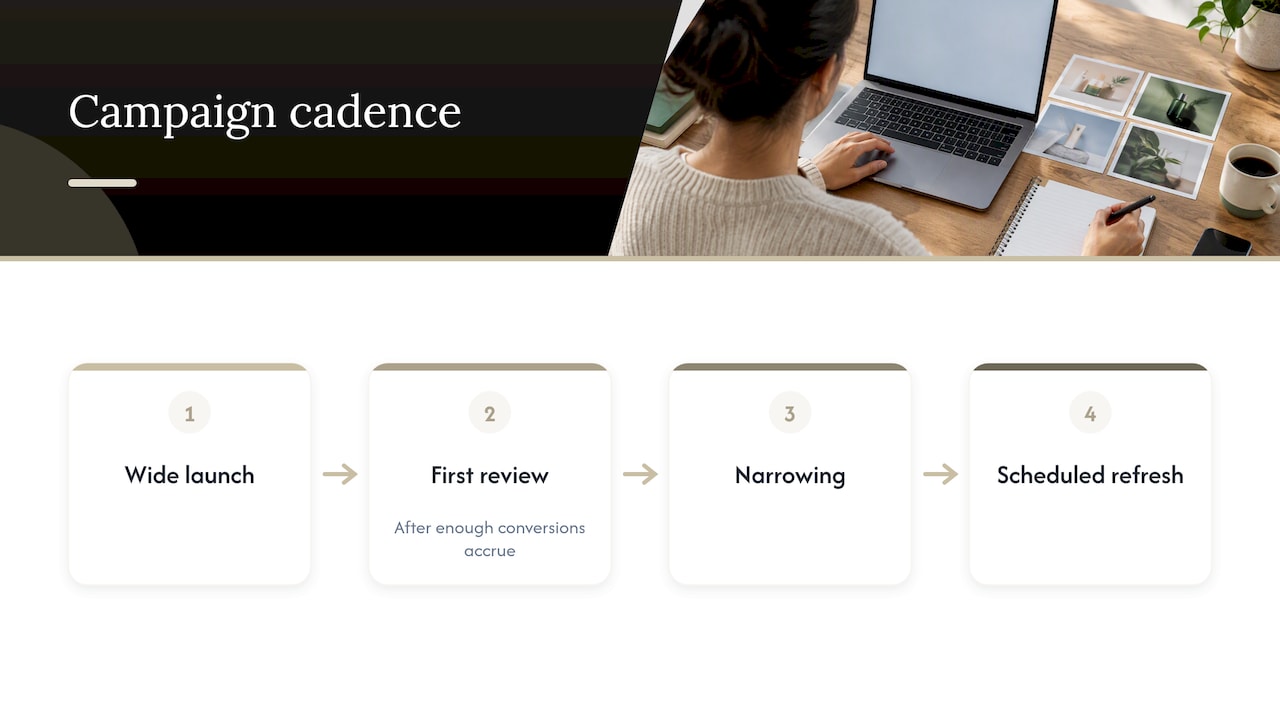
Finally, plan the cadence: an initial wide launch, a first review once enough conversions accrue, a narrowing step, and a scheduled refresh. Teams that skip the refresh step often watch good ads quietly decay.
If you would rather have senior operators build and run this plan with you, that is exactly what our ChatGPT Ads management work covers.
What do strong ChatGPT ad creative examples look like?
We will not invent results, so here are illustrative patterns that follow the rules above, clearly framed as examples rather than reported campaign data.
A bookkeeping service for freelancers. Angle one: title “Catch up on bookkeeping before tax season,” description about a flat-rate cleanup for freelancers who fell behind. Angle two: title “Separate business and personal spending,” description about categorizing transactions from linked accounts. Same product, two distinct buyer moments, two ad groups with their own context hints.
A home goods retailer. For a visual placement, the image is a single, well-lit shot of a compact desk in a small apartment. The title promises a workspace that fits a studio, and the description names dimensions and delivery. No overlaid text, one focal point, high contrast.
A B2B scheduling tool. A text-first card extends a conversation about reducing no-shows. The title names the outcome, the description explains automatic reminders for appointment-based teams, and the landing page opens on that exact feature, not a generic homepage.
What these share: each ad answers a specific question, each description adds detail the title omitted, and each destination finishes the task. For documented agency learnings from live accounts, read what we’ve learned from ChatGPT ads.
How can you use audience data to personalize ChatGPT ad creative?
Personalization in ChatGPT starts with what you already know about buyers, translated into creative angles and context hints rather than individual targeting. Mine your first-party data for the patterns that matter: the questions customers asked before buying, the problems that appear most often in support tickets, the objections that stall deals, and the segments that convert at the best margin.
Each pattern becomes an angle. If your best customers are agencies with small teams, write a title and context hint for that exact situation. If a common objection is setup time, write a variation that speaks to speed and names the number of steps involved.
Customer reviews and sales call notes are especially useful because they contain the words real buyers use. Matching that language makes an ad read like a helpful reply to the way people actually ask.
Keep privacy in mind. The goal is to describe moments and needs, not to follow individuals, and OpenAI frames its measurement work around protecting privacy. Use customer data to learn what to say, then let context hints and ad group structure decide where it appears.
Finally, feed results back in. Conversions by ad group show which segments respond, and that tells you where to deepen personalization and where to stop investing effort.
How does ChatGPT creative fit with your Google Ads campaign goals?
Treat ChatGPT as one stage in the same funnel your Google Ads already serve, not a separate experiment. People often ask a research question in ChatGPT and later search by brand or product name on Google, so the two channels influence each other.
Align the goals first. If Google Ads is driving qualified leads at a target cost, set the ChatGPT conversion event to the same business outcome so reports compare like with like. Reuse what you have already learned: your best-converting Google headlines and your highest-margin product segments are strong starting angles for ChatGPT creative.
Watch for overlap in attribution. A ChatGPT ad might start a journey that a branded Google search finishes, and last-click reporting will credit Google. That is why cross-channel attribution and incrementality testing matter, so you do not cut a channel that is quietly feeding another.
Keep naming conventions and UTMs consistent across both platforms so analytics can stitch the path together. If your Google Ads account needs a cleaner structure before you add another channel, our Google Ads management team handles account restructures and conversion tracking, and the free Google Ads audit is a low-friction way to see where you stand.
What automation and AI tools help generate and scale ChatGPT ad creative?
AI is a sensible way to draft creative at volume, as long as a person decides what is worth running. Use a language model to generate many candidate titles and descriptions from a brief, then edit hard. The brief matters more than the tool: give it the buyer moment, the benefit, the audience, and the proof points, and ask for genuinely different angles instead of rephrasings.
A caution on shortcuts: the “Add new ad” feature in Ads Manager pre-fills drafts from website metadata, which is a convenient starting point but not a testing strategy. Treat the draft as raw material, then write distinct angles on top of it.
Automation helps most in the unglamorous work: generating variations to a template, resizing and cropping images, tagging UTMs consistently, and flagging ads that fall below your thresholds. For visibility and positioning inside ChatGPT’s wider ecosystem, platforms like the one covered in Babylovegrowth discuss storytelling approaches that can inform your phrasing.
Whatever you automate, keep a human on three decisions: whether a claim is accurate, whether an image is relevant, and whether a variation is truly distinct. Those checks protect you from policy rejections and from burning budget on near-duplicates.
Why does senior-led testing change creative decisions?
In our experience, the fastest way to waste a ChatGPT budget is to run many look-alike ads and read noise as insight. Senior oversight changes that: someone who has seen how tests fail decides which angles are truly different, sets the guardrails before data arrives, and refuses to cut winners early. That discipline saves spend and shortens the path to a result you can trust. If you want that kind of review on your own account, we offer a free audit and are glad to look.
— Eric
Get senior-led help launching and measuring ChatGPT ads
If you would rather not build this from scratch, we run it for you. Here is what we bring to ChatGPT Ads:
- Senior-led ChatGPT Ads management, with direct oversight of your account
- Pixel setup and verification
- Campaign launch and structure, from ad groups to context hints
- ChatGPT Ads audits of existing setups
You own the account throughout, and strategy comes in writing with attribution you can take to your CFO. Our focus is businesses spending serious budget on paid media who want measurable returns.
Ready for a second pair of expert eyes? Book a free strategy audit or see our ChatGPT Ads agency services and tell us what you are trying to achieve.
FAQ
What are some creative prompts I can use in ChatGPT?
For ad copy, give the model the buyer moment, the benefit, the audience, and the proof point, then ask for several distinct angles rather than rewordings. A useful prompt is: “Write five ad titles for [audience] who need [outcome] when [situation], each built on a different motivation.” Edit every output for accuracy before you upload.
Who is making the ChatGPT ads?
OpenAI operates the advertising program and publishes the formats, ad policies, and measurement tools. The ads themselves are created by advertisers, either in-house or with an agency, then reviewed against those policies before they run.
What will ChatGPT ads be like?
They are designed to feel useful rather than disruptive, with concise, benefit-focused text and, in some placements, a simple image. OpenAI has also announced a new visual ad format to help people imagine products and services.
How do I measure whether my ChatGPT ads work?
Install the pixel, add the Conversions API where possible, and connect a measurement partner if you use one. OpenAI lists AppsFlyer, Triple Whale, Northbeam, and Measured among its integrations, which support conversion linking and incrementality experiments.
Are context hints the same as keyword targeting?
No. Context hints describe the conversations or situations where your ad is useful, and they guide relevance rather than acting as hard targeting. Write them to say what the product does, who it helps, and when it fits.
Sources
- Create Ads for ChatGPT Ads | OpenAI Help Center
- More ways to measure ChatGPT Ads | OpenAI Ads
- Building advertising for the way people use AI | OpenAI