
Expect early ChatGPT Ads results to land near a 0.5% median CTR, with CPCs that can clear well above platform suggestions, and treat any conversion figure as provisional until your pixel, Conversions API, and view-through reporting are verified. No published number is a universal benchmark. Run a measured pilot and compare it against your own historical campaigns.
TL;DR:
- Industry reporting puts median CTR near 0.5% and the top quartile near 1.0%; treat both as context, then segment by objective and conversation depth.
- Pair the browser Pixel with the Conversions API, reuse event IDs to deduplicate events, and verify one real conversion end to end before meaningful spend.
- Report click through and view through conversions separately, label modeled results, and use a geo lift or audience holdout test to assess incremental impact.
- Compare campaigns with your own history using the same conversion event, audience cohort, offer, and margin before deciding whether to scale.
Table of Contents
- What do realistic ChatGPT Ads benchmarks look like for CTR, CPC, and ROAS?
- Why do ChatGPT Ads benchmarks vary so much between advertisers?
- How should you set up the pixel and Conversions API?
- How do you test results and know if the ads are incremental?
- What budget and bids should you plan for early tests?
- How do you compare ChatGPT Ads with your historical channels?
- Which KPIs matter beyond CTR and CPC?
- How do benchmarks differ across awareness, consideration, and conversion?
- How do creative and prompt choices change ad performance?
- How should you read benchmark swings from seasonality and outside factors?
- How do you fold ChatGPT Ads benchmarks into multi-channel measurement?
- What do we recommend after running senior-managed ChatGPT Ads tests?
- Get a measurement-first ChatGPT Ads pilot built for you
- FAQ
- Sources
What do realistic ChatGPT Ads benchmarks look like for CTR, CPC, and ROAS?
Start with CTR, the metric everyone quotes first. Industry reporting puts the median near 0.5%, the top quartile around 1.0%, and the highest observed result at 5.4%. Treat these as context, not promises. OpenAI itself describes measurement infrastructure rather than a canonical industry average, so your own market, objective, and audience set the real baseline.
Cost is where surprises happen:
- CPC: OpenAI suggests $3–$5 starting bids, but pilots have seen real B2B intent clear at $15–$20, according to Graphite’s playbook.
- CPM: Impression-based billing changes the math, so compare it to clicks only after converting both to cost per outcome.
- CPA and ROAS: These vary by advertiser. Some pilots show higher CPC but acceptable ROAS, so judge outcomes, not click price.
WeightWatchers’ CPA came in 15.3% below its blended paid-search benchmark in a partner-measured case study, and it reflects one advertiser’s result under one measurement method, not a population average.
Why do ChatGPT Ads benchmarks vary so much between advertisers?
A single blended CTR hides the factors that move performance most. Conversation depth is the biggest one: ads can appear on an early turn or deep into a long exchange, and Similarweb reports that impressions differ by turn. It recommends separating early-turn from deeper-conversation exposure instead of comparing one blended CTR with Google Search.
Objective and billing model also reshape the numbers. A Views objective billed on CPM, a Clicks objective billed on CPC, and a Conversions objective each optimize toward different behavior, so their reported CPC and CPM are not interchangeable.
Build your reporting with these fields from day one:
- Conversational turn
- Campaign objective and billing type
- View-through eligibility
- Creative format
- Landing page
- Audience cohort
Pro Tip: Log conversational turn as its own column before launch. Adding it later means rebuilding a report you have already presented.
For deeper audience signals that complement this segmentation, see our guide to ChatGPT Ads targeting.
How should you set up the pixel and Conversions API?
Measurement setup changes your conversion totals more than any bid adjustment. OpenAI’s documentation separates the Pixel (browser actions), the Conversions API (server-recorded actions), and hybrid setups. Using both with shared event IDs helps prevent duplicate conversions and improves measurement quality.
Work through the setup in this order:
- Install the browser Pixel and confirm that events fire on the right pages.
- Send server-side events through the Conversions API, including confirmed orders and registration completions.
- Reuse the same event ID and Pixel ID on browser and server events so duplicates collapse into one conversion.
- Preserve click references (oppref/obref) through every redirect and attach them to server-side events when available.
- Check Event Quality Score as a health signal for your instrumentation, and fix low scores before trusting results.
Expect modeled conversions to appear in reports, and note that when a view-through and a click both qualify, the click takes precedence.
Pro Tip: Test one real conversion end to end, from ad click to server event, before you spend meaningful budget. One traced conversion exposes broken redirects faster than a dashboard review.
How do you test results and know if the ads are incremental?
Interpretation starts with reporting more than one attribution view. OpenAI advises evaluating click-through, view-through, attribution, and incrementality together rather than judging the channel by CTR. View-through matters here because users often keep chatting instead of clicking. In an early global analysis, 52.7% of eligible one-day view-through conversions occurred within an hour of matched impressions, though that is OpenAI’s own analysis, not an independent benchmark.
Do not expect platforms to agree. Per OpenAI’s Help Center, Ads Manager, analytics tools, and other ad platforms can report different totals because of attribution windows, consent conditions, timestamps, deduplication, and modeled reporting. A mismatch is not automatically a tracking failure.
To test incrementality:
- Run a geo-lift test, pausing ads in matched regions to see what disappears.
- Hold out a random audience group and compare conversion rates.
- Use tag-based experiments for smaller accounts.
- Bring in a third-party measurement partner when budgets justify it, remembering that OpenAI calls incrementality work early-stage.
Let the campaign stabilize before reading results, and label modeled conversions separately in early analysis.
What budget and bids should you plan for early tests?
Treat the first spend as paid learning, not a performance campaign. Graphite’s playbook suggests planning for $5k–$10k per month in many B2B pilots, since smaller budgets rarely produce enough clicks to read.
- Start from the platform’s $3–$5 suggested CPC, but expect to bid higher on competitive B2B intent. Pilots have seen $15–$20 clear.
- Bid high enough early to win delivery, then trim once you see stable data.
- Watch pacing closely: daily budgets can be averages rather than caps, so check spend several times before concluding a campaign is underdelivering.
- Move budget toward scale only after instrumentation, incrementality, and unit economics all hold up.
How do you compare ChatGPT Ads with your historical channels?
Your own history beats any published average. Measurement frameworks such as SurveyMonkey’s recommend benchmarking against your own campaigns first, using category ranges only as context. Use this checklist:
- Compare on the same conversion event, not the same headline CTR.
- Compare at the cohort level, matching audience, offer, and margin.
- Treat category medians as illustrative, and weight your historical baseline most.
- Before scaling, confirm the required incremental lift, your target CPA or ROAS, and healthy instrumentation.
For the value side of this math, see how we measure ROI from ChatGPT Ads.
Which KPIs matter beyond CTR and CPC?
CTR and CPC describe the click, not the business. Because ChatGPT is a conversational surface, consider a wider set of campaign goals and the KPIs that fit each one.
For awareness goals, track impressions, view-through conversions, and the share of impressions landing at different conversation depths. For consideration, track engagement depth: how far a user continues the conversation after seeing the ad, how many pages they view on arrival, and how long they stay. For conversion goals, track cost per qualified lead or purchase, conversion value, and new-customer share.
Retention metrics deserve a place too, even though they sit downstream of the platform. Return visits, repeat purchases, and subscription renewals from ChatGPT-sourced customers show whether the channel brings people who stay. Partner studies hint at this value: one reported finding put 67% of Dose’s incremental purchases from net-new customers.
Pick one primary KPI per campaign goal and a short list of supporting ones. A long scorecard can hide the decision you actually need to make.
How do benchmarks differ across awareness, consideration, and conversion?
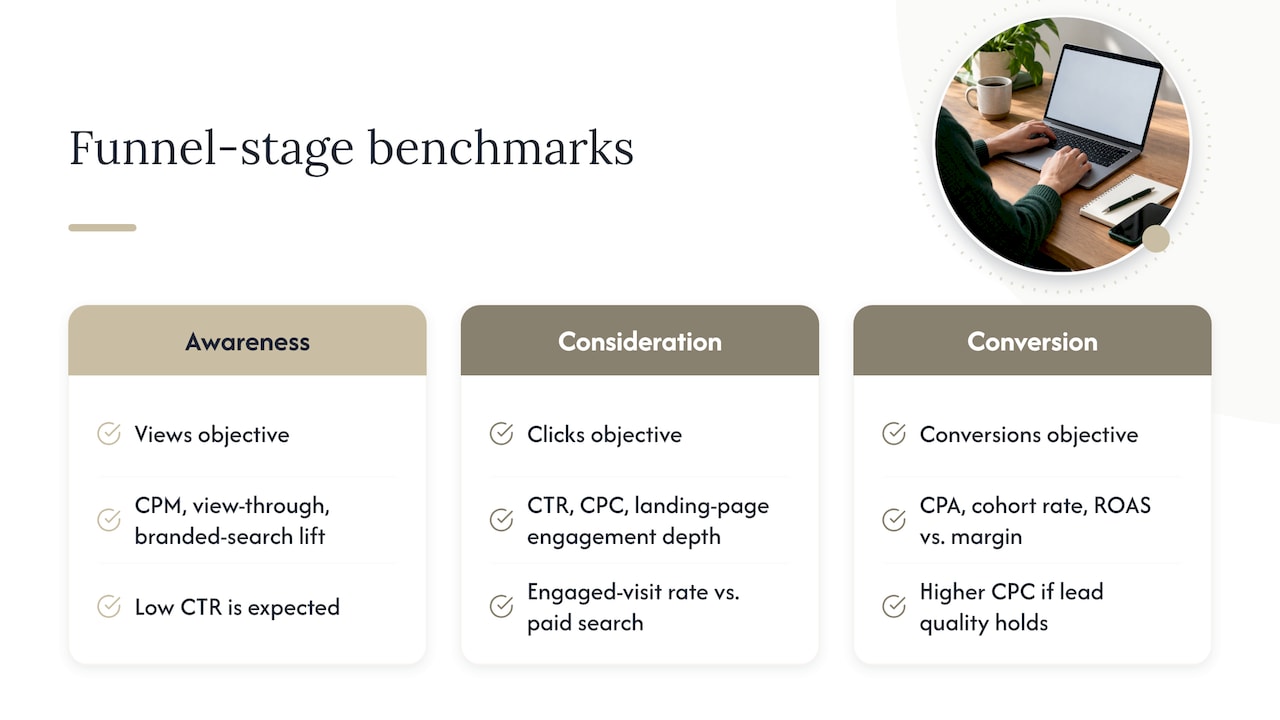
A funnel stage changes what “good” means, so benchmark each stage against its own job.
Awareness. Suppose you run a Views objective for a new software category. Judge it on cost per thousand impressions, view-through conversions, and branded search lift in the following weeks, not on CTR. A low CTR here is expected, because people often keep chatting rather than click.
Consideration. Say you promote a comparison guide on a Clicks objective. Here CTR, CPC, and engagement depth on the landing page matter most. Compare your click-to-engaged-visit rate against the same offer on paid search, segmented by conversation turn.
Conversion. Now imagine a Conversions objective for demo requests. The yardsticks include CPA, conversion rate by cohort, and ROAS against your margin target. Compare against your best-performing search campaign for the same conversion event, and expect a higher CPC as part of the trade if lead quality holds.
Keep these illustrative setups separate in reporting. Blending them yields an average that describes none of them, and it can push you to cut an awareness campaign for failing a conversion test it was never built to pass. A partner perspective from the performing arts sector shows how funnel goals shift by industry and attribution needs.
How do creative and prompt choices change ad performance?
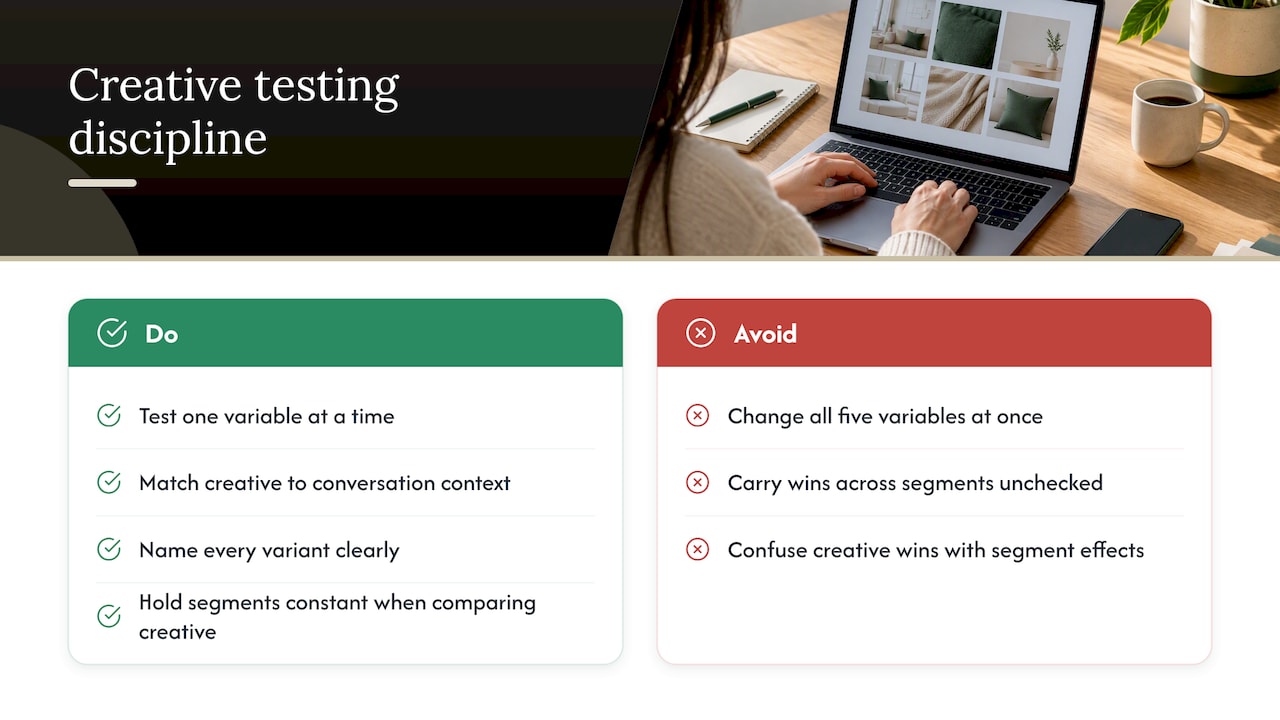
Creative is one lever you can control directly, and testing it may affect performance alongside bids. Test one variable at a time: headline, offer, image, call to action, or landing page. Changing all five at once teaches you nothing.
Because ads sit inside a conversation, relevance to the surrounding topic matters. Messaging that echoes the question a user is exploring tends to read as helpful, while generic brand copy reads as interruption. Write creative variants for distinct intents, such as researching, comparing, and ready to buy, and map each to the conversation context where it fits.
Prompt engineering applies in a narrower sense for advertisers: it governs how you shape the context signals, themes, and offer framing you submit, and how you brief your own team when drafting variants. Document every variant with a clear name so results trace back to a specific idea.
Do not carry a creative result across segments without checking. A variant that wins on early-turn exposure may lose deeper in a conversation. Hold creative constant while you compare benchmarks across segments, and hold segments constant while you compare creative. That discipline keeps a creative win from being mistaken for a segment effect.
How should you read benchmark swings from seasonality and outside factors?
A weekly dip is not a verdict. Before reacting, ask what changed outside the account. Retail peaks, quarter-end budget cycles, holidays, and industry events all shift click behavior and competition for the same intent.
Because the channel is new, platform changes also move results. OpenAI has added a Conversions objective, view-through measurement, and measurement partners, and Graphite’s analysis reports CTR climbing 112% since launch in one dataset. A benchmark from last quarter may describe a product that no longer exists.
Use a simple triage:
- Check measurement first: did tagging, consent rules, or attribution windows change?
- Check delivery: did budget pacing or bids change?
- Check the calendar: does the swing match a known seasonal pattern in your own history?
- Check the market: did competitors enter or leave your intent set?
Compare against the same period in prior years on your other channels, and give ChatGPT Ads at least a full cycle before you declare a trend. For a channel this young, wait for a pattern to repeat before you rewrite the plan around it.
How do you fold ChatGPT Ads benchmarks into multi-channel measurement?
No channel should be judged alone. Trade coverage of the topic, including Ad Age’s guidance on measuring ChatGPT ads as part of the marketing mix, stresses building measurement into tests from day one so the channel fits a single view of performance.
In practice, define one conversion event and one value model shared by every channel. Then reconcile the numbers: expect platform-reported totals to disagree, and use a neutral source such as your analytics platform or CRM as the tiebreaker. If you use a third-party attribution or incrementality tool, run ChatGPT Ads through the same system as your search and social spend so results are comparable.
Watch for cross-channel effects. ChatGPT exposure can lift branded search or direct traffic without a click, which is why view-through and incrementality testing matter. If branded search rises as ChatGPT spend rises, a last-click report will credit search and understate the new channel.
Finally, report at the portfolio level: blended CPA, blended ROAS, and new-customer share across channels, with ChatGPT Ads shown as one line. Decisions about scaling should then come from marginal returns, meaning what the next dollar earns here versus in the channel you would take it from.
What do we recommend after running senior-managed ChatGPT Ads tests?
Our approach is simple and not glamorous: senior oversight on every account, instrumentation before spend, and cohort benchmarking before scale. We verify the pixel, Conversions API, and deduplication first, because tests built on broken tracking produce confident wrong answers. Measurement quality matters when deciding whether a result can be trusted. Read more in our 2026 ChatGPT Ads write-up. If you qualify, the next step is a focused audit and pilot with measurement verification.
— Eric
Get a measurement-first ChatGPT Ads pilot built for you
We set up and verify your ChatGPT Ads pixel, structure the campaign launch, wire conversion tracking and attribution, and run senior-led optimization so your scaling decision rests on trustworthy numbers. We also offer a free audit to find where your measurement is leaking. See our ChatGPT Ads services or book the free audit to start a strategy conversation.

FAQ
What is a good CTR for ChatGPT Ads?
Industry reporting cites a median around 0.5% and a top quartile near 1.0%, but no single number is a universal benchmark. OpenAI’s measurement documentation describes infrastructure rather than an industry average, so build your baseline by objective, audience, and conversation depth.
How much does a ChatGPT Ads click cost?
OpenAI suggests starting bids of $3–$5 per click, while pilots have seen real B2B intent clear at $15–$20, per Graphite’s playbook. Your cost depends on competition for your intent, so test and adjust.
Why do my ChatGPT Ads conversions differ from my analytics?
Platforms count conversions differently because of attribution windows, consent conditions, timestamps, deduplication, and modeled reporting. OpenAI’s Help Center notes that a mismatch is not automatically a tracking failure.
Should I use the pixel or the Conversions API?
Use both. The pixel captures browser actions and the Conversions API captures server-recorded actions, and sharing event IDs between them prevents duplicate counting and improves matching.
How do I know ChatGPT Ads are driving new business?
Report click-through and view-through together, then run a geo-lift or holdout test. Incrementality testing can help distinguish net-new conversions from ones that would have happened anyway.
Sources
- Building advertising for the way people use AI | OpenAI
- Conversion Measurement | OpenAI Help Center
- Conversion Tracking
- AI Advertising: How Advertising Works on AI Platforms | Similarweb
- More ways to measure ChatGPT Ads | OpenAI Ads