
For most advertisers running Google Ads in 2026, the right starting point is broad match paired with Smart Bidding, but only when your conversion tracking is solid. If your measurement is weak or your campaign is new, phrase match gives you tighter control while you build the data the algorithm needs.
- Choose broad match + Smart Bidding when you have reliable conversion signals, a mature campaign with 30+ conversions per month, and a clear conversion value wired in. Google notes that 15% of daily search queries are new, so a manually curated keyword list will always leave discovery on the table.
- Choose phrase match when you’re running manual or enhanced CPC bidding, launching a new campaign without conversion history, or protecting a specific intent (brand terms, competitor terms, local service queries).
- Use exact match for brand campaigns and high-value, high-confidence terms where any variation is a waste.
North Country Consulting’s account work consistently shows the same pattern: accounts that switch to broad match before fixing their measurement see budget bleed fast. Get the signals right first.
Table of Contents
- What broad match and phrase match actually do in Google Ads
- How match types evolved and what that means today
- How broad and phrase match compare across what actually matters
- When to choose broad match vs phrase match for your campaign
- How to roll out broad or phrase match without wasting budget
- Key Takeaways
- Why signal engineering matters more than match type selection
- North Country Consulting manages match types at the account level, not in isolation
- Useful sources
What broad match and phrase match actually do in Google Ads
Keyword match types control which search queries trigger your ads. Google Ads offers three: broad match, phrase match, and exact match. The syntax is simple.
- Broad match: Enter the keyword as plain text, no symbols. Example:
running shoes - Phrase match: Wrap the keyword in quotation marks. Example:
"running shoes" - Exact match: Wrap the keyword in square brackets. Example:
[running shoes]
Broad match is the default. If you paste keywords into Google Ads without any formatting, they go in as broad match automatically.
How broad match works in practice: Google doesn’t just look for your keyword. It looks for related intent. If your keyword is auto parts, broad match might serve your ad for a query like car components near me or even vehicle repair supplies because the underlying intent overlaps. Google’s own documentation confirms that broad match can match queries that share no words with your keyword, as long as the intent aligns. That’s powerful when the algorithm is well-fed. It’s expensive when it isn’t.
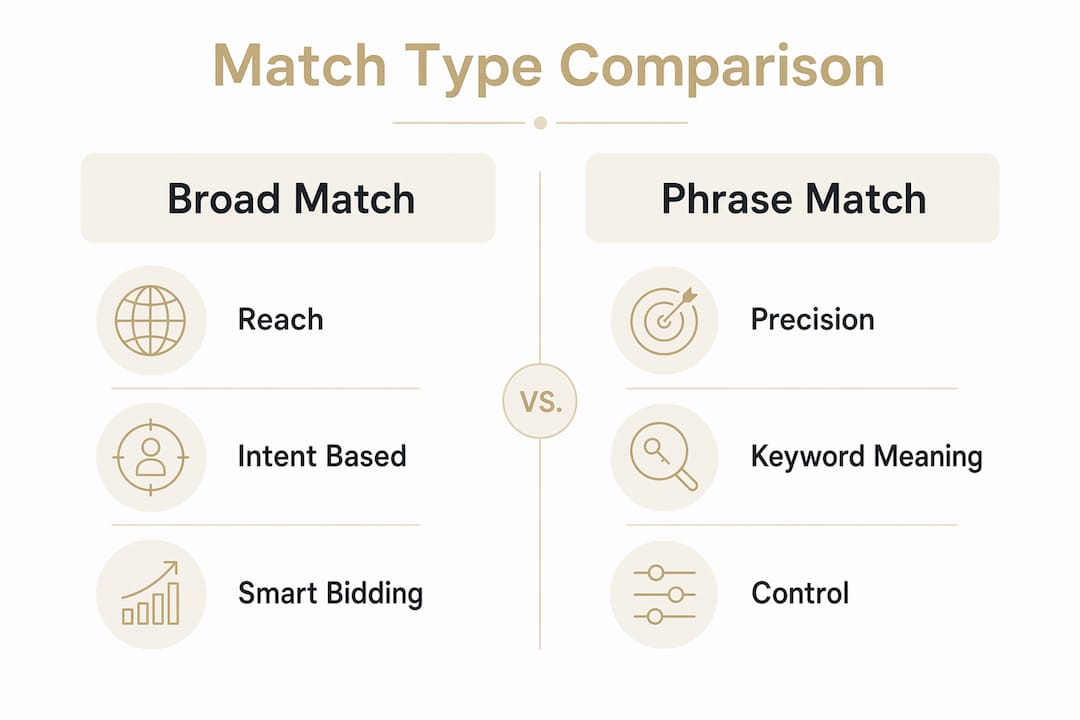
How phrase match works: Phrase match requires the meaning of your keyword to be present in the query. Extra words can appear before or after, and Google allows minor rewording if the intent stays the same. So "running shoes" might match best running shoes for women or buy running shoes online, but it won’t match casual sneakers or athletic footwear because the core meaning shifts. Phrase match generates more impressions than exact match but fewer than broad, sitting in the middle of the reach spectrum.

A quick illustration of expected matching behavior:
| Your keyword | Match type | Query that triggers | Query that doesn’t |
|---|---|---|---|
| running shoes | Broad | trail running gear | dress shoes |
| “running shoes” | Phrase | best running shoes for men | athletic footwear |
| [running shoes] | Exact | running shoes | buy running shoes online |
How match types evolved and what that means today
Understanding the current state of matching requires knowing what changed, because a lot of legacy advice online is built on a Google Ads that no longer exists.
Key changes over the past several years:
- Close variants (2017–2019): Google expanded exact and phrase match to include misspellings, plurals, abbreviations, and reordered words with the same meaning. Exact match stopped meaning “only this exact query.”
- Broad match modifier (BMM) deprecation (July 2021): BMM, which used a
+keywordsyntax to require specific words in a query, was retired. Google migrated existing BMM keywords to phrase match automatically. New BMM keywords can no longer be created. - Phrase match absorbed BMM behavior: After the migration, phrase match became more expansive. It now covers many of the use cases BMM handled, requiring the phrase meaning to be present while allowing word order flexibility.
- Broad match intent improvements (2022–2026): Google’s AI-based matching for broad match has gotten significantly better at filtering for intent, especially when paired with Smart Bidding signals like conversion value, audience data, and landing page context.
The practical consequence: if you’re still running legacy BMM keywords, editing those keywords converts them to phrase notation. Review them to confirm they behave as intended.
Many advertisers try to recreate BMM behavior by using very restrictive phrase match keywords. That approach tends to miss the broader intent-based opportunities that broad match with Smart Bidding now surfaces. The old playbook of layering match types for coverage has largely been replaced by a signal-first approach: one keyword, broad match, strong conversion data, let the algorithm do the filtering.
How broad and phrase match compare across what actually matters
The decision between these two match types comes down to six practical dimensions.
| Dimension | Broad match | Phrase match |
|---|---|---|
| Reach / volume | Highest; matches related intent and novel queries | Mid-range; more than exact, less than broad |
| Relevance / intent match | Strong with Smart Bidding; risky without it | Consistent; requires phrase meaning to be present |
| Control / irrelevant query risk | Low control without negatives; high risk on manual CPC | Moderate control; predictable query patterns |
| Best-for use cases | Discovery, scaling proven campaigns, new audience segments | Precision campaigns, limited budgets, new accounts |
| Smart Bidding interaction | Designed for it; broad match + Smart Bidding is Google’s recommended architecture | Works with Smart Bidding but doesn’t require it |
| Management overhead | High: daily search terms review, aggressive negative lists | Moderate: weekly review cadence, lighter negative workload |
Broad match use cases that work:
- Scaling a mature e-commerce campaign where tROAS is established and conversion value is wired in
- Discovery campaigns for new product categories where you don’t yet know the full query universe
- High-budget accounts where the algorithm has enough conversion data to filter effectively
Phrase match use cases that work:
- New campaigns without conversion history
- Brand protection and competitor campaigns where intent specificity matters
- Local service businesses where irrelevant geographic or service queries waste budget fast
On “near me” queries: Both match types can trigger for local intent queries. Phrase match gives you more predictable coverage for "plumber near me" type searches. Broad match might surface related local queries you hadn’t considered, but it also risks matching unrelated local services. For tight local budgets, phrase match is the safer default.
When to choose broad match vs phrase match for your campaign
The right match type depends on where your campaign sits in its lifecycle, not just your preference.

Early-stage campaigns (0–30 conversions/month): Start with phrase match. You don’t have enough conversion data for Smart Bidding to make reliable decisions, and broad match without that signal will burn budget on irrelevant queries. Phrase match offers a safer balance of volume and relevance when conversion data is thin.
Established campaigns with manual or enhanced CPC bidding: Phrase match remains the better choice. Without Smart Bidding, broad match lacks the quality filter that makes it viable. Broad match without Smart Bidding and without a disciplined negative keyword list can exhaust budget on irrelevant queries quickly.
Mature campaigns with Smart Bidding and strong conversion signals: This is where broad match earns its place. If you’re running Target ROAS or Target CPA with 50+ conversions per month and your conversion values reflect actual margin, broad match becomes a discovery engine. The algorithm filters which expansions are worth bidding on.
Three example campaign setups:
- Discovery/scale campaign: Broad match keywords + Target ROAS bidding + margin-based conversion values. Review search terms weekly, add negatives aggressively in the first 30 days.
- Precision/conversion campaign: Phrase match keywords + Target CPA or enhanced CPC. Tighter query control, lower management overhead, predictable CPL.
- Brand campaign: Exact match only. No reason to let Google expand brand terms. Every variation of your brand name gets its own exact match keyword.
For competitor campaigns, phrase match is almost always the right call. You want to capture queries that include the competitor’s name with purchase intent, not every loosely related query the algorithm might associate with that brand.
How to roll out broad or phrase match without wasting budget
This is where most accounts go wrong. The match type decision is step one. The operational setup is what determines whether it works.
Step 1: Wire your conversion signals before you launch. Before switching to broad match, confirm that your conversion actions are firing correctly, your conversion values reflect actual revenue or margin, and any offline conversions or call tracking are connected. Broad match optimizes toward whatever signal you give it. Garbage in, garbage out.
Step 2: Set your bid strategy to match your data maturity. New campaigns start on manual CPC or enhanced CPC with phrase match. Once you hit 30+ conversions per month, test Target CPA. Once conversion value is reliable, move to Target ROAS. Only then does broad match make sense as a primary match type.
Step 3: Build your negative keyword list before launch. Don’t wait for irrelevant queries to appear. Seed your negative list with obvious exclusions based on your product category. For a B2B SaaS company, that means negating consumer terms, job-seeking queries, and unrelated industries. A strong negative keyword strategy is the difference between broad match working and broad match bleeding.
Step 4: Follow a structured monitoring schedule.
- Days 1–7: Review search terms daily. Add any irrelevant high-impression queries to negatives immediately. Flag any unexpected query categories for bid adjustments.
- Days 8–14: Shift to every-other-day review. Look for patterns, not just individual queries. Are you matching a query category you didn’t intend?
- Days 15–30: Weekly review. Evaluate conversion patterns. If broad match is pulling in conversions at your target CPA or ROAS, let it run. If not, tighten to phrase.
- After 30 days: Make structural decisions. Pause underperforming ad groups, adjust bids based on conversion data, and consider whether any phrase match keywords are ready to convert to broad.
Step 5: Avoid duplicate keywords across match types. There is no benefit to bidding on the same keyword in both broad and phrase match when using Smart Bidding. Duplicates dilute algorithmic learning and complicate attribution. Pick one match type per keyword per campaign.
Pro Tip: Feed margin-based conversion values, not just revenue, into your Smart Bidding campaigns. When broad match optimizes toward profit rather than top-line revenue, it naturally deprioritizes high-volume, low-margin queries. This single change often improves broad match efficiency more than any keyword restructuring.
For a deeper look at identifying where broad match is wasting spend before it becomes a problem, North Country Consulting’s guide on Google Ads wasted spend walks through the diagnostic framework.
Key Takeaways
Broad match with Smart Bidding wins at scale when conversion signals are strong; phrase match is the right default when they aren’t.
| Point | Details |
|---|---|
| Match type depends on data maturity | Use phrase match for new or low-conversion campaigns; switch to broad match once Smart Bidding has reliable signals. |
| Broad match requires Smart Bidding | Without Smart Bidding, broad match lacks quality filtering and risks rapid budget waste on irrelevant queries. |
| BMM is gone; phrase match absorbed it | Broad match modifier was deprecated in July 2021; phrase match now covers most of those use cases. |
| No duplicate keywords needed | Bidding on the same keyword in both broad and phrase match dilutes Smart Bidding’s learning and complicates attribution. |
| North Country Consulting | Provides senior-led Google Ads management that wires conversion signals, structures match types correctly, and monitors search terms on a disciplined schedule. |
Why signal engineering matters more than match type selection
The debate over broad match vs phrase match often misses the bigger point: match type is a lever, not a strategy. The real work is in what you feed the algorithm.
Google’s matching logic has improved substantially with advances in intent-driven SEO strategies. Broad match in 2026 is not the same blunt instrument it was in 2018. When Smart Bidding has access to accurate conversion values, audience signals, and margin data, it makes better filtering decisions than most manual keyword lists ever could. The advertisers who get the most out of broad match aren’t the ones who picked the right match type. They’re the ones who built the measurement infrastructure that makes the algorithm useful.
Phrase match still has a clear role, and it’s not just for cautious advertisers. It’s the right tool for campaigns where intent specificity matters more than discovery, where budgets are tight, or where the account is still building the conversion history Smart Bidding needs. Treating phrase match as a fallback for “when you’re not ready for broad” undersells it. For competitor campaigns, brand protection, and high-CPL service businesses, phrase match is often the permanent answer, not a stepping stone.
The mistake most accounts make isn’t choosing the wrong match type. It’s choosing broad match before the measurement is ready, or sticking with phrase match long after the account has the data to scale. Both errors are expensive. The fix is the same: audit your conversion signals first, then pick your match type.
North Country Consulting manages match types at the account level, not in isolation
High-spend advertisers running $25,000 or more per month on Google Ads don’t just need match type advice. They need someone who will wire the conversion signals correctly, build the negative keyword infrastructure, and monitor search terms on a schedule that actually catches problems before they compound.
North Country Consulting’s Google Ads management is built around exactly this: senior-led account restructuring, margin-based conversion value setup, Smart Bidding optimization, and a search terms review process that runs on a real cadence. The average return on ad spend across managed accounts is 8.7×, across more than $40 million in managed spend. If your current setup has broad match running without a solid measurement foundation, or phrase match holding back a campaign that’s ready to scale, a strategy audit will show you exactly where the gap is. Request an audit to see what a properly structured match type strategy looks like for your account.
Useful sources
Official Google Ads documentation:
- About keyword matching options — Definitions, syntax, and match type overview from Google Ads Help
- Matching the most relevant keyword to every search — Google’s guidance on broad match + Smart Bidding, including the 15% new-query stat
- About changes to phrase match and broad match modifier — Official documentation on the BMM deprecation and phrase match migration
- Your guide to broad match — Google’s current broad match best practices and Smart Bidding pairing guidance
North Country Consulting resources:
- Google Ads broad match: when it works and when it doesn’t — Account-level analysis of broad match performance conditions
- Google Ads negative keywords strategy — Operational workflow for building and maintaining negative keyword lists
- Google Ads Smart Bidding strategies explained — How tCPA and tROAS interact with match type decisions
- Google Ads wasted spend: how to find and stop it — Diagnostic framework for identifying irrelevant traffic from broad match