
Branded keywords capture demand that already exists for your business; non-branded keywords create discovery that builds future demand. The action follows directly: protect your brand terms with efficient, low-cost coverage, and put your incremental budget and content effort into non-brand, where growth actually happens.
TL;DR:
- Branded search should be limited to demand capture, focusing on efficiency metrics such as ROAS, CPC, and impression share, rather than growth.
- Non-branded search is essential for building discovery, requiring content clusters aligned with buyer intent stages and monthly impression tracking.
- Automating classification tools can misidentify certain keywords, so manual judgment remains crucial to accurately separate brand, non-brand, and competitor queries.
- Most accounts should periodically test paid brand campaigns against organic traffic to determine if paid brand spend is redundant or necessary.
- Proper segmentation and senior-led audits of brand versus non-brand campaigns are vital to avoid blended reporting that misjudges growth potential.
Table of Contents
- Brand vs Non-Brand Search: Definitions and Classification Rules
- How Branded and Non-Branded Search Behave Across the Funnel
- Budget Split, Bidding, and Reporting Rules for Brand vs Non-Brand
- Winning Non-Branded Discovery While Owning Your Branded Results
- When to Bid on Branded Keywords and When to Trust Organic
- Common Mistakes and Reporting Red Flags to Fix Now
- North Country Consulting’s Approach to Brand and Non-Brand in High-Spend Accounts
- Why Most Teams Get the Brand vs Non-Brand Split Backwards
- Get a Senior-Led Review of Your Brand and Non-Brand Split
- Sources
Brand vs Non-Brand Search: Definitions and Classification Rules
A branded keyword includes your company or product name, or an unmistakable variation of it, like a common misspelling. A non-branded keyword describes the problem, category, or need without naming a specific vendor, the way someone searches before they know your company exists.
The edge cases are where teams get sloppy. Misspellings and abbreviations still count as branded. Product names tied exclusively to your company count as branded. But a brand name that’s also a common word (think “Delta” or “Square”) creates real classification noise. Competitor-brand searches, meanwhile, deserve their own bucket entirely, since they behave like branded intent but aren’t your traffic.
Google’s newer branded queries filter in Search Console automates this split, but the classification is AI-assisted rather than a fixed rule set, so it can misidentify edge cases occasionally. Semrush takes a similar approach: it flags queries containing your brand name or unique variations, then lets you filter and adjust from there. Neither tool replaces judgment.
Where classification typically breaks down:
- Common-word brand names getting swept into non-branded buckets
- Competitor-brand terms blended into your branded performance data
- Product SKUs or model numbers not recognized as brand-adjacent
- Regional spelling variants slipping through automated filters
How Branded and Non-Branded Search Behave Across the Funnel
Branded search sits at the bottom of the funnel. Someone typing your company name already knows who you are and is usually close to a purchase decision. Non-branded search sits earlier, often at the awareness or consideration stage, when a buyer is still comparing options or researching a problem.
The split varies more by company size than most marketers assume. Global brands often see branded search account for a much larger share of total volume than small and mid-sized businesses do, since Ahrefs cites a 42% branded share for large brands versus roughly 19% for SMBs. If your branded share looks unusually low, that’s often less about SEO weakness and more about how much offline or paid demand-generation activity you’re running.
The metric signature differs sharply between the two:
- Branded terms: high CTR, low CPC, high conversion rate, but a shrinking pool of new customers
- Non-branded terms: lower CTR, higher CPC, lower conversion rate, but access to buyers who’ve never heard of you
- Rising branded impressions over time often reflects PR, paid media, or word of mouth working, not organic content gains
- Rising non-branded impressions is the more reliable signal that your content is actually building discovery
Read your Search Console and ad platform reports as two separate trend lines, not one blended average, or you’ll misattribute growth to the wrong channel.
Budget Split, Bidding, and Reporting Rules for Brand vs Non-Brand
Most accounts fall into one of three modes, and knowing which one you’re in changes almost every decision downstream.
- Demand-capture mode. Early-stage or budget-constrained accounts should fund brand campaigns just enough to cover valid searcher demand, then stop. Nothing extra goes toward brand once impression share on branded terms is comfortably high.
- Balanced growth mode. Once brand demand is fully covered, additional budget shifts to non-brand clusters that have proven efficient in testing.
- Aggressive expansion mode. Mature accounts cap brand spend near actual demand and push most new dollars into non-brand experiments, even at a higher blended CPC, because the incremental customer volume outweighs the cost.
On bidding mechanics, use exact and phrase match on your own brand terms to control cost and message, and build negative keyword lists that keep brand and non-brand campaigns from cannibalizing each other’s traffic. A disciplined negative keyword strategy is often the single fastest fix for wasted brand spend.
Report brand and non-brand as separate KPI sets. Brand should be judged on efficiency (ROAS, CPC, impression share) since the demand already exists. Non-brand should be judged on incremental value: net new customers, assisted conversions, and cost per acquisition against a lifetime value benchmark, not just first-click ROAS.
Pro Tip: Run a brand holdout test for two to four weeks in a low-risk market, pausing paid brand ads while tracking organic clicks on those same terms. If organic absorbs most of the lost paid clicks, your paid brand spend is largely redundant.
Winning Non-Branded Discovery While Owning Your Branded Results
Non-branded search is where content-driven organic growth strategy earns its budget. Building topic clusters around the problems your buyers search before they know your name works better than chasing individual keywords one page at a time. Map content to intent stages: educational content for early research, comparison content for consideration, and case-study or pricing content near decision. Internal linking ties these stages together so a reader moving from “what is X” to “how much does X cost” never leaves your site.
Branded search requires a different kind of ownership. You need a strong brand or homepage that ranks first, positive third-party coverage, an active support or FAQ presence, and review or comparison content that doesn’t cede the SERP to competitors bidding on your name. Missing any of these gives competitors an opening on your own branded queries.
For measurement, the branded queries filter in Search Console is the starting point, but treat its output as directional. What matters more is watching your non-branded impressions trend over months, since that’s the clearest signal that your content investment is actually converting into new-buyer discovery rather than just serving people who already knew you.
- Build topic clusters mapped to pre-purchase questions, not just product keywords
- Secure brand-name SERP real estate with owned pages, PR, and support content
- Track non-branded impressions monthly as your leading discovery metric
- Cross-check Search Console’s branded filter against manual spot checks quarterly
When to Bid on Branded Keywords and When to Trust Organic
Not every account needs paid brand campaigns running indefinitely. The decision usually comes down to three questions.
- Are competitors bidding on your brand name? If a rival consistently appears above your organic listing on branded searches, paid brand defense is usually worth the modest spend.
- Does your organic listing already dominate the branded SERP? If your site holds the top organic spot with strong reviews and no aggressive competitor bidding, paid brand often adds cost without adding conversions.
- Is there urgency or a launch event driving branded searches? Product launches, PR spikes, or crisis moments justify temporary paid brand coverage even in otherwise organic-dominant accounts.
Test incrementality directly rather than guessing. Run a geographic split where one region gets paid brand ads and a matched region doesn’t, then compare organic click-through in both. Auction insights reports also reveal whether competitors are actually showing up on your brand terms, which tells you whether defense is a real necessity or a reflexive habit worth breaking.
Common Mistakes and Reporting Red Flags to Fix Now
Blending brand and non-brand into one performance number is the most common distortion in PPC and SEO reporting. A campaign with heavy brand traffic can look wildly efficient while masking a non-brand program that’s actually losing money, and vice versa.
Competitor-brand queries deserve a third bucket entirely, separate from both your brand and generic non-brand terms, since lumping them into either group skews cost-per-click and conversion-rate math in misleading directions.
- Build separate dashboards for brand, non-brand, and competitor-brand from day one
- Use regex filters in Search Console and Google Ads to enforce the split consistently
- Audit negative keyword lists monthly, since brand and non-brand campaigns drift into each other’s territory over time
- Recheck Search Console’s automated branded classification quarterly for false positives
Pro Tip: If your blended ROAS suddenly jumps, check whether it’s a brand-traffic seasonality spike before crediting your non-brand campaigns for the lift.
North Country Consulting’s Approach to Brand and Non-Brand in High-Spend Accounts
North Country Consulting has managed more than $40 million in ad spend and reports an average 8.7x return on ad spend across client accounts, with senior strategists directly rebuilding account structures rather than delegating to junior staff. That senior oversight matters most in brand and non-brand separation, because misclassified spend hides in blended reports for months before anyone notices the waste.
Applying this article’s framework means auditing existing campaigns for brand and competitor-brand bleed, rebuilding attribution so non-brand incrementality is measurable, and setting budget-split targets tied to account maturity rather than habit. The free strategy audit is where that assessment starts.
Why Most Teams Get the Brand vs Non-Brand Split Backwards
The conventional advice treats brand versus non-brand as a philosophical debate: some marketers insist paid brand is always wasteful, others treat it as untouchable. Both camps are wrong for the same reason. Neither has actually tested incrementality in their own account.
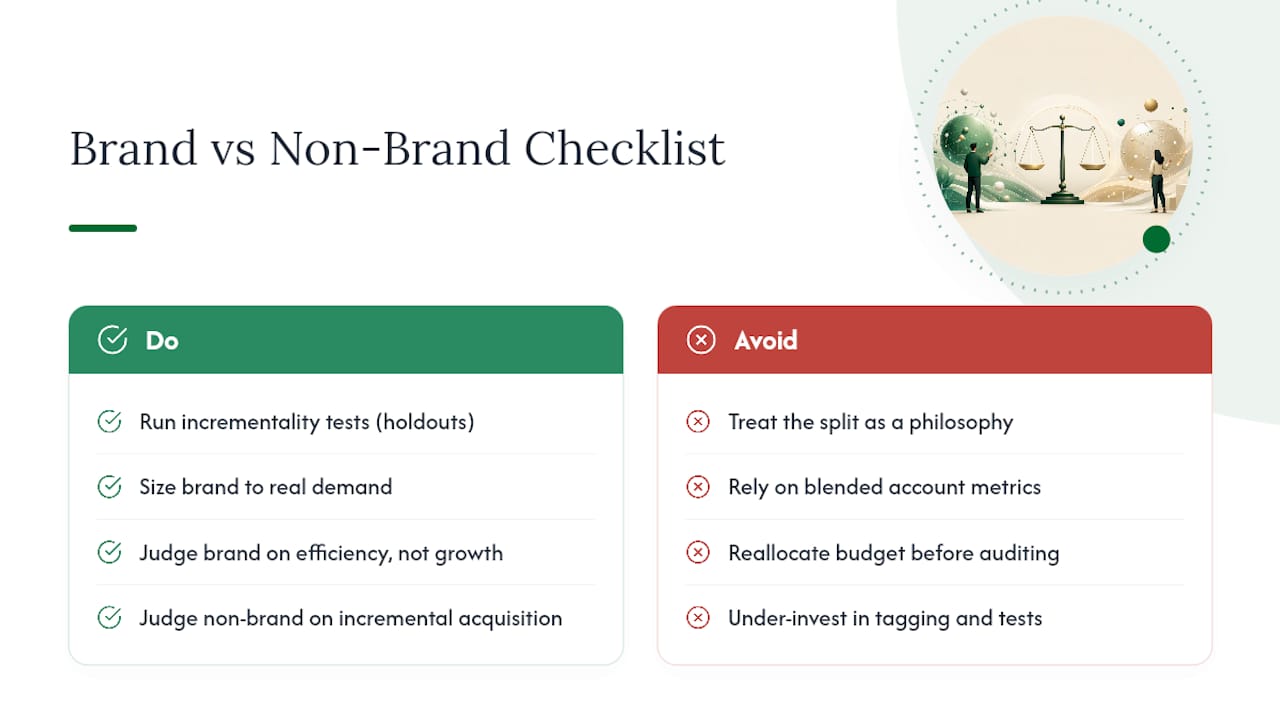
What the research supports is narrower and more useful. Brand campaigns should be sized to actual demand and judged on efficiency, not growth. Non-brand campaigns should be judged on incremental customer acquisition, even when the blended numbers look worse in the short term. The mistake I see most often isn’t overspending on brand. It’s under-investing in the measurement infrastructure, like clean UTM tagging, holdout tests, and separated dashboards, that would tell you which mode your account is actually in.
Prioritize the audit before the budget reallocation. You cannot fix a split you can’t see clearly, and most accounts have been reporting a blended number for so long that nobody remembers what the honest non-brand ROAS looks like on its own.
— Eric
Get a Senior-Led Review of Your Brand and Non-Brand Split
If your reporting still blends brand and non-brand into one number, you’re likely misjudging which campaigns actually drive growth versus which ones just collect existing demand. North Country Consulting rebuilds account structures and attribution models for businesses spending $25,000 or more a month on Google Ads, with senior strategists handling the work directly instead of routing it through junior account managers.
That direct, senior-led structure is why clients see the split fixed in weeks, not quarters, with clear separate KPIs for brand protection and non-brand expansion. The free strategy audit reviews your current brand and non-brand mix, flags where budget is misallocated, and shows where competitor-brand bleed might be inflating your reported costs. Request the audit and get a clear read on whether your paid brand spend is earning its place or just riding on demand you’d capture organically anyway.
Sources
- Introducing the branded queries filter in Search Console | Google Search Central Blog
- Branded search vs. non-branded search: What’s the difference?
- What is the difference between Branded and Non-branded keywords?
- Brand vs Non-Brand PPC Strategy Rules