AppsFlyer is the stronger default for most US campaign managers, and Adjust is the sharper tool for gaming studios and GDPR-sensitive apps. That’s the short answer. The longer one depends on your app’s fraud exposure, privacy requirements, integration needs, and how much you’re willing to pay for features that ship as add-ons rather than core functionality.
Pick AppsFlyer if you:
- Need the widest ad network coverage with the broadest partner integrations
- Run cross-channel attribution across mobile, web, and CTV
- Want a free entry point with the Zero tier (up to 12,000 monthly attributions)
- Value strong documentation and a high product direction score (9.2 on G2)
- Plan to scale past $50K monthly paid spend within the next year
Pick Adjust if you:
- Operate a gaming app or buy from high-risk ad networks
- Need GDPR-native data residency with a Berlin-based infrastructure
- Want the lightest SDK footprint among major MMPs
- Prefer proactive, rules-based fraud blocking over post-attribution detection
- Require raw data export and unlimited lookback windows as baseline features
Table of Contents
- How Adjust vs AppsFlyer actually differ on core features
- Which app types and business profiles fit each platform?
- Pricing models and the philosophy behind each platform
- Which platform should you choose?
- What real-world results look like on each platform
- How each platform handles scale and reliability
- How each platform evolves and what’s on the roadmap
- Key Takeaways
How Adjust vs AppsFlyer actually differ on core features
The two platforms share a long feature overlap: install attribution, post-install event tracking, SKAdNetwork support, deep linking, and fraud prevention. Where they split is in how those features are built and priced.
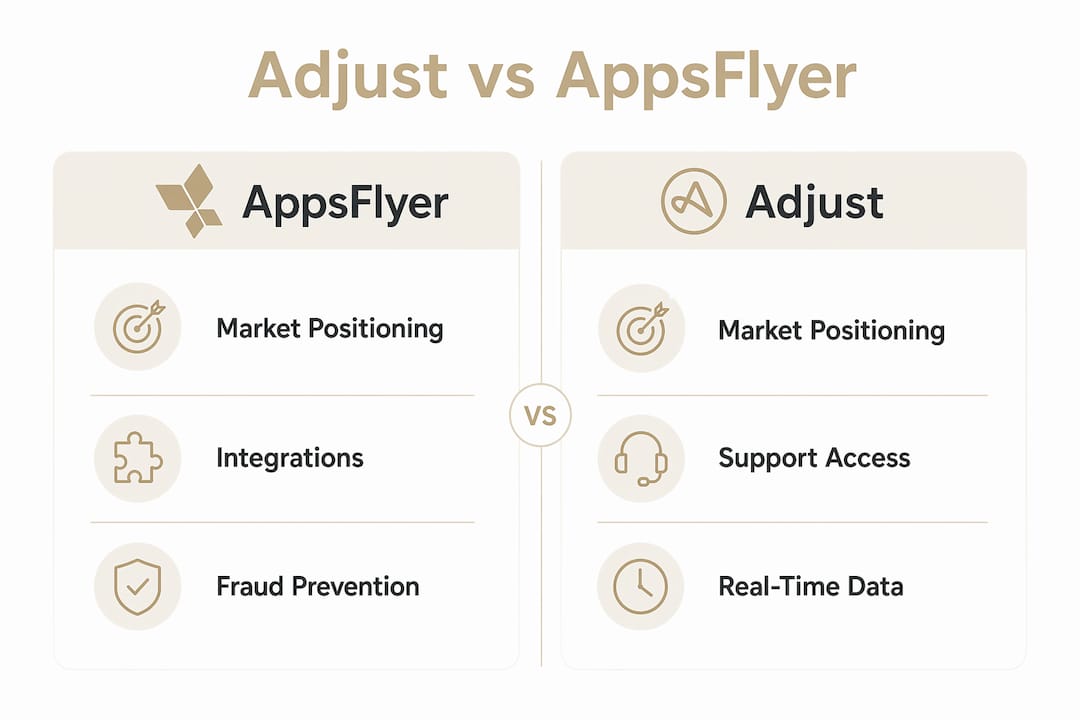
| Dimension | AppsFlyer | Adjust |
|---|---|---|
| Market positioning | Modern Marketing Cloud, productized suite | Measurement and analytics, data ownership focus |
| Network integrations | 8,000+ partner integrations | thousands of partners |
| Fraud prevention | Privacy-compliant detection, post-attribution reconciliation | Automated rules-based blocking, proactive pre-campaign |
| Data privacy | EU options available; strong iOS privacy tooling | GDPR-native, Berlin HQ, explicit data residency |
| Real-time features | G2 score — for real-time insights | G2 score — for real-time insights |
| Pricing structure | Zero (free/12K), Growth ($0.07/conversion), Enterprise | Free base (1,500/month), Core and Enterprise by quote |
| Ideal profile | Scaling apps, multi-channel marketers, subscription apps | Gaming studios, European apps, fraud-sensitive buyers |
On fraud prevention, the philosophies diverge sharply. AppsFlyer uses privacy-compliant detection methods that identify suspicious patterns without blocking traffic preemptively. Adjust runs automated rules that stop suspicious activity before it touches your campaign data. For gaming apps buying rewarded inventory from long-tail networks, Adjust’s approach tends to catch problems earlier.
AppsFlyer scores higher than Adjust across G2 categories including quality of support (8.6 vs. 7.5), attribution windows (9.0 vs. 8.1), custom event tracking (8.7 vs. 8.3), and cross-platform attribution (8.5 vs. 7.2). Adjust’s product direction score of 6.0 versus AppsFlyer’s 9.2 is a gap worth noting if roadmap alignment matters to your team.
AppsFlyer strengths:
- Broadest ecosystem coverage by a wide margin
- Superior cross-platform attribution (mobile, web, CTV, PC/console)
- Stronger documentation and onboarding resources
- Higher user satisfaction scores across most G2 categories
Adjust strengths:
- Lightest SDK footprint among major MMPs
- Proactive fraud blocking suited for high-risk inventory
- GDPR-native architecture with explicit data residency controls
- Raw data export and real-time callbacks as standard features
Which app types and business profiles fit each platform?
The MMP choice should match your app’s business shape, not just your feature wishlist.
Adjust fits best when:
- You’re a gaming studio buying rewarded or interstitial inventory from networks with elevated fraud rates
- Your app is European-focused or you serve users under GDPR and need documented data residency
- Your engineering team wants a lighter SDK that won’t drag app performance
- You have technical capacity to configure Adjust’s automation rules and data export pipelines
- Fraud prevention is a first-order concern, not an afterthought
AppsFlyer fits best when:
- You’re launching paid acquisition for the first time and want the safest, most widely supported default
- Your app runs subscription monetization and needs strong LTV and ROAS reporting
- You operate across multiple channels and need one attribution view that reconciles them cleanly
- You’re a mid-market or enterprise team that values a productized suite over modular configuration
- Your monthly attribution volume fits the Zero tier, making the entry cost zero
Budget sensitivity matters here too. Smaller teams with under $5K monthly paid spend can run AppsFlyer Zero without paying anything. Adjust’s free Starter tier is more restrictive and functions mainly as a trial rather than a production-ready option for most campaigns.
Pricing models and the philosophy behind each platform

AppsFlyer publishes its entry pricing clearly. The Zero tier covers up to 12,000 monthly attributions and includes core attribution, fraud filtering, SKAdNetwork support, and basic deep linking. Growth runs at $0.07 per conversion after that. Enterprise pricing requires a conversation, and premium modules like Protect360 and ROI360 sit behind additional gates.
Adjust’s pricing is less transparent at scale. The free Base tier covers up to 1,500 monthly attributions for up to 12 months. Core and Enterprise tiers require a quote. More importantly, the features most teams actually need — TrueLink deep linking, the Fraud Prevention Suite, Web Attribution, and Data Residency — are paid add-ons called Growth Solutions. That structure means the base cost understates what you’ll actually spend as your app scales.
Key pricing and philosophy points:
- AppsFlyer bundles capabilities into integrated modules; you pay for suites, not individual features
- Adjust prioritizes data ownership: unlimited lookback windows and no-charge data pulls are core positioning, but advanced features cost extra
- Adjust’s Growth Solutions add-ons can raise total cost unexpectedly as apps grow beyond initial tiers
- AppsFlyer’s pricing transparency reduces procurement friction, especially for startups and mid-market teams
- Both platforms price aggressively at high enterprise volume; neither is cheap at scale
Good analytics infrastructure compounds over time, and the platform you pick shapes how your attribution data flows into every downstream decision.
Which platform should you choose?
AppsFlyer is the right default for most US campaign managers running multi-channel paid acquisition. Its network coverage, documentation quality, and G2 user satisfaction scores make it the lower-risk starting point. If you’re scaling a subscription app or need maximum ad network reach, it’s the clear front-runner.
Adjust earns its place for gaming studios, European-market apps, and any team where fraud prevention is a hard requirement rather than a nice feature. Its lighter SDK and GDPR-native architecture solve real problems that AppsFlyer handles less precisely.
Strategic decision checklist:
- Match the platform to your app’s monetization model, not just your attribution volume
- Factor Growth Solutions add-ons into Adjust’s total cost before signing
- Test SDK weight if your app is performance-sensitive
- Verify that your key ad networks are supported before committing to either platform
- Plan for 18–24 months minimum before migrating; switching MMPs mid-campaign is expensive
Pro Tip: Before finalizing your MMP contract, ask both vendors to show you exactly how they reconcile SKAdNetwork and device-level data into a single number. The methodology gap between platforms is where reporting discrepancies actually originate.
Your attribution platform choice feeds directly into how you read campaign performance and allocate budget. Getting that layer right is worth the evaluation time.
What real-world results look like on each platform
Published G2 reviews surface a consistent pattern. AppsFlyer users cite deep linking reliability, click tracking across Facebook and Google, and fraud deduplication as standout strengths. One G2 reviewer noted that AppsFlyer’s deep linking “works better than any past partner” and eliminated internal flags about broken links entirely.
Adjust users consistently praise the account team accessibility and the ability to reach support for both technical and financial questions. The platform’s raw data export model also draws positive feedback from teams that pipe attribution data into their own analytics infrastructure.
Negative reviews exist on both sides. Some AppsFlyer users have flagged discrepancies between reported install data and App Store records. Adjust reviewers note that the Core and Enterprise pricing opacity makes annual budgeting harder than it should be.
How each platform handles scale and reliability
AppsFlyer is trusted by 15,000+ brands and 1 in 3 Fortune 500 companies, which gives it a dataset scale advantage that matters specifically on iOS. Larger attribution datasets produce more accurate probabilistic models under ATT constraints, and AppsFlyer’s volume translates directly into better iOS install visibility.
Adjust, with 300,000+ apps on the platform, handles significant volume and maintains a strong uptime record. Its real-time callback infrastructure and cloud storage export options are built for teams that need attribution data flowing into their own systems continuously, not just available in a dashboard.
How each platform evolves and what’s on the roadmap
AppsFlyer’s 9.2 G2 product direction score reflects active development and strong user feedback integration. Recent additions include AI-powered anomaly detection, a Data Clean Room for privacy-safe collaboration, and Signal Hub for enriched targeting. The platform’s investment in PC and console attribution also signals a push beyond mobile-only measurement.
Adjust’s 6.0 product direction score on G2 suggests slower perceived innovation relative to user expectations. That said, Adjust continues to refine its privacy-era measurement tooling and automation rules, with ongoing updates to its Extended Privacy Measurement framework for ATT-constrained environments.
If your team evaluates platforms partly on where they’ll be in two years, AppsFlyer’s roadmap momentum is a real differentiator.
Key Takeaways
AppsFlyer is the stronger default for most US campaign managers, while Adjust leads for gaming and GDPR-sensitive apps where fraud prevention and SDK weight are priorities.
| Point | Details |
|---|---|
| AppsFlyer leads on integrations | AppsFlyer offers the broadest partner integrations in the market, giving broader ad network reach. |
| Adjust wins on fraud blocking | Adjust’s rules-based proactive blocking stops suspicious activity before it affects campaign data. |
| Pricing transparency differs | AppsFlyer publishes a free Zero tier; Adjust’s Core and Enterprise costs require a quote. |
| Adjust add-ons raise total cost | Features like TrueLink and Fraud Prevention Suite are paid Growth Solutions, not included in base plans. |
| Platform direction favors AppsFlyer | AppsFlyer scores 9.2 on G2 product direction versus Adjust’s 6.0, reflecting stronger roadmap momentum. |
Your attribution setup shapes every budget decision downstream. If you want a senior-led review of how your current attribution model is affecting your Google Ads performance, North Country Consulting offers a free Google Ads audit that covers attribution gaps, account structure, and spend efficiency across your full paid acquisition stack.