
Both 6sense and Demandbase are 2026 Gartner Magic Quadrant Leaders for ABM platforms, and both pull from Bombora intent data underneath their own signals. The real question is architectural. 6sense is built prediction-first: its job is surfacing which accounts are entering a buying window before they raise a hand. Demandbase Inc is built advertising-first: its job is orchestrating coordinated multi-channel campaigns once you have a defined account list. Get that distinction right and the choice becomes obvious. Get it wrong and you have a six-figure tool your team opens twice a month.
CRM fit reinforces the split. 6sense integrates most deeply with Salesforce; Demandbase has the stronger HubSpot bidirectional sync. If your revenue operations lives in Salesforce and your biggest gap is knowing which accounts to work first, 6sense wins. If your stack runs on HubSpot and your primary gap is running account-based advertising at scale, Demandbase wins.
| Dimension | 6sense | Demandbase Inc |
|---|---|---|
| Architecture | Prediction-first revenue intelligence | Advertising-first account orchestration |
| Best for | Enterprises prioritizing predictive intent scoring and Salesforce-centric RevOps | Enterprises emphasizing account-based advertising, multi-channel activation, and HubSpot integration |
| ABM feature set | Intent data, buying group scoring, surge detection, audience builder | Account identification, native B2B DSP, journey orchestration, personalization |
| AI capabilities | RevvyAI: predictive buying-stage models, 6QA scoring, buying group intelligence | Demandbase AI: account intelligence summaries, orchestration recommendations, personalization generation |
| Cross-channel orchestration | Intent-driven audience creation; ads managed via LinkedIn and Google integrations | Native account-based display, frequency capping, creative sequencing, unified dashboard |
| CRM fit | Deepest with Salesforce | Deepest with HubSpot |
| Pricing (median annual) | Enterprise-level | Enterprise-level |
| User ratings | 2.6★ (28 reviews) | 4.2★ (18 reviews) |
How do 6sense and Demandbase compare on core ABM features?
The feature overlap between these two platforms is genuinely high. Both offer intent data, account identification, predictive scoring, advertising, and reporting. The differences live in emphasis and depth, not presence or absence.

6sense centers on its proprietary Company Graph, which maps anonymous visitors and third-party signals to specific accounts, then assigns buying-stage scores from Awareness through Decision. The operational output is the 6sense Qualified Account (6QA), a configurable threshold that routes surging accounts directly into BDR workflows. That upstream intelligence is most valuable when you genuinely do not know which of thousands of potential accounts to prioritize today. Coverage is most granular for software and technology buyers who leave heavy digital footprints.
Demandbase’s clearest differentiator is its native B2B Demand-Side Platform. It supports account-level frequency capping, creative sequencing, and journey-stage-based ad delivery that a generic consumer DSP cannot replicate. An ABM manager running a 200-account target list can coordinate display ads, website personalization, and LinkedIn audience syncs from a single dashboard. Demandbase also tends to provide broader intent coverage across non-technology verticals like manufacturing, financial services, and healthcare, where buyers leave fewer signals on review sites.
On CRM integration depth, 6sense’s native Salesforce objects and bidirectional sync give sales reps intent signals inside their daily workflow. Demandbase’s HubSpot integration is the deeper of the two for that CRM. A signal that does not surface inside the rep’s daily view gets ignored regardless of model quality.
How do 6sense and Demandbase use AI and predictive analytics?
The architectural difference is the most consequential thing to understand. 6sense is a revenue intelligence engine designed to reduce the dark funnel, the vast majority of the buyer journey that happens before a prospect fills out a form. Demandbase is an account-based experience orchestration platform that assumes you already have a defined TAM and need to activate it.
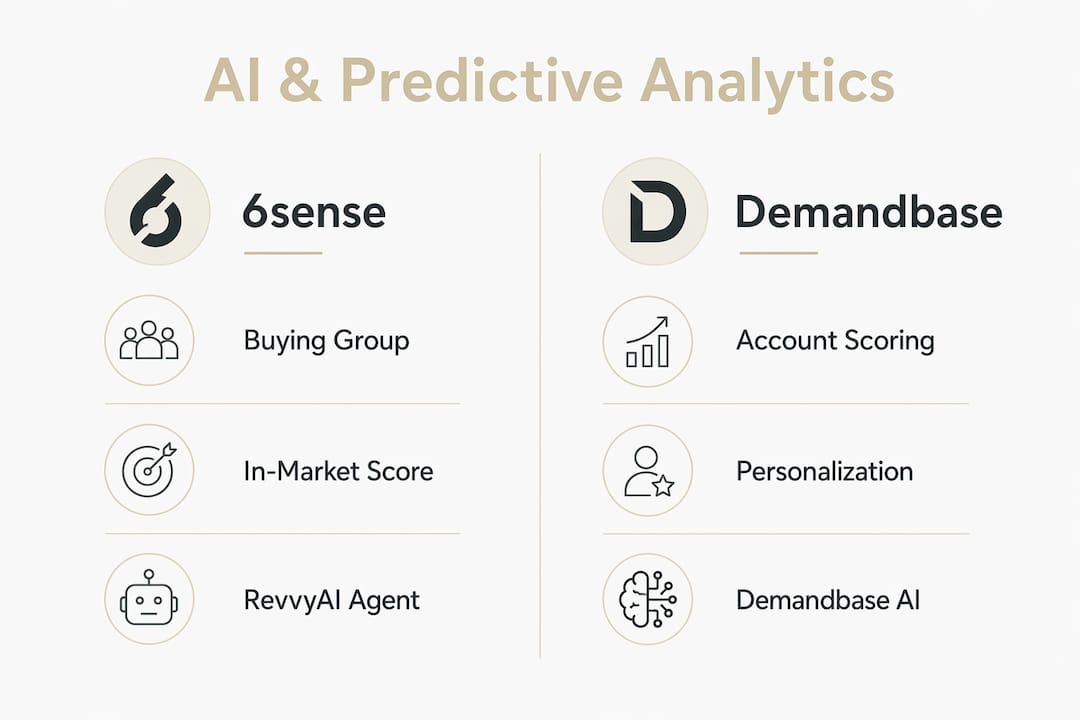
6sense’s predictive models use buying group intelligence to assign granular in-market scores. A RevOps manager can configure 6QA thresholds to route accounts showing a surge score directly into a Salesloft sequence, collapsing the time from intent signal to first outreach from days to hours. That is 6sense’s core strength: actionable, contact-level intelligence for complex buying committees.
Demandbase’s AI layer, the Demandbase AI suite launched in late 2025, focuses on account-level scoring, personalization generation, and orchestration recommendations. It works at a higher altitude. The BDR sees that Acme Corp has a high account score and has been served display ads, but the contact-level buying group signal is less granular, requiring more manual research to identify who to reach and what they care about.
Both platforms launched AI agent lines recently (RevvyAI for 6sense, Demandbase AI for Demandbase). Both remain assistant-grade in practice, not fully autonomous. The predictive models also depend heavily on data hygiene in your CRM and sufficient website traffic to feed the algorithms, particularly for 6sense, which needs roughly 10,000 monthly visitors to produce reliable scores.
What are the user experience and onboarding differences?
Neither platform is easy. Both require a dedicated internal champion, RevOps involvement, and cross-functional alignment before they deliver value.
6sense implementations typically take 4–6 weeks for technical integration, with an additional 4–6 weeks for the predictive models to ingest enough data to produce reliable scores. The interface is data-heavy and designed for analytics-oriented users. Once 6QA thresholds are configured, the system surfaces prioritized accounts automatically for BDRs, which reduces the ongoing management burden. The tradeoff is a steeper initial learning curve for anyone outside RevOps.
Demandbase’s advertising components can go live faster, but full orchestration takes longer to build out. The interface follows established marketing platform patterns, which makes campaign setup and audience building more intuitive for demand generation teams. The ongoing management demand is higher, though, because multi-channel journeys require hands-on maintenance to stay effective.
Both platforms face occasional account management turnover on the customer success side, which reviews on Gartner Peer Insights and G2 note consistently. Before signing, ask specifically which tier of customer success you are getting and whether you will have a named CSM.
What does pricing and total cost of ownership look like?
Enterprise ABM platform pricing is expensive and opaque. Annual licenses start around $50,000 and median 6sense and Demandbase contracts run at enterprise-level price points. Enterprise deals on either platform can reach $300,000 or more once advertising modules and premium features are layered on.
The license fee is typically only 40–60% of what you will actually spend in year one. The rest comes from integration debt and operational headcount. Total first-year costs including implementation, data mapping, and onboarding frequently exceed $100,000 for mid-market deployments. Demandbase’s DSP seat fees can add substantially depending on media spend.
Neither vendor publishes list prices. Multi-year contracts typically unlock meaningful discounts. If your ABM budget is limited or your target account list is relatively small, the economics do not work for either platform. A lighter stack will return more pipeline per dollar at that scale.
Pro Tip: Request a pilot with your actual account list and ICP data, not the vendor’s sample data. The platform that surfaces the most relevant and actionable intelligence for your specific accounts is the right choice, regardless of overall market reputation.
What do customer reviews say about each platform?
6sense earns strong marks for prediction accuracy and intent data depth. The most common criticisms are UI complexity, high cost, and operational overhead. Users on a major review site rate 6sense positively with a high recommendation level. The platform suits revenue teams, CROs, and RevOps leaders who want AI-driven prioritization to drive account selection.
Demandbase draws consistent praise for its advertising capabilities and integrated platform feel. Onboarding demands and a steep learning curve are recurring complaints. User feedback is generally positive with a strong recommendation rate. Marketing teams running ad-led ABM programs tend to be the most satisfied Demandbase customers.
Both platforms generate the same pattern in community discussions: high value for teams with the scale and headcount to run them, expensive shelfware for teams that do not. The dissenting view, common on Reddit and in practitioner forums, is that a lighter-weight platform would close more pipeline in the first six months for most mid-market teams evaluating these two.
How do you determine which platform fits your enterprise ABM needs?
The decision hinges on three honest questions, not a feature checklist.
- Which CRM does your revenue team actually live in? Salesforce points to 6sense; HubSpot points to Demandbase.
- What is your single biggest operational gap? If you cannot identify which accounts to work first from a large TAM, that is a 6sense problem. If you cannot run targeted account advertising at scale, that is a Demandbase problem.
- Do you have the program, the scale, and the dedicated headcount to run an enterprise platform? Both require a real RevOps function, sales and marketing alignment, and a tiered target account list before they pay off.
Additional questions worth answering before you commit:
- Is your TAM larger than roughly 5,000 accounts?
- Does your website receive enough traffic to feed predictive models?
- Is your CRM data clean enough to support reliable account-to-contact mapping?
- Does your sales motion depend on multi-threaded outreach to buying committees (favors 6sense) or top-of-funnel account-level air cover (favors Demandbase)?
Misalignment is expensive. A platform whose architecture does not match your primary operational gap becomes a six-figure tool your team resents. For teams exploring B2B advertising alternatives alongside ABM platforms, the channel mix question matters as much as the platform choice.
What are the contract terms and cancellation policies?
Both platforms use annual contracts as the default, and multi-year deals of two to three years are common. Neither vendor publishes standard cancellation terms publicly. In practice, enterprise ABM contracts are structured to minimize mid-term exits, with payment schedules tied to annual or semi-annual billing rather than monthly. Negotiating exit clauses, data portability provisions, and renewal pricing caps before signing is worth the effort. Year-one pricing is negotiable; year-two and year-three pricing on either platform is typically less flexible once you are in.
How long does implementation actually take?
Plan for a full quarter before either platform is operational. Both typically require 8–14 weeks for technical integration, data mapping, and user onboarding. 6sense’s predictive models need an additional 4–6 weeks of data ingestion to produce reliable scores. Demandbase’s advertising components can go live faster, but full journey orchestration takes longer to configure and maintain. Anything faster than eight weeks requires a pre-existing RevOps team that has done this before. Budget for professional services on top of the license fee regardless of which platform you choose.
North Country Consulting: a different approach for paid media
If your pipeline problem is less about ABM orchestration and more about getting better returns from paid search, North Country Consulting offers a direct alternative to the enterprise platform route.
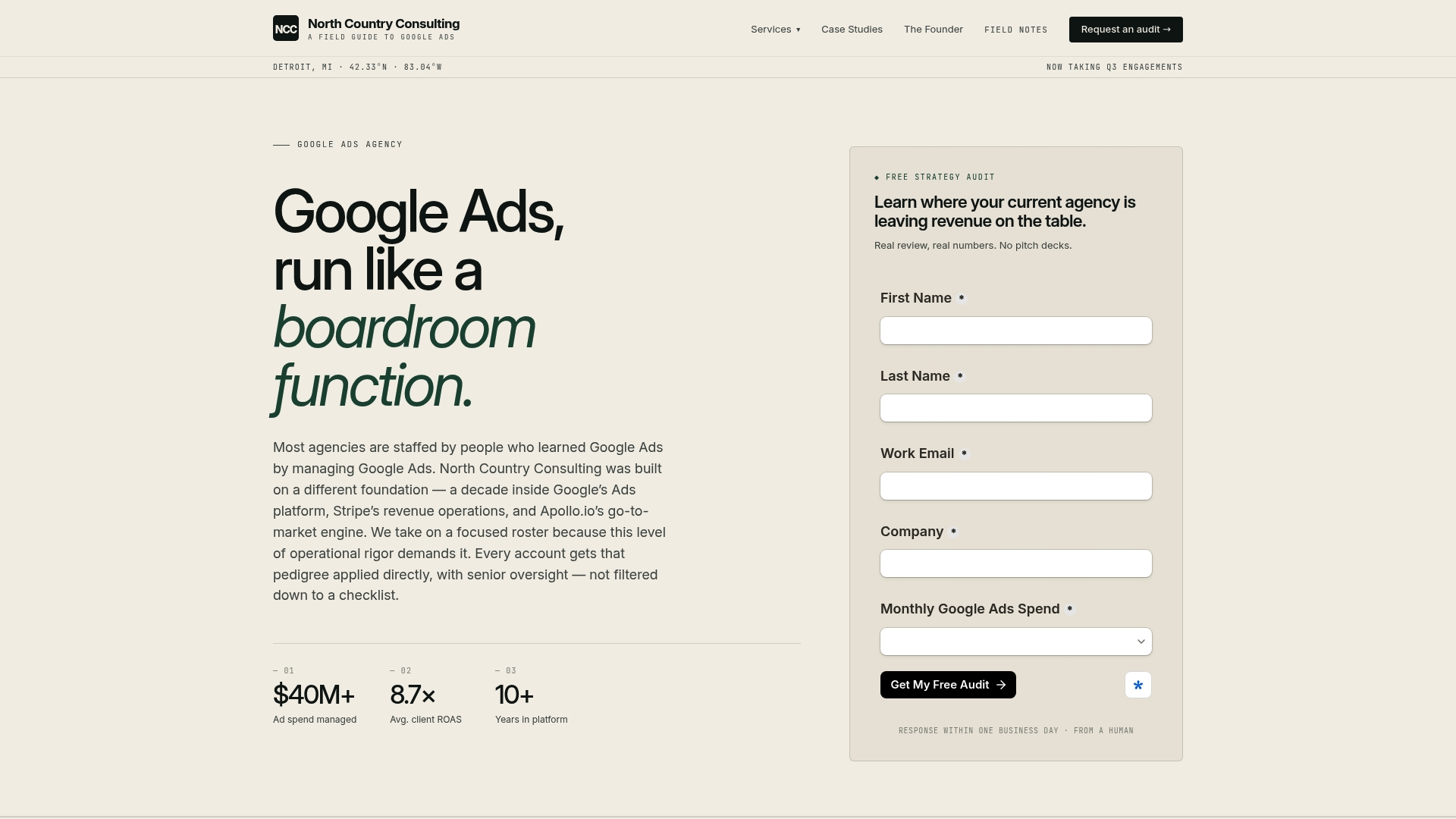
While 6sense and Demandbase are built to orchestrate account-level intent across your entire GTM motion, North Country Consulting focuses on one thing: making Google Ads and ChatGPT Ads work harder for B2B businesses spending $25,000 or more per month. Every account gets senior-level oversight, not a junior account manager. The methodology averages an 8.7× return on ad spend across more than $40 million in managed spend, with a free strategy audit that identifies specific revenue gaps before any commitment. For SaaS and B2B teams weighing a six-figure ABM platform against better-performing paid channels, that audit is a useful reality check. You can also explore how Google Ads for SaaS companies fits into a demand generation strategy before deciding where to allocate budget.
Key Takeaways
6sense wins the signal-discovery conversation; Demandbase wins the signal-activation conversation, and the right choice depends entirely on which problem your revenue team actually has.
| Point | Details |
|---|---|
| Architecture drives the choice | 6sense is prediction-first for identifying in-market accounts; Demandbase is advertising-first for orchestrating campaigns against a defined list. |
| CRM fit matters | 6sense integrates most deeply with Salesforce; Demandbase has the stronger HubSpot bidirectional sync. |
| True cost exceeds the license | Total first-year costs frequently exceed $100,000 once implementation, integration, and headcount are included. |
| Scale is a prerequisite | Teams with smaller target account lists or limited budgets will get more pipeline from a lighter stack. |
| North Country Consulting | For B2B teams where paid search drives pipeline, North Country Consulting’s senior-led Google Ads management averages 8.7× ROAS across $40M+ in managed spend. |