
For high-budget ad teams, Amplitude is the stronger long-term platform if you have analytics headcount and run a structured experimentation program. Mixpanel wins when you need fast funnel answers, predictable pricing, and lighter instrumentation overhead.
The short version:
- Amplitude bundles native experimentation, feature flags, and Smart Traffic routing directly into its analytics dashboard, shortening the ad-to-product feedback loop without a third-party tool.
- Mixpanel’s Group Analytics add-on handles account-level B2B reporting well, but you’ll need AB Tasty or a similar tool to run full A/B experiments.
- Amplitude’s data governance and schema enforcement deliver a reliable single source of truth, but require dedicated personnel to manage event taxonomy.
- Mixpanel rebuilt its pricing and SDKs in 2024–2025 for better cost predictability. Reviewer estimates put Amplitude median contracts near $64K/year vs. Mixpanel near $38K/year.
Pick Amplitude if: you have at least one dedicated analytics engineer, run 10+ ad experiments per quarter, and need governed metrics shared across multiple product and marketing teams.
Pick Mixpanel if: your team is PM- or growth-led, you need answers this week, and you want pricing that scales without surprise thresholds.
30–90 day pilot plan:
- Hypothesis: Define one ad campaign variant and one product funnel metric it should move (e.g., paid trial activation rate).
- Measurement plan: Instrument three to five events in your chosen platform; connect ad click data via UTM parameters and your existing warehouse.
- Success metric: A measurable lift in the target funnel metric within 60 days, with experiment results statistically significant at 95% confidence.
Request a free ad account audit from North Country Consulting to map your current ad-to-product data gaps before committing to either platform.
Table of Contents
- Mixpanel vs Amplitude: Head-to-Head for Marketing Teams
- What North Country Consulting Does After You Pick a Platform
- Key Takeaways
Mixpanel vs Amplitude: Head-to-Head for Marketing Teams
| Dimension | Amplitude | Mixpanel | AB Tasty |
|---|---|---|---|
| Best for | Product-led growth and enterprise teams needing integrated experimentation | PM/growth teams needing fast funnels and predictable pricing | Teams running a separate web experimentation stack |
| Experimentation & feature flags | Native (Amplitude Experiment, Smart Traffic, feature flags) | Requires third-party tools (e.g., AB Tasty) | Dedicated A/B testing and personalization |
| Account-level / group analytics | Group behavior analysis; limited native company profiles | Group Analytics add-on; strong company-profile reporting | Not applicable |
| Data governance | Schema enforcement, event taxonomy governance, single source of truth | Convention-based; lighter platform nudges | Not applicable |
| Ease of use | Steeper learning curve; advanced features require analyst expertise | Faster time-to-first-insight; PM-friendly | Moderate; focused UI |
| Team fit | Mid-to-large orgs with analytics headcount | Small-to-mid teams; engineering-led or PM-driven | Any team needing specialized web testing |
| Pricing / TCO | Quote-based; MTU model can spike at scale; higher median contract cost | Transparent event-based pricing; ~$38K/year median (reviewer estimate) | Separate licensing cost on top of analytics platform |
| Integrations | Native CDP, Snowflake/BigQuery/Redshift, audience syncs | Warehouse-native mode, lighter SDKs, third-party experiment tools needed | Integrates with Amplitude, Mixpanel, and most analytics stacks |
| Implementation timeline | Multi-week setup; event taxonomy planning required upfront | Faster proof-of-value; warehouse-native mode reduces ingestion overhead | Days to weeks depending on test complexity |
| Privacy & data retention | GDPR/CCPA controls; enterprise data governance and SSO on Enterprise tier | GDPR/CCPA compliant; data deletion and opt-out APIs available | GDPR-focused; consent management built in |
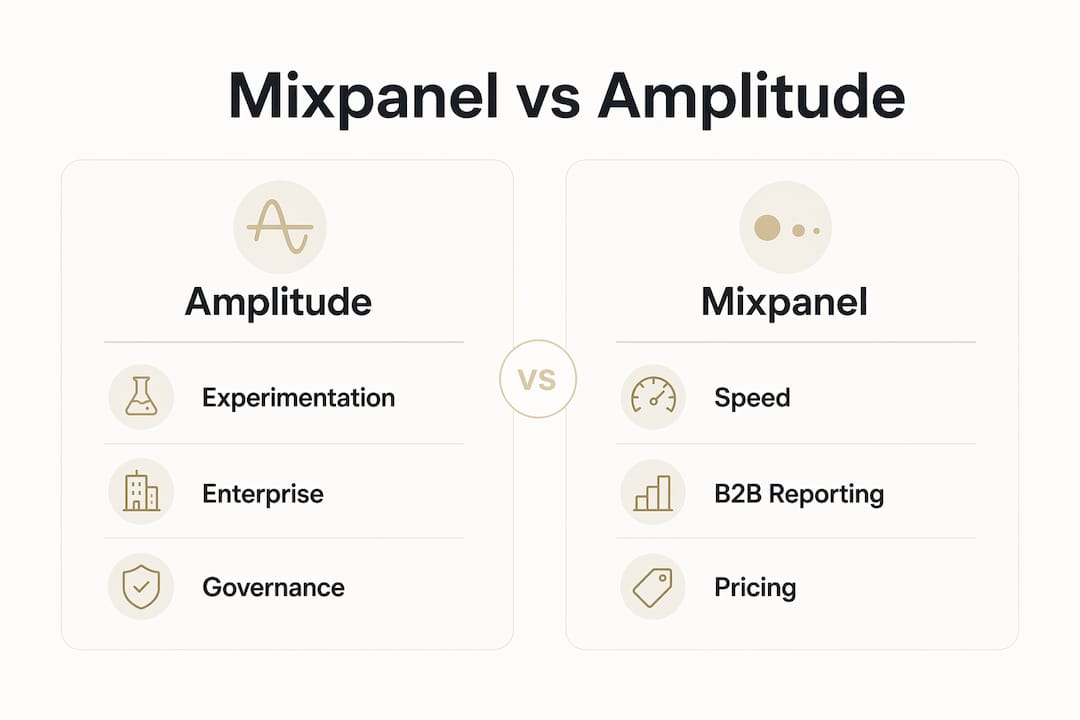
Experimentation: where Amplitude pulls ahead
Amplitude Experiment is integrated directly into the analytics dashboard, letting you measure test impact on any defined metric without exporting data or stitching tools together. Smart Traffic uses AI-driven routing to allocate users toward winning variants automatically. For teams running Google Ads experiments alongside product tests, that closed loop matters. Mixpanel has no native equivalent. You’d pair it with AB Tasty or a similar tool, which adds licensing cost, integration work, and a data seam between experiment assignment and behavioral outcomes.
One caution: AI-generated charts in both platforms can degrade in accuracy on complex, multi-filter queries. Treat automated insights as a starting point, not a final answer.
Account-level analytics and B2B use cases
Mixpanel’s Group Analytics add-on is genuinely strong for B2B teams tracking KPIs at the account level. Company-profile reporting lets you see which accounts are activating, churning, or expanding, which maps directly to how B2B ad targeting should be measured. Amplitude handles group behavior analysis but lacks native company profiles out of the box, which matters if account-level ROAS attribution is a core workflow.
Governance vs. speed
Decentralized, PM-driven teams consistently prefer Mixpanel; organizations that need a governed single source of truth across many squads lean toward Amplitude. Amplitude’s schema enforcement is powerful, but without dedicated analytics resources it creates what practitioners call “complexity debt.” Mixpanel’s governance lives in your team’s conventions, which is faster to start but harder to scale.

Amplitude claims preference among nearly 50% of Fortune 100 companies, a signal worth weighing if enterprise SLAs and procurement standards matter to your organization.
Pro Tip: Before any vendor conversation, audit your current event volume and monthly tracked users. Both platforms price on usage, and underestimating scale is the single most common source of contract surprises at renewal.
Amplitude pros for ad teams: native experimentation closes the test-to-action loop; CDP features enable direct audience activation; behavioral cohorts support LTV measurement beyond ROAS.
Amplitude cons: steeper implementation, higher median contract cost, MTU pricing spikes at scale, advanced features locked to paid tiers.
Mixpanel pros: faster setup, predictable pricing, strong B2B account-level reporting, warehouse-native mode cuts instrumentation overhead.
Mixpanel cons: no native A/B testing, requires AB Tasty or equivalent for full experiments, governance depends on team discipline rather than platform enforcement.
Red flags to raise with vendors: ask each vendor to show you exactly which features are available on the tier you’re quoting, what triggers an MTU or event overage charge, and what the SLA looks like for data freshness during high-traffic ad campaigns.
What North Country Consulting Does After You Pick a Platform
Choosing the right analytics platform is only half the problem. The harder part is connecting your ad spend to product behavior in a way that actually changes bidding decisions.
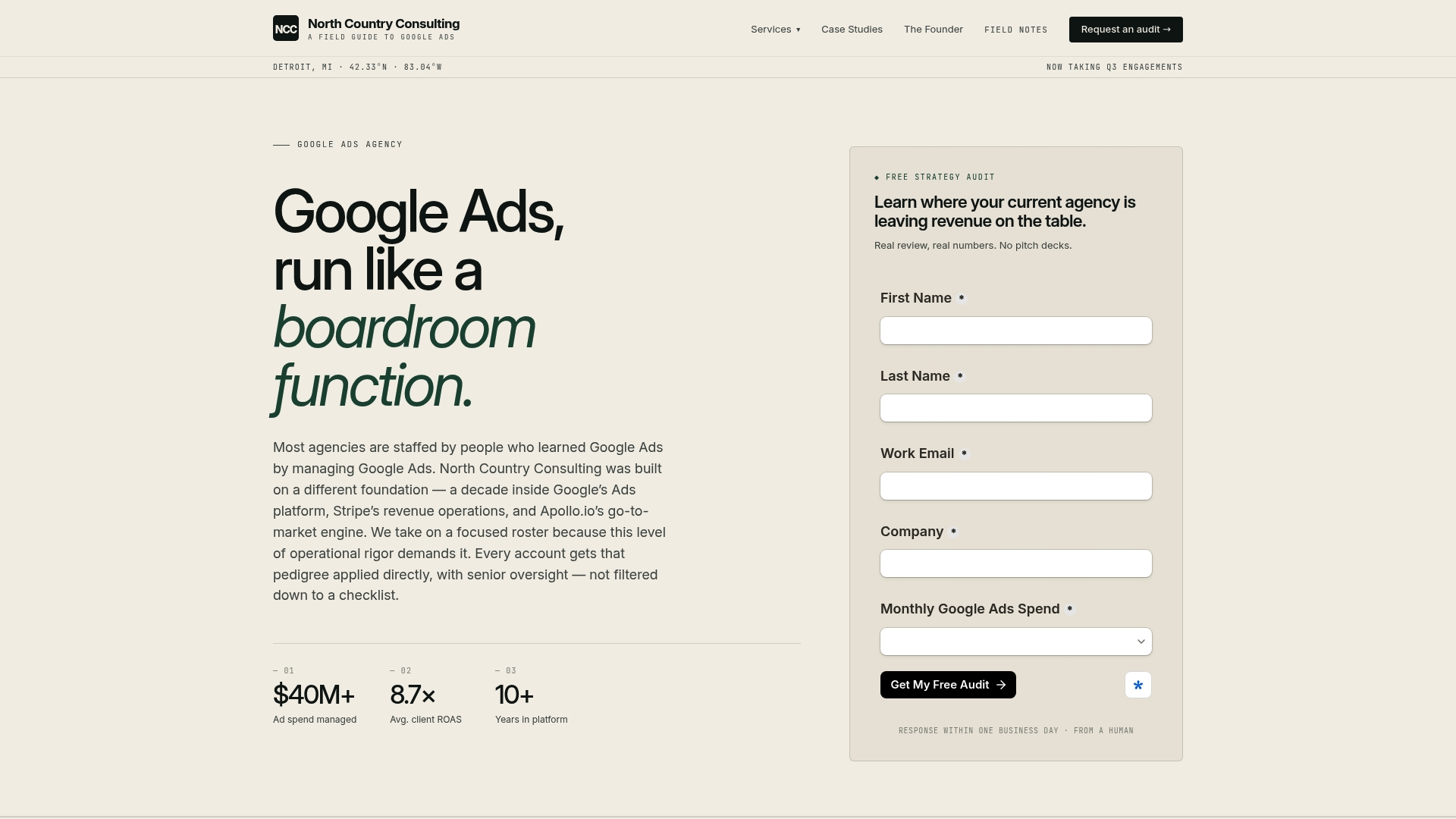
North Country Consulting manages over $40 million in ad spend with an average ROAS of 8.7×, and the methodology is built around closing exactly this gap. A free audit maps your current ad-to-product data flow, identifies where experimentation is missing or broken, and scopes a 30–90 day pilot with a realistic TCO estimate for whichever platform fits your team.
A typical pilot engagement runs like this, guided by insights from analytics for content marketing that boost SaaS growth:
- Discovery: audit ad account structure, conversion tracking, and existing analytics instrumentation.
- Instrumentation plan: define the five to eight events that connect ad clicks to product outcomes.
- Experiment design: build one ad-to-product experiment with a clear hypothesis and measurement plan.
- Reporting cadence: weekly experiment readouts tied to ad performance metrics, not just dashboard screenshots.
The outcome is a faster experiment-to-decision cycle, a predictable analytics cost model, and ad ROAS improvements grounded in real behavioral data. Visit North Country Consulting’s services page to start the conversation.
Key Takeaways
For ad-driven marketing teams, the platform choice comes down to one variable: whether your organization has the analytics bandwidth to operate Amplitude’s governance model or needs Mixpanel’s speed and pricing predictability to move now.
| Point | Details |
|---|---|
| Amplitude for experimentation | Native Experiment and Smart Traffic close the ad-to-product loop without third-party tools. |
| Mixpanel for B2B accounts | Group Analytics add-on handles account-level KPIs better than Amplitude’s native company profiles. |
| Governance vs. speed | Amplitude requires dedicated analytics headcount; Mixpanel scales on team conventions. |
| Pricing reality | Reviewer estimates put Amplitude median contracts near $64K/year vs. Mixpanel near $38K/year. |
| North Country Consulting | Senior-led audit maps your ad-to-product data gaps and scopes a 30–90 day pilot tied to measurable ROAS outcomes. |