
If you’re a media buyer running high-ticket funnels, Hyros is the stronger call. If you’re operating a Shopify DTC store and need P&L clarity fast, Triple Whale gets you there in days, not weeks.
The core trade-off: Hyros gives you per-conversion accuracy through server-side identity stitching, which matters enormously when phone sales, multi-step funnels, or CRM-attributed revenue are in play. Triple Whale gives you a blended ROAS and profit dashboard that a Shopify operator can actually act on without an engineering team.
- Choose Hyros if you’re running multi-checkout or phone-sales funnels and need granular conversion-level attribution to feed accurate signals to Smart Bidding.
- Choose Triple Whale if you’re a Shopify-first DTC brand that needs consolidated P&L, creative-level ROAS, and fast time-to-value.
- Immediate caveats: Hyros requires a sales demo and a minimum ad spend of $5,000 or more per month before they’ll even discuss pricing. Triple Whale’s free tier (Triple Pixel) is self-serve but blended ROAS is a coarser signal than true multi-touch attribution. And both tools, if misconfigured, can feed wrong conversion values to Google’s Smart Bidding, which will systematically bias spend toward high-revenue, low-margin SKUs unless you’re sending profit-based values.
Table of Contents
- How do Hyros and Triple Whale actually compare side by side?
- How do you decide which tool fits your business?
- How does each platform collect and attribute data?
- What does pricing actually look like, and how long does setup take?
- What does real-world impact look like with these tools?
- Key Takeaways
- What the market keeps getting wrong about attribution tools
- North Country Consulting manages the measurement layer, not just the ads
- Useful sources
How do Hyros and Triple Whale actually compare side by side?
| Dimension | Hyros | Triple Whale |
|---|---|---|
| Best for | Media buyers, high-ticket, multi-step funnels | Shopify DTC operators, blended ROAS focus |
| Core measurement | Server-side + first-party scripts + identity stitching | Triple Pixel (client-side) + Sonar server-side pixel |
| Accuracy / lost-data recovery | Strong on cross-device, phone, CRM attribution | Good for Shopify orders; weaker on complex funnels |
| Integrations | Ad platforms, CRMs, call tracking, email | Shopify-native, major ad platforms, some CRMs |
| Dashboard / insights | Conversion-level, funnel paths, ad-to-revenue | P&L summary, blended ROAS, creative analytics, cohorts |
| Pricing model | Tracked-revenue tiers | Order-volume tiers; free plan available |
| Implementation time | 2–4 weeks typical | 3–5 days or faster |
| Bidding impact | High: accurate conversion values for Smart Bidding | Moderate: blended signals, less granular per-conversion |
Hyros pros: Deep funnel visibility, strong phone/CRM attribution, server-side identity stitching that recovers iOS 14+ signal loss, and conversion-level data that can meaningfully improve Smart Bidding when configured correctly.
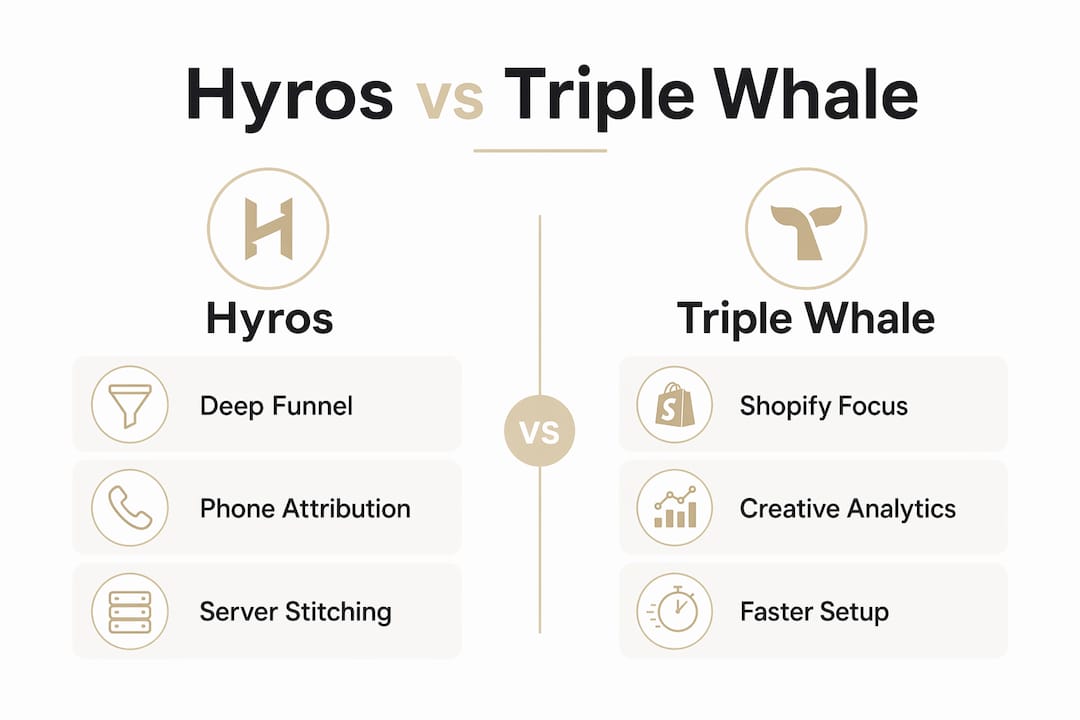
Hyros cons: Mandatory sales demo, opaque pricing until you’re in the funnel, 2–4 week setup, and tracked-revenue billing that can balloon costs as you scale.
Triple Whale pros: Shopify-native, self-serve onboarding, free entry tier, P&L and creative dashboards that non-technical operators can use on day one, and cohort/LTV analysis built in.
Triple Whale cons: Blended ROAS is a business-level snapshot, not a per-conversion signal. It won’t map individual lead paths in multi-step funnels, which is a real constraint for lead-gen or high-ticket models.
Risk callout: Wrong attribution data doesn’t just produce bad reports. It feeds bad signals to automated bidding engines. Smart Bidding misallocates spend toward high-revenue, low-margin SKUs when it receives revenue-based conversion values instead of profit-based ones. A 500% ROAS on a 15% margin product is a net loss. That’s the POAS vs ROAS problem in practice, and neither tool solves it automatically.
Pro Tip: Before you pick a platform, decide whether you need per-conversion accuracy (Hyros territory) or business-level P&L visibility (Triple Whale territory). Those are different jobs, and conflating them is the most common reason teams end up switching tools six months in.
How do you decide which tool fits your business?
Decision checklist
- Funnel type: Single-checkout Shopify store? Triple Whale. Multi-step funnel with phone sales or CRM handoffs? Hyros.
- Monthly ad spend: Under $20K/month, start with the Shopify-native option. Above $20K with complex attribution needs, Hyros earns its cost.
- Sales channels: Shopify-only? Triple Whale was built for this. Multi-checkout or offline sales? Hyros handles it better.
- Phone/CRM sales present? If yes, Hyros’ call-tracking and CRM attribution is a material advantage.
- Need product-level POAS? Neither tool does this automatically. You’ll need to send gross profit as the conversion value regardless of which platform you choose.
Vendor questions to ask in the demo
- How does your server-side implementation work, and what server access do you require?
- How is tracked revenue defined for billing, and what happens when revenue spikes?
- What’s your trial or refund policy? Is annual billing mandatory?
- Can I export raw data to a warehouse? Who owns the data after I leave?
- What’s the minimum ad spend or revenue threshold to use the platform effectively?
Red flags to watch
- Demo-only sales process with no published pricing tiers
- Aggressive annual-only contracts with no exit clause
- Poor data export support or restricted warehouse access
- Billing complaints tied to tracked-revenue calculation disputes
Pro Tip: Run a 30–60 day pilot before committing. Validate by comparing platform-reported conversions against your CRM or Shopify order data. If the delta is under 5%, the tool is working. If it’s 20%+, something in the implementation is broken before you’ve signed anything long-term.
How does each platform collect and attribute data?
Hyros uses first-party JavaScript scripts placed on your pages, combined with server-side calls and identity stitching that links cross-device journeys using email addresses, phone numbers, and other first-party identifiers. This is why it recovers conversions that pixel-only tools miss, particularly for phone and CRM sales where the purchase happens off the web.

Triple Whale runs a client-side pixel (Triple Pixel) plus its Sonar server-side pixel for iOS 14+ signal recovery. It uses a blended attribution model that combines platform-reported data with its own pixel data to produce a unified view. Both platforms claim server-side methods, but Hyros leans harder into identity stitching across devices while Triple Whale emphasizes blended modeling.
Implementation requirements:
- Hyros: Shopify API access, server-side script deployment, CRM/ESP hooks, call-tracking integration. Expect engineering involvement.
- Triple Whale: Shopify app install, pixel snippet, ad platform connections. Most stores are live in under a week.
Privacy and compliance: Both tools rely on first-party data, which is the right direction for a cookieless environment. Hyros’ identity stitching requires collecting email/phone at checkout, which has consent implications you need to address in your privacy policy. Triple Whale’s blended modeling is less dependent on individual identity but also less precise.
Edge cases that trip teams up: Multi-checkout flows (Shopify + a separate checkout for subscriptions), cross-device journeys that span days, and phone sales that close in a CRM days after the ad click. Hyros handles these better. Triple Whale will undercount them.
Pro Tip: Whatever platform you choose, validate your ecommerce conversion tracking setup independently. Attribution tools report what they see. If your tagging is broken upstream, both tools will give you confident-looking wrong numbers.
What does pricing actually look like, and how long does setup take?
Hyros prices by tracked revenue, with entry-level tiers beginning at $69/month at low tracked revenue, and scaling to $1,499/month or higher at greater tracked revenue. This means your cost rises with your success and can catch scaling brands off guard. Triple Whale uses order-volume tiers with a free plan (Triple Pixel) as the entry point.
Pricing gotchas to know:
- Hyros’ tracked-revenue billing starts at $69/month but can rise to $1,499/month or more for scaling brands. Understand the tier thresholds before you sign.
- Annual-only billing is common at higher Hyros tiers. Ask explicitly about monthly options and exit terms.
- Triple Whale’s free tier is real but limited. P&L dashboards and advanced cohort analysis sit behind paid tiers.
Implementation timelines:
- Triple Whale: Shopify app install, pixel live, initial data flowing within hours. Full dashboard value in 3–5 days.
- Hyros: Sales demo, contract, server-side deployment, identity stitching configuration, CRM hooks. Realistic timeline is 2–4 weeks.
- Validation step for both: compare platform-attributed revenue against Shopify or CRM actuals for 14 days before trusting the numbers.
Pro Tip: Negotiate data export rights and portability clauses before you sign anything. If you leave, you want your historical attribution data in a format you can use. Some platforms make this harder than it should be.
What does real-world impact look like with these tools?
The clearest business impact from either platform comes from correcting the signals sent to Smart Bidding. When Google’s algorithm receives revenue as the conversion value, it optimizes for revenue. When it receives gross profit, it optimizes for profit. That single change, regardless of which attribution tool you use, often produces a more meaningful ROAS improvement than switching platforms.
Analyst guidance consistently frames this split as a “weapon vs. control center” distinction: Hyros for media buyers obsessed with per-conversion accuracy, Triple Whale for ecommerce operators who need consolidated P&L and creative-to-profit visibility.
“Wrong attribution feeds wrong signals to automated bidding engines. At scale, this can systematically bias Smart Bidding toward high-revenue but low-margin SKUs unless profit signals are sent.” — Connexity
Practical verification steps during a pilot:
- Compare platform-reported conversions to CRM/Shopify actuals weekly.
- Track blended ROAS before and after implementation to measure signal improvement.
- Run a cohort comparison: same traffic, same period, platform-attributed POAS vs. manually calculated POAS.
- If Smart Bidding performance improves after sending profit-based values, the attribution change is working.
For ad creative decisions, Triple Whale’s creative analytics dashboard gives DTC teams a direct line from ad spend to SKU-level margin, which Hyros doesn’t prioritize.
Key Takeaways
Hyros wins on per-conversion accuracy for complex funnels; Triple Whale wins on speed, cost, and P&L clarity for Shopify DTC brands under $20K/month in ad spend.
| Point | Details |
|---|---|
| Pick by funnel type | Multi-step or phone-sales funnels need Hyros; single-checkout Shopify stores are better served by Triple Whale. |
| Pricing scales differently | Hyros’ tracked-revenue billing starts at $69/month at low tracked revenue and can reach $1,499+/month as you grow; Triple Whale starts free and tiers by order volume. |
| Attribution affects bidding | Sending revenue instead of profit to Smart Bidding systematically favors low-margin SKUs; fix conversion values regardless of which tool you use. |
| Pilot before committing | A 30–60 day pilot with CRM/Shopify validation is the only reliable way to confirm a tool is working for your specific setup. |
| North Country Consulting | Offers managed Google Ads with conversion value engineering and POAS-aligned bidding for teams that want this done right without a multi-week DIY setup. |
What the market keeps getting wrong about attribution tools
The attribution tool debate usually focuses on the wrong variable. Teams spend weeks comparing dashboards and pricing tiers when the actual lever is what conversion value gets sent to the bidding engine.
Both Hyros and Triple Whale can improve your reporting. Neither one automatically fixes a Smart Bidding setup that’s optimizing for revenue when it should be optimizing for profit. That’s a configuration decision, and it requires someone who understands how Google Ads attribution models interact with bid strategies.
The other thing audits consistently surface: teams that implement these tools but never validate the output against ground truth. A platform can show you confident attribution numbers that are 20–30% off from your actual CRM data, and if nobody checks, those numbers flow straight into bidding decisions. The tool isn’t the problem. The absence of a validation step is.
If you’re a Shopify DTC operator, Triple Whale is probably the right starting point. If you’re a media buyer running high-ticket or multi-channel funnels, Hyros earns its complexity. But in both cases, the measurement setup is only as good as the conversion values you’re sending downstream.
North Country Consulting manages the measurement layer, not just the ads
Most teams that come to North Country Consulting aren’t failing because they picked the wrong attribution tool. They’re failing because the measurement layer, the conversion values, the bidding signals, and the POAS alignment, was never set up correctly in the first place.
North Country Consulting’s Google Ads management service includes conversion value engineering for POAS-aligned bidding, server-side tracking support, and pilot design for teams that want to validate before scaling. The average client sees an 8.7× return on ad spend across more than $40 million in managed spend. Your data stays yours: full export rights and no vendor lock-in are standard in every engagement.
The free Google Ads audit covers measurement gaps, POAS/ROAS alignment, and a pilot plan specific to your account. It takes 20 minutes to request and surfaces the exact issues that attribution tools alone won’t fix.
Useful sources
- Hyros vs Triple Whale 2026 comparison (Botapolis): Pricing tiers, implementation timelines, and support ratings used throughout this article.
- POAS explained: why ROAS isn’t enough (SKU Analyzer): Definitive breakdown of POAS vs ROAS math, Smart Bidding implications, and breakeven logic.
- ROAS as a vanity metric (Connexity): The case for profit-based bidding signals and why revenue-based optimization misleads at scale.
- Hyros vs Triple Whale full breakdown (Fittle Project): Analyst framing of the “weapon vs. control center” distinction and spend-threshold guidance.
- Triple Whale vs Hyros compared (Polar Analytics): Feature matrix including incrementality testing, cohort/LTV, and data warehouse access.
- Ad feedback and creative ROI analysis (POPJAM.IO): How creative analytics and attribution data connect to campaign ROI decisions.