
Target Impression Share sets bids to reach a chosen percentage of impressions at a chosen location, either absolute top, top of page, or anywhere on the results page. It belongs in your toolkit when guaranteed visibility, not conversions, is the goal, such as defending branded searches or dominating a handful of critical queries. For performance goals like leads or revenue, a conversion-focused Smart Bidding strategy is the better fit.
TL;DR:
- Reserve absolute top for branded searches, top of page for critical queries, and anywhere on page for awareness when position matters less than reach.
- Target Impression Share works only on Search campaigns, and its bid ceiling must match auction costs; a low ceiling can prevent the target even when demand exists.
- Track Search impression share, Search top impression share, and Search absolute top impression share, then compare lost impressions from budget against lost impressions from Ad Rank.
- Wait a week of stable spend before judging results; rising impression share with falling click through rate warns that costs may climb.
- With enough conversion history, use Target CPA or Target ROAS for performance goals, while reserving Target Impression Share for brand defense.
Table of Contents
- How Target Impression Share works: settings, auction behavior, and what Google actually bids
- When to use Target Impression Share: clear use cases and goals
- How to set up Target Impression Share step by step
- Monitoring and KPIs: the metrics to track after enabling TIS
- Common problems and troubleshooting checklist
- Alternatives and migration path: moving from TIS to conversion or value bidding
- Our perspective on deciding when Target Impression Share earns a place in your account
- Get a professional read on your bidding strategy
- FAQ
- Sources
How Target Impression Share works: settings, auction behavior, and what Google actually bids
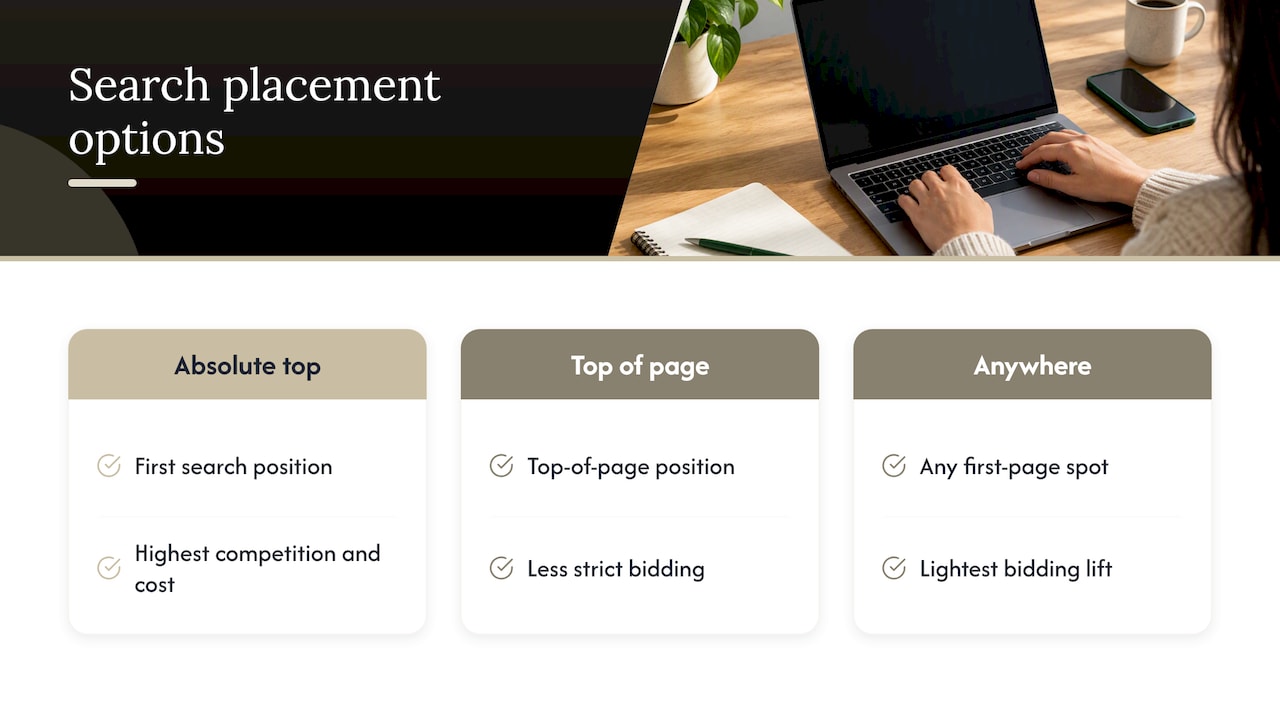
Target Impression Share runs on three placement choices: absolute top of the page, top of the page, or anywhere on results. Each one changes how aggressively the system bids. Absolute top means your ad has to win the very first position, so competition and cost both climb. Top of page is less strict, and anywhere on the page is the lightest lift since it includes any spot on the first page of results.
Two settings do the real work: the target percentage and the max CPC bid ceiling. Google adjusts bids to chase the percentage you set, but the ceiling caps how high it will go. Set that ceiling too low relative to the competition at your chosen placement, and the strategy simply cannot reach the number you asked for, regardless of how the bidding algorithm tries. According to Google’s own documentation, this strategy applies only to Search campaigns, whether managed as a single campaign or across a portfolio.
One quirk worth remembering: Target Impression Share ignores nearly all bid adjustments, including location and audience modifiers.
When to use Target Impression Share: clear use cases and goals
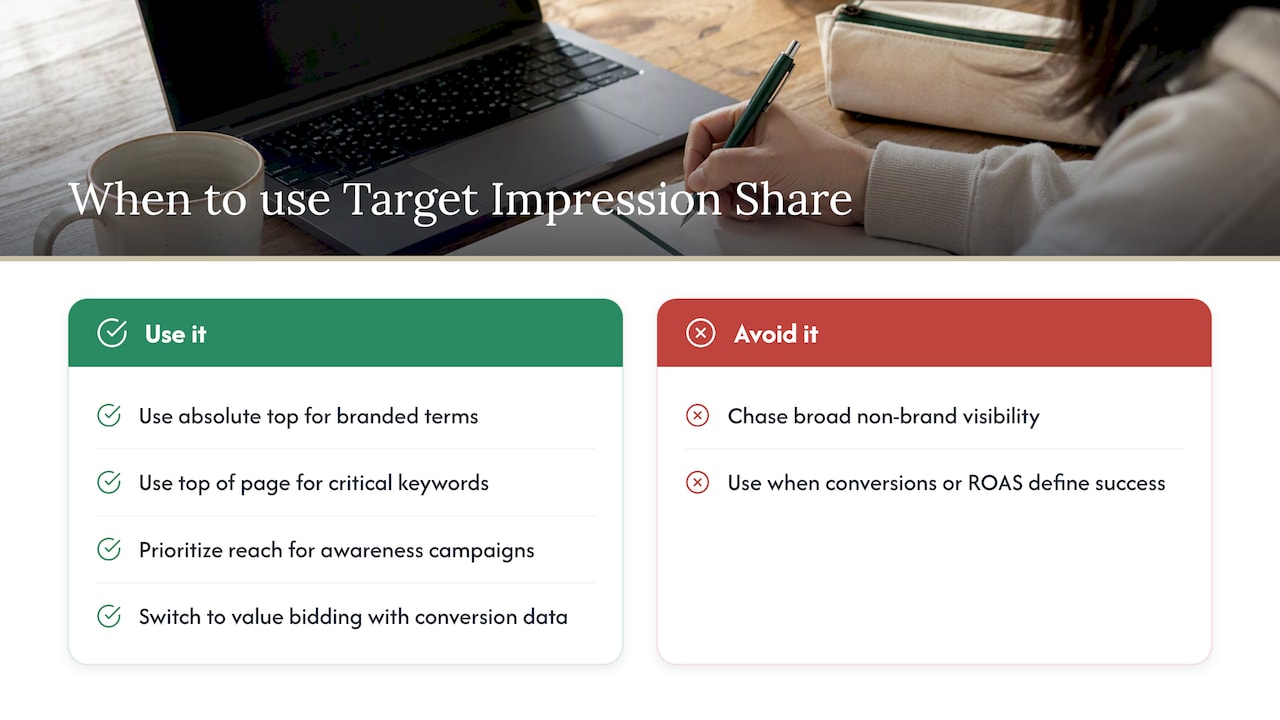
Target Impression Share earns its keep in a narrow set of situations. Brand protection is the clearest case: when a competitor starts bidding on your company name, a high target percentage on absolute top keeps your own ad from getting pushed down. The same logic applies to a handful of queries so central to your business that losing the top spot costs more than the extra bid spend. Awareness campaigns, where the goal is simply to be seen rather than clicked, are a third fit.
Where it tends to disappoint is any account where conversions or return on ad spend define success. Chasing visibility for its own sake on a broad set of non-brand keywords usually inflates cost per click without moving the metrics that matter to the business.
Typical setups include a high target percentage on absolute top for branded terms, a moderate target percentage on top of page for mission-critical keywords, and a moderate target percentage anywhere on the page for general awareness campaigns, prioritizing reach over position.
As Search Engine Land notes, practitioners tend to reserve this strategy for brand terms or a short list of critical queries, then shift to value-based bidding once there is enough conversion data to justify it.
How to set up Target Impression Share step by step
Switching a campaign over takes just a few fields, but the order matters.
- Open the campaign’s bidding settings and select Target Impression Share as the strategy.
- Choose a location: absolute top, top of page, or anywhere on page.
- Set your target percentage, starting conservatively if this is a new campaign.
- Set a max CPC bid ceiling that reflects what your competitive set actually costs, not a round number picked at random.
- If you’re applying this across several campaigns at once, confirm whether you’re editing a single-campaign strategy or a shared portfolio strategy, since the two are configured in different menus.
- Apply a -100% device adjustment if you need to exclude a device type, since it’s the only modifier TIS still honors.
For a first attempt, a target in the 70 to 80 percent range on top of page tends to be more forgiving than jumping straight to absolute top, which carries the steepest competition for the highest spots.
Pro Tip: If you’re targeting a high percentage on absolute top, build in extra daily budget headroom before you launch, since hitting that placement often requires more clicks than your current spend assumes.
Monitoring and KPIs: the metrics to track after enabling TIS
Once a campaign is live, add the three core impression share columns to your reports: Search impression share, Search top impression share, and Search absolute top impression share. Two diagnostic columns matter just as much.
- Search lost IS (budget) shows impressions missed because your daily budget couldn’t cover demand.
- Search lost IS (rank) shows impressions missed because of weak Ad Rank, driven by quality or bid strength.
Google’s own guidance on getting impression share data confirms this is the fastest way to tell a budget problem from a quality problem. Alongside those, watch click-through rate, Quality Score trends, and CPC as guardrails: a rising impression share paired with a falling CTR usually means you’re paying more to show ads that fewer people want to click.
A high impression share with a declining CTR is an early warning sign that cost per click will climb before the impression share report shows a clear trend, according to Search Engine Land’s analysis of the strategy. Give a new target at least a week of stable spend before judging it; shorter windows tend to reflect auction noise rather than a real pattern.
Common problems and troubleshooting checklist
When a campaign won’t hit its target, work through the list in order rather than guessing.
- Check the max CPC bid ceiling first. If it’s set below what the competitive set at your chosen placement actually costs, the strategy has no room to bid up.
- Compare your daily budget against the click volume needed to sustain the target. A ceiling that’s high enough won’t help if the budget runs out by midday.
- Review Ad Rank components, including Quality Score, since a weak landing page or low expected CTR can cap visibility no matter how high you bid.
- Look at landing page conversion behavior. A page that converts poorly won’t break TIS directly, but it’s worth flagging before you commit more budget to visibility alone.
A quick test: raise the bid ceiling temporarily, run the campaign for three to five days, and watch CPC, CTR, and conversion volume for signs the extra spend is either working or simply inflating cost. For a deeper look at this process, our breakdown of impression share loss walks through the same diagnostics in more detail. Balancing impression goals against cost control usually means accepting a slightly lower target in exchange for a ceiling that doesn’t bleed budget.
Alternatives and migration path: moving from TIS to conversion or value bidding
Once a campaign has enough conversion history, Target CPA, Target ROAS, and Maximize Conversions or Maximize Conversion Value typically outperform a pure visibility goal. Target CPA fits when cost per lead is the main constraint, Target ROAS fits revenue-driven accounts with varied order values, and Maximize Conversions suits accounts still building a baseline. Search Engine Land points to this exact shift as the natural next step once data supports it.
A safe migration starts with confirming you have enough conversion history to train the new strategy, setting a realistic baseline target, and testing on a cloned campaign before touching the original. Expect a learning window of one to two weeks, as our guide to how Smart Bidding actually works explains. A common hybrid: keep brand keywords on Target Impression Share for defense, while shifting non-brand campaigns to value-based bidding where performance data is stronger.
Our perspective on deciding when Target Impression Share earns a place in your account
Before recommending Target Impression Share on any account, we review conversion volume, existing impression share by placement, budget flexibility, and landing page conversion rates. An account with thin conversion history and strong brand defense needs often benefits from TIS on branded terms while everything else stays on a performance strategy. One with mature conversion data rarely needs it at all.
Senior oversight changes this call in a way junior account management often misses: a less experienced manager may chase a high absolute top target because it looks impressive in a report, without weighing the cost against what that visibility actually returns. A free audit is one way to get a second look at whether TIS makes sense for a high-spend account before committing budget to it.
— Eric
Get a professional read on your bidding strategy
If you’re weighing Target Impression Share against a conversion-focused approach, senior-led Google Ads management means someone with direct platform experience reviews your account structure, conversion tracking, and bid strategy before anything changes. We rebuild attribution models, fix tracking gaps, and restructure campaigns so the bidding strategy you choose is working with accurate data, not guesswork.
A free Google Ads audit shows exactly where your current setup is losing impression share or spend, and whether Target Impression Share, a conversion-focused strategy, or a hybrid of both fits your account.
FAQ
What are the main value-based Smart Bidding strategies compared to Target Impression Share?
Target Impression Share is a visibility strategy, not a value-based one. The main conversion and value-based options are Maximize Conversions, Maximize Conversion Value, Target CPA, and Target ROAS, each optimizing for outcomes rather than impression position.
Is $20 a day a reasonable Google Ads budget?
Whether a daily budget works depends on your industry’s cost per click and how many clicks you need to generate meaningful data, so there’s no universal answer. A small budget limits how competitive a placement like absolute top is realistic, since Search Engine Land notes that placement carries the highest competition and cost.
What does search impression share mean in Google Ads?
Search impression share is the percentage of eligible impressions your ads actually received on the Search Network. Google’s documentation breaks this down further into lost impression share due to budget versus lost impression share due to Ad Rank.
What are the most common Google Ads bidding strategies?
The most common strategies include Maximize Conversions, Target CPA, Target ROAS, Maximize Conversion Value, Manual CPC, and Target Impression Share. Each one optimizes for a different goal, from pure visibility with TIS to profit-driven outcomes with ROAS-based bidding.
How is Target Impression Share different from click share?
Target Impression Share measures how often your ad appears for eligible searches at a chosen placement, while click share reflects the clicks you receive relative to total clicks available in your market. An ad can hold a strong impression share while still underperforming on clicks if its CTR lags behind competitors.
Sources
- About Target impression share bidding – Google Ads Help
- Google Ads Target Impression Share explained: Pros, cons, and when to use it – Search Engine Land