
The biggest warning signs in a PPC agency relationship are account ownership traps, broken or misreported conversion tracking, opaque reporting, and contract terms that reward spend over results. The FTC holds agencies liable for deceptive claims, and most of these issues surface in a focused 30 to 90 minute review. Below is the checklist to run before you sign, renew, or fire.
TL;DR:
- Ensuring your ad account is owned and controlled by your business avoids losing valuable data history and audience lists upon termination.
- Confirm that conversion tracking is accurate, with properly owned tags and no duplicate actions, to prevent misleading performance reports.
- Avoid broad-match keywords, irrelevant landing pages, and unchecked automation recommendations that can waste budget and impact results.
- Review contract terms for fee structures that incentivize spend over results and demand ownership of data, accounts, and creative assets after ending the relationship.
- Prioritize verifying account ownership and tracking accuracy within 30 minutes, as these issues can cause long-term damage and are hard to recover from afterward.
Table of Contents
- Top red flags to check first
- Account ownership and access red flags
- Tracking, attribution, and reporting red flags
- Tactical red flags: poor campaign choices and automation risks
- Contract and fee red flags to watch for
- How to vet an agency now: a practical checklist and questions to ask
- How North Country Consulting addresses these red flags
- Unrealistic performance promises and guarantees
- Lack of transparency in ad spend and budget allocation
- Inadequate expertise or certification in PPC platforms
- Absence of a dedicated account manager or team
- Failure to conduct competitor and market analysis before campaign setup
- What actually matters most in this checklist
- Quick offer: free Google Ads audit and next step
- FAQ
- Sources
Top red flags to check first
Before digging into any single issue, run through this quick scan. Each item below takes a few minutes to check and tells you whether a deeper audit is worth your time.
- Account ownership: if the agency created your Google Ads account under its own manager hierarchy rather than yours, you risk losing history and data if you ever leave.
- Conversion tracking: missing conversion actions, duplicate tags, or unclear ownership of tracking setup point to sloppy technical work.
- Reporting gaps: dashboards that show rising return on ad spend while your bank account tells a different story usually mean misattributed or cherry-picked data.
- Tactical shortcuts: broad-match keywords with no negative list, or ads routed to your homepage instead of a relevant landing page, waste budget fast.
- Unchecked automation: auto-apply recommendations turned on with no human review can quietly reshape your account without anyone noticing.
- Fee structure: percentage-of-spend pricing with no cap can reward an agency for raising your budget rather than your results.
Each of these deserves its own closer look, starting with the one that causes the most long-term damage: who actually controls your account.
Account ownership and access red flags
Agency-owned ad accounts create a structural lock-in. If your campaigns live inside the agency’s manager account instead of your own, you can lose years of performance history, Quality Score data, and audience lists the moment the relationship ends. Search Engine Land’s coverage of MCC account-control risks documents real cases where this exact setup cost advertisers their data.
Here’s how to confirm your access is correct:
- Log into Google Ads and check Admin > Access and security; your business email should hold Admin access, not just a user-level invite.
- Confirm your account sits under your own manager account (MCC), not the agency’s, by checking the account ID hierarchy at the top left of the dashboard.
- Ask the agency directly for a written transfer plan that specifies how campaigns, tags, and audiences move with you if you part ways.
Pro Tip: Never let an agency create your Google Ads account from scratch under its own login. Have them request access to an account you already own and control.
Tracking, attribution, and reporting red flags
Broken or inconsistent conversion tracking is one of the easiest ways for an agency’s reported numbers to drift from reality. Duplicate conversion actions, missing event tags, and cross-account conversion sharing through a manager account can all inflate or deflate what shows up in your dashboard. Google’s own documentation on cross-account conversion actions notes that conversion ownership set at the manager-account level can change which account controls your optimization goals without your direct input.

Misreported ROAS from currency mismatches or account-structure errors can distort reported performance by a factor of two or more, which is why reconciling platform numbers against your own CRM revenue matters more than trusting a dashboard at face value.
Run this quick technical check:
- Pull your list of active conversion actions and confirm each one maps to a real, distinct action (purchase, lead form, call).
- Check who owns the Google Tag Manager container tied to your site; it should be you, not the agency’s personal account.
- Review the account’s change history for tracking edits made in the last 90 days and ask for the reasoning behind each one.
- Compare platform-reported revenue to CRM revenue; a gap beyond roughly 20 to 30% signals a tracking or attribution problem worth investigating immediately.
Tactical red flags: poor campaign choices and automation risks
Some mistakes are visible the moment you open the campaign list. Broad-match keywords with no negative keyword list burn budget on irrelevant searches, and ads that send every click to your homepage instead of a dedicated landing page quietly tank conversion rates. These aren’t matters of strategy preference; they’re basic execution gaps.
Automation adds a second layer of risk. Google’s auto-apply recommendations can make live changes to bids, budgets, and keywords without anyone reviewing them first. Guidance on making AI safer in live ad accounts points out that automation only works safely when it sits behind a policy layer and a human review step, something absent in a surprising number of managed accounts.
Watch for these signs:
- Campaigns still running on broad match with few or no negative keywords after the first few months.
- Ad groups sending traffic to a generic homepage rather than a page matching the ad’s offer.
- Auto-apply recommendations switched on across the account with no documented review process.
- No visible change-history entries explaining why bids, budgets, or targeting shifted.
Google Ads keeps a recommendation and change-history log you can review directly to see exactly who enabled what and when.
Contract and fee red flags to watch for
Fee structure shapes incentives more than most advertisers realize. A pure percentage-of-ad-spend model can quietly reward an agency for pushing your budget higher, regardless of whether results improve. That doesn’t make the model dishonest by default, but it does mean your contract needs guardrails.
Before signing or renewing, ask these five questions:
- What happens to my data and account access if I cancel?
- Is there a cap on management fees as spend scales, or does the percentage apply with no ceiling?
- What’s the minimum commitment period, and what’s the early-termination fee?
- Who owns the ad accounts, tracking setup, and creative assets after the contract ends?
- Can I see a sample change-history log from an existing client account?
Redline any clause that locks you in beyond an initial setup period of a few months, or that leaves data and account ownership undefined. A legitimate partner should accept month-to-month terms once initial setup work is complete.
How to vet an agency now: a practical checklist and questions to ask
You can run most of this during a single discovery call or within the first week of a new engagement. Here’s the condensed version to work from:
- Ask for direct Admin access to your own Google Ads account rather than an agency-created one.
- Request the account’s change history for the last 90 days and ask for context on the larger changes.
- Ask for a written optimization plan that names specific owners and deadlines, not just a monthly call.
- Require a transition clause specifying data and account ownership on exit.
- Ask for a sample performance report and independently verify two or three numbers against raw platform data.
Pro Tip: If an agency hesitates to give you Admin access to your own account, treat that alone as a disqualifying red flag.
A credible sample report should break down spend, conversions, and cost per conversion by campaign, not just a single blended return figure. If the agency can’t explain how a reported number was calculated, that’s worth a second look before you commit.
How North Country Consulting addresses these red flags
We built our process around the opposite of what causes most of these problems: accounts stay in your ownership, a senior operator oversees the work directly, and changes get documented rather than buried in a dashboard. Our free Google Ads audit applies this same scrutiny to your account before you ever sign anything.
Unrealistic performance promises and guarantees
A fixed return on ad spend promised before an agency has even reviewed your account, your market, or your competitors is a guess dressed up as a guarantee. Paid search outcomes depend on your industry, your average order value, seasonality, and how competitive your auction is, none of which an agency can know from a sales call alone.
Watch for language like “guaranteed first-page ranking” or a specific ROAS multiple promised in week one. The FTC’s guidance on online advertising and marketing makes clear that agencies can be held liable for deceptive or unsupported claims made in the ads and pitches they produce, and the same scrutiny applies to performance promises made to you as the client.
A more honest approach sounds different: an agency that reviews your historical data first, gives you a realistic range based on comparable accounts in your category, and explains the variables that could move that number up or down. If a pitch skips straight to a guaranteed number without asking about your margins, average order value, or existing conversion rate, the promise is built on nothing.
Ask directly: “What data did you use to calculate that number?” A credible answer references your account history, your industry’s typical benchmarks, or a documented methodology. A vague answer, or a pivot to “trust our process,” means the number was never grounded in anything specific to your business.
Lack of transparency in ad spend and budget allocation
You should be able to see, at any point, exactly where every dollar of your budget went: which campaign, which ad group, and roughly how much went to management fees versus media spend. If your agency can’t produce that breakdown on request, or if the number shifts depending on who you ask, that’s a transparency failure.
This shows up in a few common ways. Some agencies blend media spend and management fees into a single line item on invoices, making it impossible to see your actual cost per click or cost per conversion. Others shift budget between campaigns without logging the change or explaining the rationale, so by the time you notice a shift in results, you have no record of what triggered it.
Ask for a budget pacing report that separates ad spend from fees, broken out by campaign or campaign group. Ask how often budget gets reallocated and who approves that decision. A transparent partner will show you the raw numbers without hesitation, often through direct read access to the ad platform rather than a filtered summary deck.
If every report you receive is a polished summary with no way to drill into the underlying data, request raw export access or direct login credentials instead. You’re paying for the media spend and the management, and you’re entitled to see both clearly.
Inadequate expertise or certification in PPC platforms
Google Ads changes constantly, from new automated bidding strategies to shifts in how Performance Max allocates budget across channels. An agency team that can’t speak fluently about recent platform changes, or that treats every account with the same generic playbook, is likely running on outdated knowledge.
This gap often shows up in small details: a campaign manager who can’t explain why a specific bidding strategy was chosen, or one who recommends broad-match keywords and automated bidding as a default without considering your account’s specific conversion volume or margin structure. Certifications alone don’t guarantee skill, but a complete absence of platform-specific knowledge during a discovery call is worth noting.
Ask your point of contact to walk you through a recent campaign change they made and why. A knowledgeable team will reference your account’s actual data: conversion volume, impression share, or auction insights, rather than general industry talk. If every answer sounds like it could apply to any business in any industry, the expertise may be thinner than the pitch suggested.
Absence of a dedicated account manager or team
High turnover and account reassignment are common complaints in the agency world, and they usually trace back to one root cause: no one person is actually accountable for your account. When your point of contact changes every few months, or when you’re routed through a general support queue instead of a named person, institutional knowledge about your business resets every time.
This matters more than it sounds. A new account manager who inherits your campaigns without a clear handoff document often has to relearn your margins, your seasonality, and your past test results from scratch, sometimes repeating mistakes the previous manager already corrected.
Ask directly who will manage your account day to day, how long that person has been with the firm, and what happens if they leave. A credible answer names a specific person and describes a documented handoff process. A vague answer about “our team” with no named individual suggests your account may be managed by whoever has capacity that week rather than someone building ongoing expertise in your business.
Failure to conduct competitor and market analysis before campaign setup
Launching campaigns without first reviewing your competitive landscape is like setting prices without checking what anyone else charges. An agency that skips this step typically defaults to generic keyword lists and standard bid strategies that ignore how crowded or expensive your specific auction actually is.
A grounded setup process starts with auction insights data, a review of competitor ad copy and landing pages, and an honest look at your market’s typical cost per click before a single campaign goes live. Search Engine Land’s reporting on client-fit failures points to weak discovery work as a recurring cause of accounts underperforming expectations from the start.
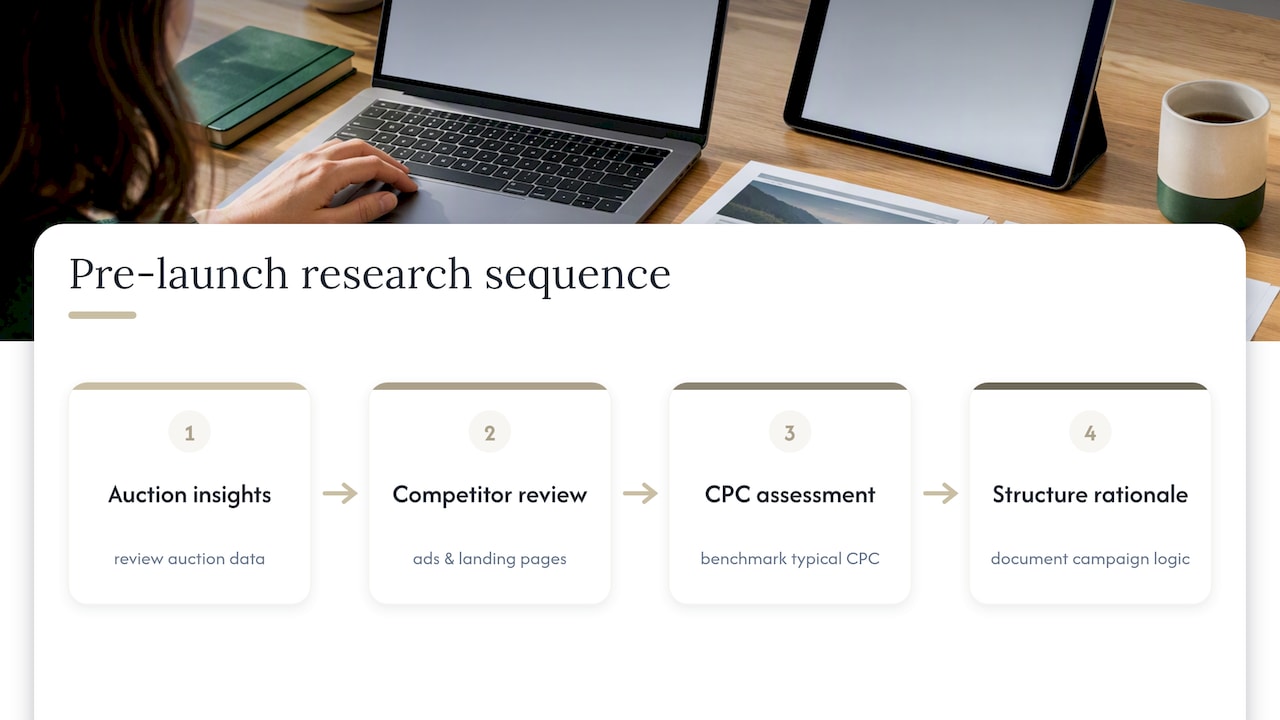
Ask what research informed your campaign structure before launch. A thorough agency can show you auction insights reports, competitor ad examples they reviewed, and a rationale for why your account was structured the way it was. If campaigns launched within days of signing with no visible research phase, your budget may be funding trial and error rather than an informed strategy.
What actually matters most in this checklist
Most advice on vetting a PPC agency treats every red flag as equally urgent, and that’s where it falls short. Account ownership and conversion tracking are the two that compound silently: a vague contract clause costs you money slowly, but a broken tracking setup or an agency-owned account can erase years of data and optimization history in a single bad exit.
Reporting polish gets too much attention in most guides. A clean dashboard with a rising ROAS number means nothing if the underlying conversion actions are miscounted or duplicated, and a plain spreadsheet with accurate numbers beats a beautiful dashboard built on bad data every time.
If you only have 30 minutes, spend it checking who owns your account and whether your conversion actions map to real, distinct events. Everything else, the contract terms, the campaign tactics, the communication cadence, matters, but those two checks catch the failures that are hardest to undo after the fact.
— Eric
Quick offer: free Google Ads audit and next step
If this checklist turned up more than one red flag, a second opinion is worth the hour it takes, as explained in Your Guide to Hiring a Pay Per Click Agency. We run a free Google Ads audit that reviews account ownership, conversion tracking accuracy, and campaign structure, then hands you a prioritized list of what to fix first.
What the audit covers:
- A direct review of your account’s conversion tracking setup and recent change history.
- An honest read on whether your current reporting matches what’s actually happening in the account.
- A prioritized list of fixes, ranked by impact on spend efficiency.
Every account we manage stays under your ownership from day one, with senior oversight on the work rather than a rotating junior team. If you want a straight answer on where your account stands, request your audit here or reach out directly if you have questions first.
FAQ
What does a PPC agency do?
A PPC agency manages paid search and paid social campaigns on a client’s behalf, handling keyword research, bid strategy, ad creative, conversion tracking, and ongoing optimization. The scope varies by provider, but the core job is turning an advertising budget into measurable conversions or leads.
How do I know if a marketing agency is legit?
Check whether they give you direct ownership of your ad accounts, provide a documented optimization plan with specific owners and deadlines, and can show you real change history rather than only a polished monthly report. A legitimate agency has no reason to resist giving you Admin access to your own accounts.
Which PPC agency is best for high-spend accounts?
The right fit depends on your spend level, platform mix, and need for senior oversight versus junior account staff. We focus on senior-led management, client-owned accounts, and rebuilt attribution for clients with significant Google Ads investment; our services overview outlines how that works in practice.
Why are marketing agencies struggling right now?
Many agencies face pressure from automation reducing the manual work clients once paid for, combined with growing client skepticism after high-profile cases of opaque reporting and account lock-in. Agencies that rely on junior staff and templated strategies have a harder time proving value as clients get more sophisticated about checking the underlying data themselves.
Sources
- Google Ads MCC/account-control risks (Search Engine Land)
- Google Ads conversion action sharing (Google Ads Help)