
A non-branded search strategy targets category and problem-based queries that never mention your company name, capturing buyers while they’re still exploring options. The single highest-priority move is building topical depth across content clusters while isolating non-branded performance from branded reporting. Get that separation wrong and every other tactic, SEO or paid, gets measured against the wrong baseline.
TL;DR:
- Building topical content clusters around category pages, comparison guides, and problem-solving articles more effectively captures non-branded traffic than focusing on isolated keywords.
- Non-branded search volume is higher for reaching new buyers, and growth in this area indicates expanding demand rather than just existing brand awareness.
- Structuring SEO and paid campaigns separately by brand status and aligning ad landing pages with the funnel stage improves targeting and conversion efficiency.
- Creating self-contained, front-loaded content with specific data points increases the chances of appearing in AI-generated answers and expands online citations.
- Regularly measuring non-branded organic rankings, AI citation trends, and campaign performance separately from branded data provides clearer insights into new customer acquisition.
Table of Contents
- What Non-Branded Search Strategy Actually Means
- Why Non-Branded Traffic Drives Real Growth
- Building an SEO Playbook for Non-Branded Queries
- Structuring Paid Campaigns Around Non-Branded Intent
- Preparing Non-Branded Content for AI Search Visibility
- Measuring What Non-Branded Search Actually Delivers
- Your 30/90-Day Non-Branded Action Plan
- How We Approach Non-Branded Strategy at North Country Consulting
- Get a Senior-Led Audit of Your Non-Branded Performance
- Sources
What Non-Branded Search Strategy Actually Means
Non-branded search covers any query where the searcher never types your company name, product name, or a close variant of it. Someone typing “enterprise inventory management software” is non-branded. Someone typing your product’s name plus “pricing” is branded, and they already know who you are.
The practical difference shows up in intent, not just keyword syntax. Branded searchers have made a decision or are close to one. Non-branded searchers are still defining the problem, comparing categories, or ruling out approaches entirely.
That distinction changes how you plan content. Chasing one high-volume phrase like “CRM software” wastes effort against unwinnable competition. Instead, building topical depth across clusters beats betting on a single keyword:
- Category pages that define the problem space
- Comparison guides for the decision stage
- Problem-solution articles for the research stage
- Use-case pages that map to specific buyer segments
Plan around the topic, not the keyword. A single high-value cluster usually outperforms ten scattered blog posts.
Why Non-Branded Traffic Drives Real Growth
Non-branded search is the main channel for reaching people who haven’t chosen a category yet, and it typically carries higher aggregate volume and more long-tail opportunity than branded search. Branded volume tells you how well-known you already are. Non-branded volume tells you how many new buyers are entering the funnel.
The measurement trap: Teams that lean on branded search volume as a growth signal are often watching a mirror, not a window. Branded clicks measure existing awareness, not new demand. If branded traffic is flat while non-branded traffic climbs, that’s evidence you’re actually expanding the pipeline instead of just harvesting people who already knew your name.
Non-branded search also feeds branded search over time. A reader who finds your comparison guide today may search your brand name directly in three weeks once they’ve shortlisted vendors. Marketing teams that ignore this sequence tend to underfund top-of-funnel content and overfund bottom-funnel branded bidding, which inflates perceived efficiency while starving the pipeline that produces future branded demand.
Building an SEO Playbook for Non-Branded Queries
Winning non-branded search requires structure before it requires volume. Start with the architecture, then write for how both search engines and AI systems actually consume content.
- Map topical clusters first. Build category pages, comparison guides, and problem-solution articles around the buyer’s decision path, not around isolated keyword lists.
- Write for extractability. One idea per paragraph. Frame headings as real questions. Put the answer in the first sentence, not the third paragraph.
- Handle the technical basics. Confirm crawlability, use server-side rendering where JavaScript could block indexing, keep load times tight, and mark up pages with schema so search engines and AI crawlers parse them correctly.
- Build outside presence. Mentions, co-citations, and a footprint across multiple platforms increase the odds that both traditional search and AI tools surface your content.
Content built around clear statistics, direct quotes, and self-contained paragraphs tends to perform better in AI-generated answers, because those formats are easier for a language model to lift cleanly without losing context.
Pro Tip: Write the first sentence of every section as if it were the only sentence an AI tool would quote. If it can’t stand alone and still answer the question, rewrite it.
None of this replaces fundamentals. Google’s own guidance treats AI-era optimization as an extension of core SEO, not a replacement for it. Sites with weak technical health rarely see gains from GEO tactics layered on top.
Structuring Paid Campaigns Around Non-Branded Intent
Non-branded PPC needs its own campaign structure, its own budget logic, and its own reporting, kept fully separate from branded search.
- Split campaigns by brand status. Never let non-branded and branded terms share an ad group or a budget pool. Blended reporting hides which dollars are actually acquiring new customers.
- Mine search terms weekly. A consistent cadence for reviewing search terms and adding negatives protects non-branded spend from drifting into low-intent or brand-adjacent queries.
- Bid for the funnel stage, not just the conversion. Top-of-funnel non-branded terms often need different bid strategies and creative than bottom-funnel comparison queries. Test bidding structures deliberately instead of applying one blanket approach account-wide.
- Align landing pages with the query’s stage. A non-branded search for a broad problem should land on educational content or a lead-gen offer, not a hard product pitch. Structuring campaigns around intent matters as much for search as it does for shopping campaigns.
Retargeting audiences built from non-branded visitors close the loop, giving you a second and third touch with people who weren’t ready to convert on the first visit.
Preparing Non-Branded Content for AI Search Visibility
Generative Engine Optimization, or GEO, focuses on getting your content cited or mentioned inside AI-generated answers rather than just ranked on a results page. For non-branded queries, this matters more than for branded ones, because AI tools are frequently the first stop for open-ended, problem-stage questions.
AI systems extract self-contained “chunks” of text. Content structured as independent, front-loaded paragraphs is more likely to get pulled into an AI answer than content that builds its point over several paragraphs.
Practical rules for AI extractability:
- Front-load the answer in the first sentence of every section
- Use specific numbers, named standards, and direct quotes instead of vague claims
- Publish supporting versions of your content across multiple platforms like YouTube, Reddit, and LinkedIn to build co-citations
- Keep sentences self-contained enough to be quoted out of context without losing meaning
Track this with new KPIs alongside traditional rankings: citation frequency, share of voice within AI-generated answers, and sentiment when your brand does get mentioned. These metrics run parallel to organic rankings, not in place of them.
Measuring What Non-Branded Search Actually Delivers
Mixing branded and non-branded data in one report hides whether you’re actually acquiring new customers or just harvesting existing demand. Filter branded terms out of your acquisition reporting entirely, using a dedicated segment or a corrected brand versus non-brand split if your current setup blends the two.
Track these separately, on a recurring basis:
- Organic non-branded rankings, grouped by topic cluster rather than individual keyword
- Assisted conversions from non-branded sessions, not just last-click credit
- AI citation trends month over month, using GEO-specific tools where available
- Non-branded PPC cost per qualified lead, isolated from branded campaign averages
Review this monthly at minimum, with a deeper quarterly audit that checks whether cluster investment is translating into ranking and citation gains.
Your 30/90-Day Non-Branded Action Plan
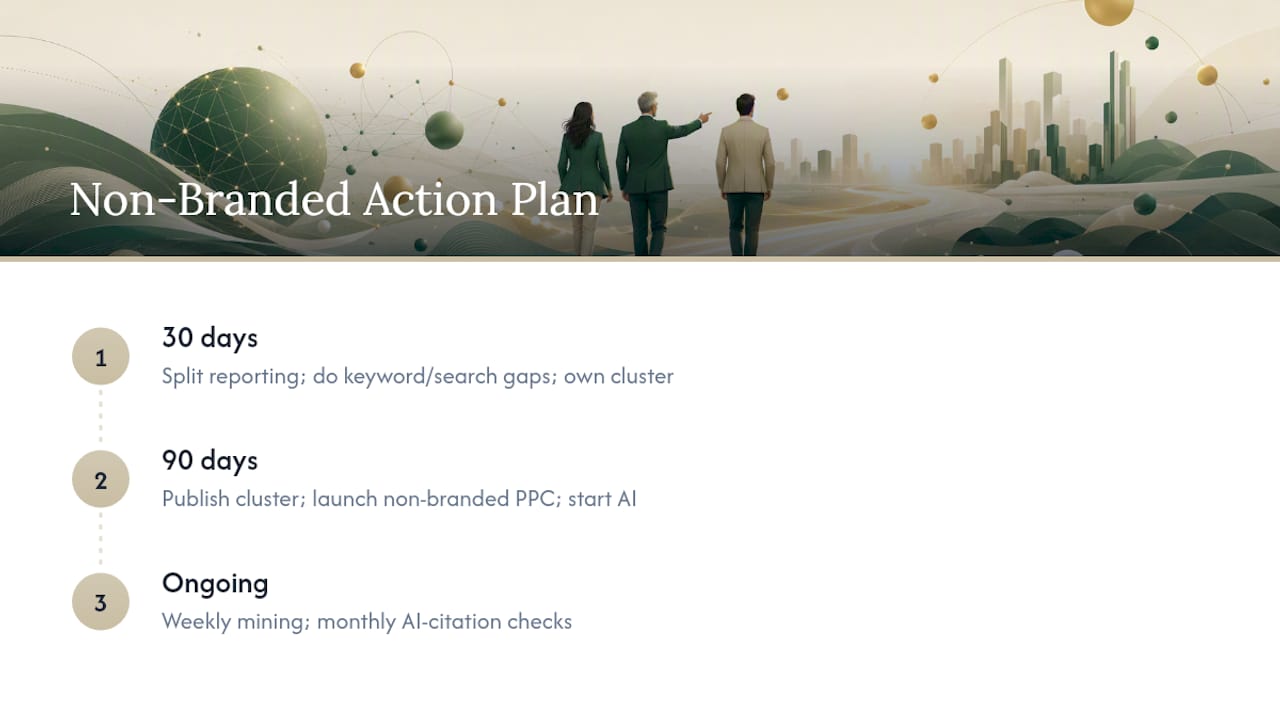
In 30 days: split branded and non-branded reporting, run a keyword gap analysis and search-term mining pass, and pick one content cluster to own completely. In 90 days: publish that cluster, launch a non-branded PPC pilot, and start building AI mentions. After that, keep mining weekly and checking AI citations monthly.
How We Approach Non-Branded Strategy at North Country Consulting
North Country Consulting applies senior-led oversight directly to each account rather than routing work through junior staff, rebuilding account structures so non-branded and branded spend get measured on separate terms. Success looks like cleaner attribution and ad spend that actually reflects new customer acquisition, not recycled brand demand. Across managed accounts, that discipline has supported an average return on ad spend of 8.7x on more than $40 million in managed spend, built on weekly search-term reviews and account structures rebuilt from the ground up rather than patched.
— Eric
Get a Senior-Led Audit of Your Non-Branded Performance
If your team is spending significant budget on Google Ads or ChatGPT Ads, and you can’t cleanly answer how much of that budget is acquiring new customers versus recapturing existing ones, that’s a structural problem, not a tactics problem. Our work ensures direct collaboration with senior strategists on every account rather than routing you through account managers who forward requests up a chain.
The free strategy audit examines your current branded versus non-branded split, campaign structure, and attribution setup, then flags where budget is leaking into low-intent or overlapping spend. It’s built for accounts already running meaningful budget, not accounts testing their first few campaigns. Engagements typically start with a full account rebuild: separated reporting, non-branded campaign architecture, and a measurement framework that tracks assisted conversions instead of last-click alone. If your current reporting can’t tell you whether last quarter’s growth came from new demand or recycled brand traffic, request the audit and get a specific answer instead of a guess.
Sources
- What is generative engine optimization (GEO)?
- Harness non-branded traffic
- SEO: When to test and experiment