
Alpha campaigns hold your proven, high-converting keywords in tightly controlled, exact-match ad groups. Beta campaigns run broader match types to hunt for new queries that haven’t earned their stripes yet. If your account has conversion history and a budget worth protecting, isolate your winners into Alpha, add mirror negatives to every Beta campaign, and let Beta keep prospecting without stepping on Alpha’s traffic.
TL;DR:
- Successful Alpha campaigns require isolating high-converting, exact-match keywords and raising bids to maximize efficiency without interference from broader match types.
- Beta campaigns should focus on discovery with lower bids and tightly themed ad groups, prioritizing broad match types to find new profitable queries.
- Implementing mirror negative lists prevents Alpha keywords from cannibalizing Beta traffic and stops double-paying for the same clicks.
- Budgets should favor Alpha for protected, predictable performance, while reserving a smaller share for Beta’s exploratory hunt for new keywords.
- Regular review and structured thresholds are essential for progressing Beta keywords into Alpha, with automated negative list management reducing wasted spend.
Table of Contents
- How to Build Alpha Campaigns That Protect Proven Keywords
- Setting Up Beta Campaigns as Your Discovery Engine
- How Do You Stop Alpha and Beta From Cannibalizing Each Other?
- How Should You Split Budget Between Alpha and Beta?
- When Should You Add Gamma or Delta Campaigns?
- How Often Should You Review and Promote Keywords?
- Why Senior Oversight Changes Alpha-Beta Outcomes
- Where Alpha-Beta Implementations Usually Break
- Get a Senior-Led Alpha-Beta Restructure Done Right
- Sources
- FAQ
How to Build Alpha Campaigns That Protect Proven Keywords
Alpha campaigns exist to run your best queries with as little interference as possible. The goal isn’t creativity here. It’s control.
Start by pulling performance data straight from your account: conversion volume, cost per acquisition, and click share by search term. Any query that consistently converts at or below your target CPA is a candidate for graduation into Alpha, a workflow Built In Chicago lays out as the standard build path from discovery to control. Here’s the sequence that works:
- Export search query report hits filtered by conversions and spend over a trailing 30 to 60-day window.
- Group winning queries into single-keyword or small-keyword ad groups, sometimes called SQAGs, rather than forcing them all into one generic bucket.
- Write ad copy and landing pages tailored to each ad group’s specific intent, not a recycled template.
- Set the keyword to exact match and raise the bid above what you’d pay in Beta, since you already know this query converts.
The tighter the match between search term, headline, and landing page, the higher your Quality Score tends to run, and the more efficient your spend gets over time, as detailed in these proven ecommerce keyword research tips. This is where the payoff of the entire Alpha-Beta model actually shows up.
Setting Up Beta Campaigns as Your Discovery Engine
Beta campaigns exist to find tomorrow’s Alpha keywords, not to convert at Alpha-level efficiency today. Treat them as a research budget, not a revenue line.
In older or legacy accounts, phrase match or modified broad match (where still available) tends to outperform pure broad match for controlling discovery without drowning in irrelevant traffic. Some ground rules worth following:
- Keep ad groups tightly themed. If two keyword clusters need meaningfully different ad copy, they belong in separate ad groups, not one catchall.
- Set bids and budgets noticeably lower than Alpha equivalents. Beta’s job is coverage, not dominance.
- Watch impression and click volume per ad group. If a cluster can’t generate enough traffic to justify its own headlines, fold it into a broader theme instead of over-segmenting.
- Let the long tail come to you. Beta’s real value shows up in the queries you never would have thought to bid on directly.
The core insight behind the entire Alpha-Beta structure is that discovery and exploitation need different economics. Beta funds the search for winners; Alpha cashes them in.
How Do You Stop Alpha and Beta From Cannibalizing Each Other?
Every keyword you promote into Alpha needs to disappear from Beta’s eligible traffic, or you’re just paying twice for the same click. The fix is a mirror negative list.
Take every exact-match keyword living in Alpha and add it as an exact-match negative across every Beta campaign, a tactic BGTheory recommends specifically to force Google’s matching engine toward the campaign you actually want to serve the ad. Beyond that single mirror list, most accounts need three layers of negatives:
- Alpha-exact mirror list, applied to all Betas, updated every time a keyword graduates.
- Bleeder list, for queries that spend without converting, reviewed weekly against fresh search term data.
- Irrelevant/topic list, catching queries that share words with your keywords but not intent (think “free,” “jobs,” or brand names you don’t own).
Ad-group-level negatives handle the finer cross-matching patterns that a shared list can’t catch, especially when two Beta ad groups share overlapping root terms.
Pro Tip: Set a recurring calendar reminder for a 15-minute negative list audit every Friday. Accounts that skip this step for even a month usually rediscover a bleeder that’s quietly burned hundreds of dollars.
How Should You Split Budget Between Alpha and Beta?
Protect the campaign that’s already making money, then fund discovery with whatever’s left. That’s the entire philosophy in one sentence, and it’s worth resisting the urge to overcomplicate it.
Most experienced operators allocate the larger share of practical daily spend to Alpha, since it’s the tier producing your predictable return, while reserving a smaller, deliberately capped budget for Beta’s exploratory traffic, a posture ExpertBeacon frames as protecting proven performance while still funding growth. In practice, budgets vary based on campaign goals and performance considerations.
- Set initial Alpha bids from your historical CPA data, then push them 10 to 20% above Beta equivalents for the same query theme.
- Cap Beta’s daily budget so a single spike in broad-match traffic can’t drain funds meant for your winners.
- Hold off on Smart Bidding until an ad group has enough conversion volume, generally 15 to 30 conversions in the last 30 days, for Google’s algorithm to have something real to learn from.
When Should You Add Gamma or Delta Campaigns?
Once Beta has proven stable for a few months and you’ve exhausted its discovery ceiling, it’s time to widen the funnel rather than force more volume through the same two tiers.
- Gamma runs true broad match for pure discovery, layered with negative lists pulled from both Alpha (exact) and Beta (phrase) so it feeds Beta without ever touching Alpha traffic.
- Delta combines dynamic search ads or audience signals with your existing structure to add scale once Gamma has proven it can surface viable new terms.
- Modern accounts are better served by small-keyword ad groups than strict single-keyword ad groups. Jordan Digital Marketing argues that Google’s matching behavior has moved far enough from literal exact match that rigid SKAGs create brittle, over-segmented structures without adding real control.
Add these tiers only after the simpler two-tier version is running clean. Skipping straight to a four-tier structure before Alpha and Beta are stable just multiplies the negative-list maintenance without multiplying results.
How Often Should You Review and Promote Keywords?
Graduation from Beta to Alpha needs a rule, not a gut feeling. Define it once and apply it consistently: a minimum conversion count, a CPA band you’re comfortable with, and enough impression volume to trust the data isn’t noise.
- Pull the search terms report every week and flag any query crossing your conversion threshold.
- Batch actual promotions into a monthly window rather than moving keywords the moment they look promising. This gives you enough data to trust the pattern.
- Run a structured experiment before rolling a big change account-wide, so you can measure the lift instead of assuming it.
- Automate the mirror negative addition with scripts or rules wherever your platform allows it, since manual updates lag and that lag is where wasted spend hides.
Choosing graduation thresholds your team can measure the same way every time matters more than picking the “correct” number. Consistency beats precision here.
Why Senior Oversight Changes Alpha-Beta Outcomes
An Alpha-Beta structure looks simple on a whiteboard. In a live account with years of accumulated keyword sprawl, overlapping ad groups, and inherited negative lists nobody remembers building, it’s a different problem entirely.
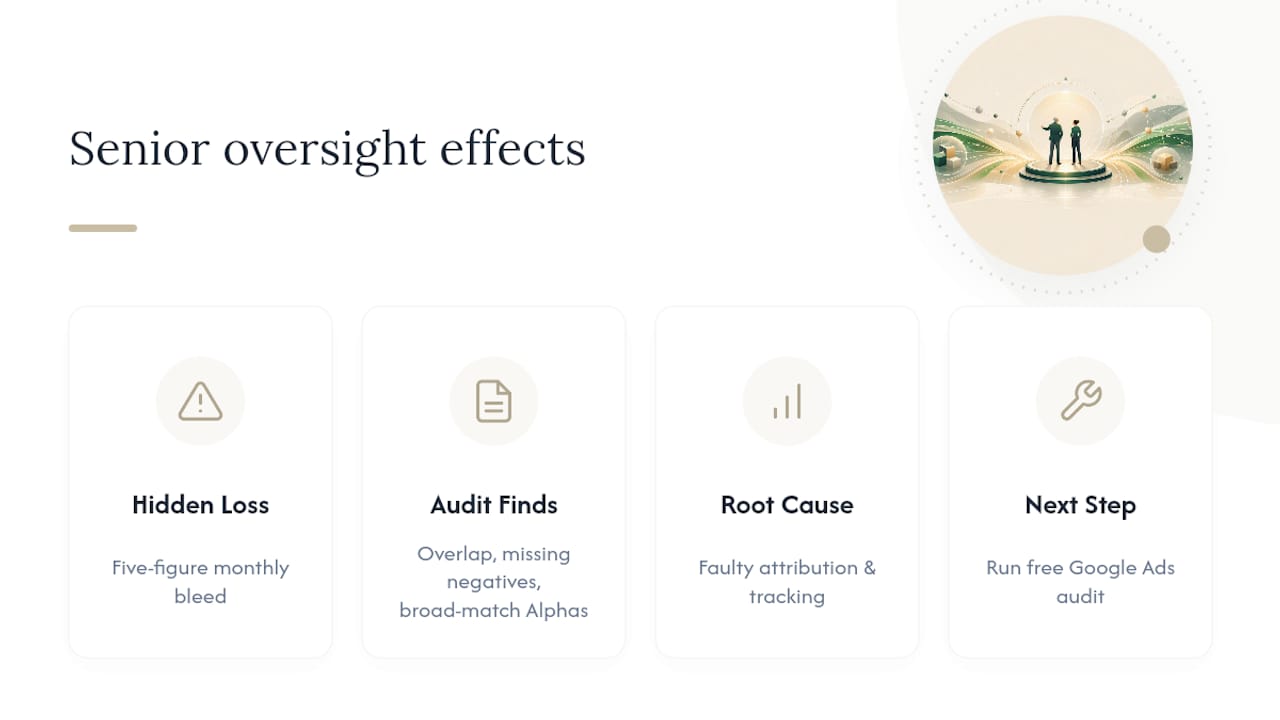
Some agencies work with accounts spending $25,000 or more per month, where the cost of a missed mirror negative or a mis-bid Alpha isn’t hypothetical. It’s a five-figure monthly bleed hiding in a search terms report nobody reviewed.
The rebuild that matters most usually isn’t the campaign structure itself. It’s the attribution and tracking underneath it, because an Alpha promoted on bad conversion data will never perform the way the spreadsheet promised.
An audit at this stage typically surfaces overlapping keywords across ad groups, missing negative lists, and Alpha candidates still sitting in broad match, unclaimed. That’s exactly the lifecycle a free Google Ads audit is built to map before a full restructure begins.
Where Alpha-Beta Implementations Usually Break
The most common failure is over-clustering. Teams get excited about small-keyword ad groups and end up with fifty Alpha campaigns nobody can actually audit weekly. Prune ruthlessly: if you can’t review a list every week, it’s too big.
The second failure is a missing shared negative list, which quietly bleeds budget for months. Check your mirror list first when performance dips. Most accounts recover measurable efficiency within two to four weeks of fixing just these two issues.
— Eric
Get a Senior-Led Alpha-Beta Restructure Done Right
North Country Consulting is the alternative to a traditional agency for advertisers who’ve read every Alpha-Beta guide but don’t have the bandwidth to rebuild a live account without breaking what’s already working. Every account gets direct senior oversight, not a junior account manager running through a checklist, and the restructure covers the full stack: campaign architecture, conversion tracking, and attribution, not just keyword sorting.
If your account has outgrown a DIY Alpha-Beta setup, or you suspect your negative lists have gaps nobody’s caught, the fastest next step is a free Google Ads audit that maps exactly where Alpha candidates are stuck in Beta and where budget is leaking. For accounts running $25,000 or more per month, North Country Consulting’s account restructure and management services rebuild the structure with written strategy and measurable, CFO-grade reporting behind it. Request the audit and see what it finds in your account.
Sources
- How to Build Alpha-Beta Campaigns | Built In Chicago
- How to Capture & Control Your PPC Keywords to Achieve a Better Account Structure – BGTheory
- Google Ads evolved, The Alpha-Beta Process has to evolve too – Jordan Digital Marketing
FAQ
What Is the Alpha-Beta Campaign Structure?
Alpha-Beta is a Google Ads organization method that separates proven, high-converting keywords (Alpha, run as exact match) from discovery keywords (Beta, run on broader match types). Alpha protects performance while Beta feeds it new candidates through ongoing search term analysis.
Is $500 a Month Enough to Run Google Ads?
A budget that small rarely generates enough conversion volume to build a meaningful Alpha tier, since Alpha depends on statistically reliable performance data. Most accounts need a much larger monthly spend before Alpha-Beta segmentation pays off; below that, focus on tight, single-theme campaigns instead of splitting budget across tiers.
What Are the Basic Steps of Building a Google Ads Campaign?
The core sequence is: define goals and conversion tracking, structure campaigns by theme, build tightly matched ad groups, write ad copy for each theme, set bids and budgets, launch, then monitor and refine based on the search terms report. Alpha-Beta layers on top of this by adding a discovery-and-graduation cycle to that refinement stage.
What Is the Hierarchy of a Google Ads Account?
Google Ads runs account, then campaign, then ad group, then keywords and ads, in that order. In an Alpha-Beta model, Alpha and Beta exist as separate campaigns within that same hierarchy, each containing its own small, tightly themed ad groups.
How Do I Know When a Keyword Is Ready to Graduate From Beta to Alpha?
Set a fixed threshold for conversions, cost per acquisition, and impression volume, then apply it consistently every time you review the search terms report. A common approach reviews data weekly but only executes promotions in a monthly window, giving the data enough time to prove the pattern is real rather than a short-term fluke.