
A non-brand shopping strategy separates campaigns targeting generic, category-level searches from those capturing your own brand name, so you can measure true customer acquisition instead of harvesting demand that would have converted anyway. The single most important move is segmenting brand from non-brand using campaign priority with a full negative-keyword list, or Performance Max brand exclusions where they apply. Before anything else, run a search-terms audit and confirm your Merchant Center account is properly linked to Google Ads.
TL;DR:
- Separate brand and non-brand campaigns using priorities and negative keywords to accurately measure customer acquisition and prevent blending performance metrics.
- Regularly review search terms, update negative keyword lists, and monitor budget pacing to ensure non-brand campaigns capture new demand without early exhaustion.
- Allocate a higher ROAS target on brand campaigns to protect existing revenue, while setting looser targets for non-brand ads aimed at customer growth.
- Track segmented ROAS and new-customer metrics independently to identify weak spots and optimize non-brand efforts effectively.
- Conduct ongoing audits focusing on campaign structure, feed health, and attribution to maintain a high-performing non-brand shopping strategy.
Table of Contents
- How non-brand shopping strategies work: intent and economics
- Step-by-step setup: Merchant Center, Shopping and PMax choices, and campaign structure
- Negative keywords and campaign-priority routing: the practical recipe
- Bidding and budget allocation for brand vs non-brand
- Measurement and reporting: what to track and how to interpret results
- Testing, optimization, and maintenance cadence
- How North Country Consulting implements this strategy
- Competitor analysis for non-brand search behavior and market gaps
- Creative and ad copy considerations tailored to non-brand audiences
- Optimizing landing pages for non-brand traffic conversion
- Seasonality and trends impact on non-brand shopping strategy
- Integration with multi-channel marketing efforts for non-brand shoppers
- When to prioritize non-brand vs when to defend brand
- Free audit and senior-led services
- Sources
- FAQ
How non-brand shopping strategies work: intent and economics
Brand searches come from people who already know your product exists. They convert at a higher rate, cost less per click, and carry inflated ROAS that flatters the account without adding new customers. Non-brand searches come from shoppers comparing options, and they carry the real cost of acquisition: lower conversion rates, higher CPCs, and the ROAS number that actually reflects growth.
When brand and non-brand queries sit in the same campaign, Smart Bidding blends the two signals. The algorithm optimizes toward the cheap, high-converting brand clicks and starves the non-brand traffic that would have expanded your customer base.
- Blended campaigns overstate performance because brand conversions mask weak non-brand results.
- Reporting becomes unreliable once brand and non-brand revenue mix together in one line item.
- A split adds real value once monthly spend and brand search volume are large enough to matter; a brand-new store with negligible brand search may not need one yet.
Step-by-step setup: Merchant Center, Shopping and PMax choices, and campaign structure
Before restructuring anything, confirm the plumbing works. Google Ads’ own instructions walk through linking a Merchant Center account, selecting a data source, and choosing a campaign type, and skipping this step is the most common reason Shopping campaigns underperform from day one.
- Link your Merchant Center account to Google Ads and confirm the connection is active before building any campaign.
- Verify feed attributes including title, GTIN, product_type, and availability, since Merchant Center’s product data specification treats these as the baseline for approval and visibility.
- Decide where brand exclusions live: Standard Shopping has no native exclusion list, so you route traffic with campaign priority and negatives, while Performance Max offers brand exclusion controls in some accounts that should be applied directly.
- Set initial campaign priorities, assign feed labels or data sources by segment, and lock in starting budget boundaries before launch.
- Build the negative-keyword list for the non-brand campaign before it goes live, not after the first budget cycle ends.
Get this sequence wrong and every metric downstream, from ROAS to new-customer rate, inherits the error. A clean setup takes an afternoon; unwinding a blended campaign’s history takes months.
Negative keywords and campaign-priority routing: the practical recipe
The routing mechanic is simple once the pieces are in place. Merchant Center’s documentation on campaign types and priority confirms that Standard Shopping has no built-in brand exclusion, which is why priority plus negatives remains the standard workaround.
- Compile every brand variation: misspellings, common typos, brand plus product combinations, and searches that include your domain name.
- Set the non-brand campaign to HIGH priority and load it with the full brand negative list.
- Set the brand campaign to LOW priority with no negatives, so any query that slips past the non-brand exclusions still lands somewhere sensible.
- Review search terms on a fixed schedule rather than reacting only when a report looks strange.
The routing breaks in one predictable way: the non-brand campaign runs out of budget mid-day, and Google shifts eligible traffic to the lower-priority brand campaign, which then serves generic queries at brand economics and quietly corrupts your reporting.
Pro Tip: Give the non-brand campaign a shared budget with enough headroom that it never exhausts before the brand campaign would naturally pick up overflow, and check pacing weekly rather than monthly.
Bidding and budget allocation for brand vs non-brand
Brand and non-brand queries are different businesses wearing the same account, and they need different return targets. Brand searches should be judged on protecting existing revenue at low cost, often with a return on ad spend (ROAS) or profit on ad spend (POAS) target well above account average. Non-brand searches should be judged on new-customer acquisition, where a lower ROAS threshold is often the right call because it is buying growth, not defending existing demand.
- Strong brand recognition can usually run tighter, higher-ROAS targets on brand and a looser target on non-brand to fund expansion.
- Weaker or newer brands may need to shift budget the other way, protecting share of voice on brand terms while non-brand spend grows more cautiously.
- Target ROAS suits accounts with stable conversion history; target CPA can work better for non-brand campaigns still building volume, and manual adjustments remain useful during the first weeks after a split.
There is no universal split that fits every account. Benchmark data from 2026 shows Shopping and Performance Max often taking the largest share of e-commerce budget, with non-branded search receiving a smaller but strategic allocation aimed squarely at acquisition rather than harvesting existing demand.
Measurement and reporting: what to track and how to interpret results
Once brand and non-brand are separated, the reports finally tell the truth. Segmented ROAS, new-customer rate, and match-to-order accuracy show whether the non-brand campaign is actually acquiring customers or just spending money that looks fine on paper.
- Track ROAS separately by segment rather than at the account level, where blended numbers hide weak non-brand performance.
- Compare conversion rate, average order value, and customer acquisition cost side by side between brand and non-brand campaigns.
- Watch for missed negatives, budget exhaustion on the non-brand campaign, and attribution mismatches between platforms as the three most common sources of a false read.
A brand campaign with a 12x ROAS and a non-brand campaign at 3x is not evidence the non-brand effort is failing. It is evidence the two campaigns are doing different jobs, and Shopping campaigns tend to show different conversion behavior than Search even before the brand split is applied, which is another reason to judge each segment on its own curve rather than against the other.
Testing, optimization, and maintenance cadence
A non-brand split is not a set-and-forget project. It needs a maintenance rhythm or it drifts back toward blended, unreliable data within a quarter.
- Check search terms weekly for new brand variations that have slipped past the negative list.
- Clean the negative-keyword list monthly, removing overly broad exclusions that may be blocking valuable non-brand queries.
- Reallocate budget quarterly based on segmented ROAS trends rather than gut instinct.
- Run experiments on product titles, feed attributes, bid strategy, and landing page variants one variable at a time.
Consider a pivot when the non-brand campaign consistently exhausts budget before the day ends, a sign that Performance Max brand exclusions or a budget increase are overdue.
How North Country Consulting implements this strategy
The consulting firm applies senior-led oversight to every account it manages, rather than handing accounts to junior staff after an initial audit. That operational model, built around direct restructuring of campaign architecture, conversion tracking, and reporting, shapes how brand and non-brand splits get built for high-spend accounts.
- Clients report a strong average ROAS, and the firm has managed substantial ad spend, according to figures stated about its own client outcomes.
- That experience informs specific choices: which queries belong in brand negative lists, how tight to set priority routing, and where to apply exclusions in campaign management.
- A free Google Ads audit examines the brand versus non-brand split, negative-keyword hygiene, feed health, and attribution setup as a starting diagnostic.
Competitor analysis for non-brand search behavior and market gaps
Non-brand search terms are also where competitors’ customers go looking for alternatives, which makes competitor research a direct input into keyword and budget decisions. Before finalizing a non-brand keyword list, pull the search terms report and look for category and problem-based phrases you are not yet bidding on, especially ones a competitor’s brand campaign would never touch.
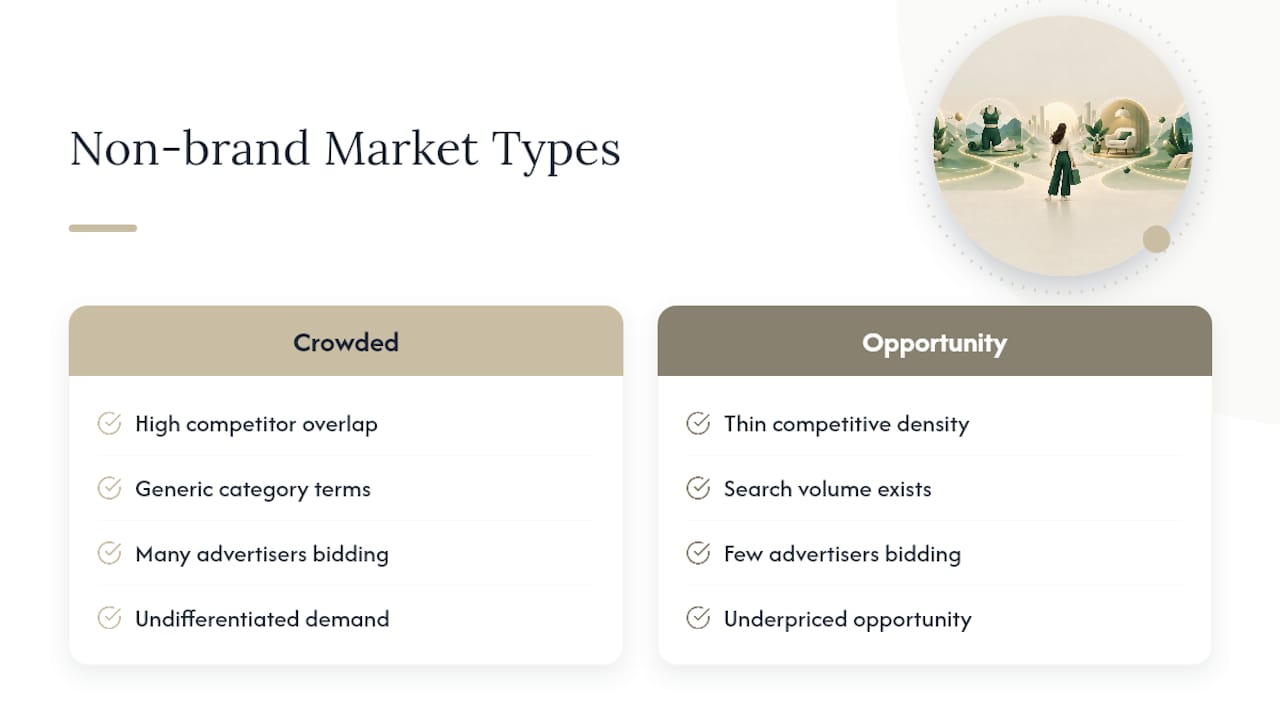
Auction insights data shows which competitors overlap most on non-brand impressions, and a high overlap share on generic category terms usually signals a market where several players are fighting for the same undifferentiated demand. That is a different situation from a gap where search volume exists but few advertisers are actively bidding, which often means an underpriced opportunity rather than a crowded one.
Watch for terms that combine a competitor’s product category with a modifier like “alternative,” “vs,” or “comparison.” These queries carry strong purchase intent and sit squarely in non-brand territory, since the shopper has not yet committed to any single brand. Building a small set of campaigns or ad groups around these comparison-intent terms, separate from generic category terms, lets you write copy and choose landing pages that speak directly to a shopper actively weighing options.
Market gaps also show up in seasonal or regional search patterns that competitors are slower to address. A retailer that only optimizes brand campaigns during a peak season and lets non-brand budgets lapse is effectively ceding that category traffic, and a competitor analysis that tracks impression share over time will surface exactly when that happens.
The goal is not to copy what competitors bid on, but to use their absence as a signal. Category terms with rising search volume and thin competitive density are the clearest sign that a non-brand investment will find room to grow rather than fight for the same impressions everyone else is already paying for.
Creative and ad copy considerations tailored to non-brand audiences
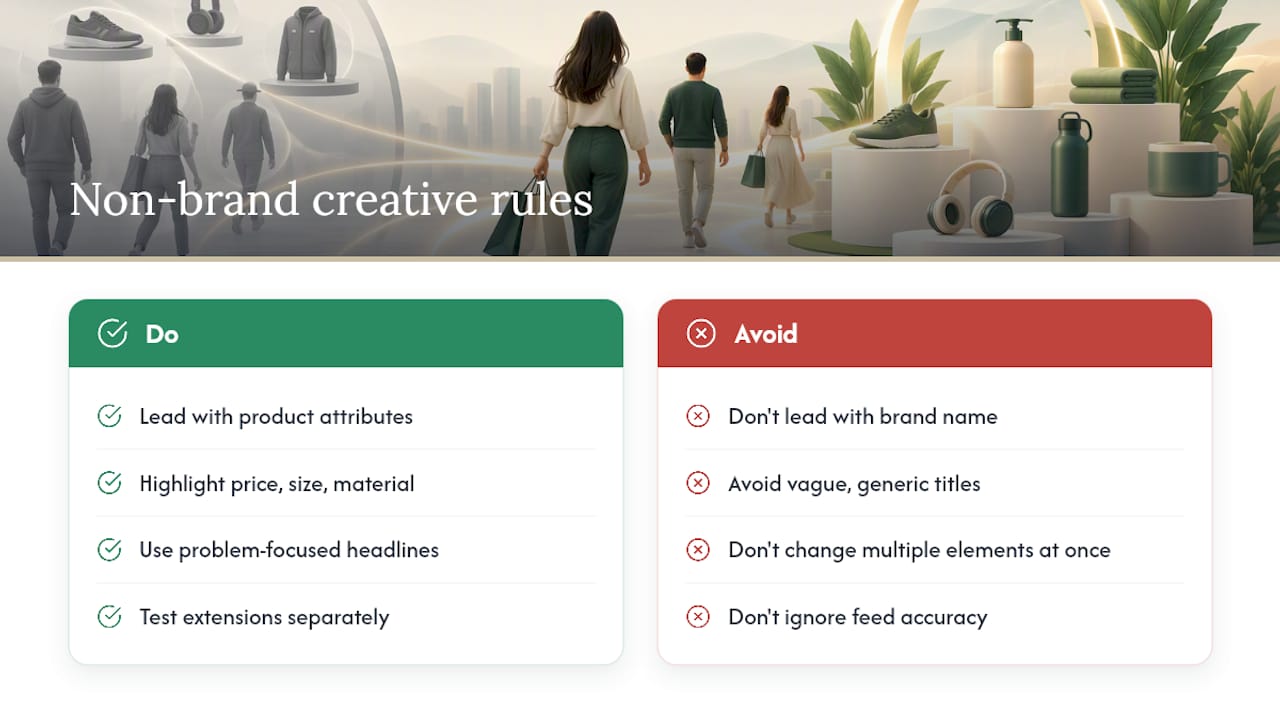
Non-brand shoppers have not decided who to buy from, which means ad copy has to do more work than simply naming the product. Brand campaigns can lean on recognition; non-brand campaigns need to earn attention with specifics: price, material, size range, shipping speed, or a feature a shopper is actively comparing across sites.
Shopping ads pull most of their visible copy directly from the product feed, so title and description quality function as ad copy whether or not you think of them that way. A title that leads with the generic product type and key attributes (color, size, material) tends to match more non-brand queries than one that leads with a brand name a new shopper does not yet recognize. Merchant Center’s own guidance on product data treats attribute accuracy and title clarity as central to both approval and match quality, which makes feed writing an extension of the ad copy strategy rather than a separate task.
For text-based non-brand campaigns, headlines built around the problem a shopper is trying to solve tend to outperform headlines built around brand pride. A shopper searching “waterproof hiking boots” is not yet loyal to any brand, so copy that answers the functional question in the headline earns the click before the brand name ever needs to appear.
Promotional extensions, price extensions, and structured snippets carry more weight in non-brand campaigns than in brand campaigns, because they give an undecided shopper concrete reasons to click your listing over a competitor’s in the same auction. Testing these elements independently of headline copy, rather than changing several variables at once, keeps the read on what actually moved performance clean.
Optimizing landing pages for non-brand traffic conversion
A non-brand shopper who clicks an ad has never been on your site before, and the landing page has to close that trust gap in seconds. The single highest-leverage fix is matching the landing page content to the ad and feed: if the product title says “matte black ceramic knife set,” the landing page headline, images, and price need to say the same thing immediately, with no scavenger hunt required.
Merchant Center’s product data guidance specifically calls out matching titles and descriptions to landing pages as a factor in Shopping performance, and that consistency matters even more for non-brand traffic, which has no existing familiarity to fall back on if the page feels off.
Beyond matching, non-brand landing pages benefit from visible trust signals higher on the page: shipping timelines, return policy, and social proof, since a first-time visitor is deciding whether to trust an unfamiliar retailer before deciding whether to buy the product. Checkout friction also costs more in non-brand traffic than brand traffic, because a first-time buyer has less patience for an account creation wall or a confusing shipping calculator than a repeat customer who already trusts the process.
For more detail on structuring these pages, landing page best practices for Google Ads cover consistency and friction points in depth, and a guide to product page optimization offers additional tactics for improving conversion once traffic lands.
Testing landing pages for non-brand traffic works best isolated from brand traffic entirely, since the two audiences respond to different cues and a page redesign that helps one can quietly hurt the other if it is judged on blended data.
Seasonality and trends impact on non-brand shopping strategy
Non-brand demand moves with the calendar in ways brand demand often does not. A shopper searching a generic category term in November is frequently comparison shopping across a wider set of retailers than a February shopper searching the same term, simply because more advertisers are competing for holiday volume, which raises CPCs and can compress ROAS even when conversion rates hold steady.
Budgets built for a flat, year-round split rarely survive a peak season intact. Non-brand campaigns often need a larger absolute budget increase heading into a seasonal peak than brand campaigns, because non-brand is the channel actually capturing new demand that shows up only during that window, while brand searches from existing customers stay comparatively stable.
Seasonal shifts also change which search terms matter. A non-brand keyword list built in the spring may miss gift-intent phrases that spike in the fourth quarter, which is one more reason the weekly search-term review matters more during peak periods than during the rest of the year. Reviewing last year’s seasonal search terms, where available, gives a head start on which non-brand phrases to add before the season begins rather than after the first week of missed opportunity.
Budget pacing controls matter more during peak seasons too. A non-brand campaign that exhausts its daily budget by mid-morning during a high-traffic week is losing exactly the volume the season was supposed to capture, which makes the shared-budget and pacing checks covered earlier in this guide a seasonal task, not just a routine one.
Integration with multi-channel marketing efforts for non-brand shoppers
A non-brand shopper rarely converts from a single touchpoint, which means the shopping campaign is often one step in a longer path rather than the whole story. Coordinating non-brand Shopping and search efforts with other channels, email, social, and other paid platforms, keeps the message consistent across whichever channel a shopper encounters first.
Retargeting is the most direct link between non-brand acquisition and other channels. A shopper who clicks a non-brand Shopping ad but does not convert is a strong candidate for retargeting on social platforms or through email capture, since that click already signaled category-level intent even without a purchase.
Attribution gets harder as channels multiply, and this is where the segmented reporting built earlier in the strategy pays off again. If a non-brand Shopping campaign gets credit for a sale that email or social actually influenced further down the path, the campaign’s true efficiency looks worse than it is, so a cross-channel view, even a simple one built from platform-reported assisted conversions, helps avoid over-correcting a non-brand budget based on incomplete credit.
Consistency in offers matters too. A non-brand shopper who sees one price or promotion in a Shopping ad and a different one on a retargeting email loses trust quickly, and that inconsistency shows up as abandoned carts more than as an obvious complaint. Coordinating promotional calendars across channels, particularly around the seasonal peaks covered above, keeps the non-brand acquisition effort from working against the rest of the marketing plan instead of alongside it.
When to prioritize non-brand vs when to defend brand
Heavy non-brand investment makes sense when growth is the goal, the product has proven demand, and margins can absorb a higher acquisition cost. Brand defense deserves more weight when margins are thin or the product feed and site experience are not yet strong enough to convert unfamiliar traffic. For most mid-to-high spend advertisers, the safer default is a real split with non-brand funded for growth, not a blended campaign hoping brand conversions carry the average.
— Eric
Free audit and senior-led services
Running this split correctly takes ongoing attention: negative lists drift, budgets misfire, and feed issues creep back in without someone watching weekly. North Country Consulting’s free Google Ads audit reviews exactly the pieces this guide covers, at no cost, before you commit to anything further.
- The audit examines your brand versus non-brand split, negative-keyword coverage, feed health, and attribution setup.
- You get a written breakdown of what is misconfigured and what it is likely costing you, not a generic checklist.
- Every account gets senior oversight rather than a junior handoff after the initial review, and account ownership stays with you throughout.
Start with the free audit to see exactly where your current setup is leaking revenue.
Sources
FAQ
What is the 3-3-3 rule for marketing?
Definitions of the 3-3-3 rule vary by marketer and channel, so there is no single agreed standard. In a Google Ads context, it is sometimes used informally to describe testing in short cycles, such as three creative variants over three weeks with three metrics tracked, rather than a rule Google itself publishes.
What are the 5 R’s of retailing?
The “5 R’s” label is used inconsistently across retail sources, and no single authoritative definition applies universally. Rather than cite a specific enumeration, focus on the fundamentals this guide covers: accurate product data, clear intent segmentation, and consistent measurement, which matter more to shopping campaign performance than any acronym.
Where does Gen Z prefer to shop?
Shopping preference by generation varies by category and is not something this guide’s sources measure directly. What matters for a non-brand strategy is that comparison-intent search behavior, regardless of the shopper’s age, is exactly what non-brand campaigns are built to capture.
What is no brand branding?
“No brand” or generic branding refers to products marketed with minimal brand identity, letting price, function, or category do the selling instead of brand recognition. In advertising terms, this connects to a non brand shopping strategy because both approaches rely on generic, attribute-based signals rather than name recognition to earn the click.
How do I know if my brand and non-brand split is working?
Check segmented ROAS and new-customer rate separately for each campaign rather than looking at blended account totals. If the non-brand campaign consistently exhausts its budget early or a search-term audit turns up brand queries slipping through, the split needs negative-keyword cleanup or a free Google Ads audit to identify the specific gap.