
The best way to measure PPC call quality is to combine attributed forwarding numbers with a validated scoring system tied to CRM outcomes, so your reporting reflects revenue, not ring volume. That means setting duration and disposition thresholds, layering in AI call scoring for consistency, and importing CRM-confirmed sales as offline conversions in Google Ads. Success looks like campaign-level ROAS and CPA built on qualified calls, not raw tel: clicks. A Google Ads conversion action combined with AI call scoring gets you there faster than either alone, and it’s the same framework North Country Consulting uses when auditing high-spend accounts.
TL;DR:
- Using dedicated forwarding numbers with CRM validation ensures PPC call reporting reflects revenue, not just ring volume or click counts.
- Level 3 call tracking, which includes duration, disposition, and CRM outcomes, is essential for value-based bidding and accurate ROAS measurement.
- AI call scoring automates review of scripted KPIs but still requires manual validation to accurately interpret tone and subtle cues.
- Proper setup involves concurrent CRM mapping, DDI implementation, recording, and later calibration of AI scoring; skipping steps reduces data quality.
- Accurate ROAS calculation depends on attributing revenue to qualified calls validated through CRM and offline conversions, avoiding inflated metrics.
Table of Contents
- What Are the Three Levels of Call Tracking?
- How Do Google Forwarding Numbers and DDI Work?
- What Makes a Call “Quality” and How Do You Score It?
- Can AI Call Scoring Replace Manual Review?
- Implementation Checklist for Tracking Call Quality
- How Do You Calculate ROAS From Call Data?
- How North Country Consulting Validates Call Quality for Clients
- Where Should You Start If Resources Are Limited?
- Get a Free Audit of Your Call Measurement Setup
- Sources
- FAQ
What Are the Three Levels of Call Tracking?
Most advertisers stop at the shallowest level of call measurement, then wonder why their cost-per-lead numbers don’t match reality.
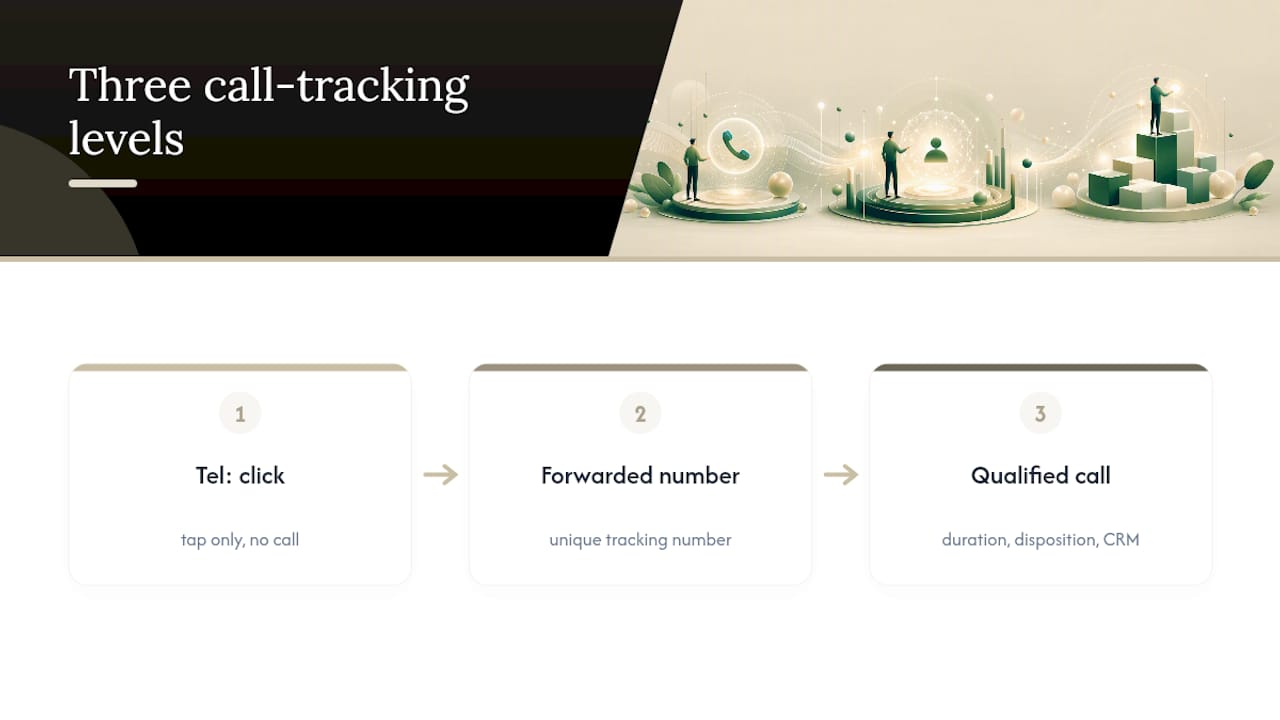
Level 1: the tel: click. This counts someone tapping a phone number on your ad or landing page. It’s the weakest signal available because a tap isn’t a conversation. Plenty of tel: clicks come from people scrolling past on mobile who never intended to dial.
Level 2: forwarded-number attribution. A unique tracking number tied to a specific keyword or ad group tells you which query actually generated a ringing phone, not just an intention to call.
Level 3: qualified calls. This layer adds duration, disposition, and CRM outcome, the data PPC bidding actually needs to optimize toward revenue instead of noise. If your account uses value-based bidding, Level 3 is not optional.
How Do Google Forwarding Numbers and DDI Work?
Google Ads assigns forwarding numbers to ads and website content, then counts qualifying calls as conversions. Recording and duration data are available for U.S. and Canada advertisers, which lets Google’s AI flag likely lead quality automatically. Dynamic number insertion (DDI) works differently: it swaps the visible phone number on your site in real time based on the visitor’s traffic source, so a call from a Google Ads visitor gets tagged to that campaign and keyword, while an organic visitor sees a different number entirely.
Setting it up correctly takes a few deliberate steps:
- Reserve a large enough pool of forwarding numbers so DDI doesn’t run out and default to your main business line.
- Test each campaign and keyword path to confirm the right number displays before launch.
- Watch for tel: click inflation once DDI is live. Some analytics platforms double count a click and the resulting call as separate conversions.
When recording or DDI isn’t available for a channel, Google Ads falls back to call duration or ad interaction data to estimate quality instead of leaving the conversion blank.
Pro Tip: Run DDI on a single high-traffic campaign for two weeks before rolling it out account-wide. Number pools that are too small create attribution gaps that look like tracking failures but are actually inventory problems.
What Makes a Call “Quality” and How Do You Score It?
“Quality” is subjective until you write it down as a scorecard. CallRail’s framework for call quality scores combines multiple KPIs, speed to answer, resolution, agent behavior, audio clarity, into a single rated outcome, usually scored 1 to 5 or 1 to 10 per criterion.
Build your scorecard around these categories:
- Outcome confirmation: Did the call end in a booked appointment, a closed sale, or a dead end?
- Discovery behavior: Did the caller ask pricing or availability questions consistent with buying intent?
- Script or compliance adherence: Did the rep collect the information needed to close or follow up?
- Next-step confirmation: Was a specific date, time, or action agreed to before hanging up?
- Call duration: Calls under 30 seconds rarely represent genuine interest; calls over several minutes usually do.
- Sentiment or tone flags: Frustration or confusion early in the call predicts a lost sale later.
Track these alongside volume, answered rate, time-to-answer, and source, then feed the disposition back into your PPC platform.
Pro Tip: Before trusting any automated score, manually review 20 to 30 calls and compare them against the AI’s output. Mismatches usually point to vague rubric wording, not a bad tool.
Can AI Call Scoring Replace Manual Review?
Not entirely, but it changes what manual review is for. AI call scoring works by transcribing the call, then running it against a manager-configured rubric to produce per-question scores and an aggregate rating. That gives you visibility into every call instead of a random sample.
Where AI scoring performs well: binary, scripted checks. Did the rep state the price? Did they ask for the caller’s phone number? Rubric items with a clear yes or no score more accurately than open-ended behavioral judgments, like whether the rep sounded genuinely helpful.
Where humans still matter: tone, rapport, and the subtle moments where a caller’s hesitation signals a near miss rather than a lost lead. Platforms like JustCall’s AI scoring link scores directly to transcript timestamps, so a manager can jump straight to the moment a call went sideways instead of listening to the whole recording.
A workable validation plan looks like this:
- Score a sample of 20 to 30 calls manually and side by side with the AI output.
- Adjust question wording and weighting where the two disagree systematically.
- Set a monitoring cadence, monthly at minimum, to catch drift as call volume or staff changes.
Implementation Checklist for Tracking Call Quality
Getting from “we get calls from ads” to “we know which calls made money” takes a sequence, not a single setting.
- Create call conversion actions in Google Ads. Set up separate actions for calls from ads, calls from website extensions, and calls uploaded manually, with duration thresholds matched to your sales cycle.
- Deploy DDI or forwarding numbers, then test at the campaign and keyword level before trusting the data. Watch early reporting closely for tel: click double counting.
- Turn on recording and transcription where your jurisdiction allows it, with proper consent language, then configure your AI scoring rubric or select a conversation intelligence vendor.
- Map call dispositions to your CRM. Import confirmed outcomes as offline conversions or use Enhanced Conversions so revenue, not just call count, reaches your bidding algorithm. This step-by-step approach to offline conversion imports covers the technical setup in more detail.
- Run a QA pass. Test the full path from ad click to CRM disposition, check for duplicate conversions between tel: clicks and forwarding numbers, and confirm the sync into your reporting dashboard actually matches CRM records.
Pro Tip: Duplicate conversions are the single most common cause of inflated call ROAS. If your tel: click count and your forwarded-call count both fire as separate conversions for the same phone call, your CPA will look better than it is.
For the underlying setup work, this Google Ads call tracking configuration guide walks through conversion action settings and duration testing in more depth.
How Do You Calculate ROAS From Call Data?
Call quality data only earns its keep once it turns into numbers a finance team recognizes. The core formulas:
- Cost per call = ad spend ÷ total tracked calls
- Cost per qualified call = ad spend ÷ calls meeting your scorecard threshold
- Lead-to-sale rate = closed sales ÷ qualified calls
- Revenue per call = total attributed revenue ÷ total tracked calls
- ROAS = revenue from call-driven sales ÷ ad spend
The diagnostic metric that ties it together is the sales conversion rate from calls, since it connects raw call volume to closed revenue rather than stopping at “the phone rang.” Build your reporting as a funnel: campaign, then calls, then qualified calls, then closed sales, then attributed revenue. Before trusting any single metric, especially duration, run it against a larger sample; a two-minute average call length means little if half those calls never closed. Offline conversion mapping, detailed in this guide to sales-qualified lead tracking, is what makes this funnel visible inside Google Ads itself.
How North Country Consulting Validates Call Quality for Clients
Call scorecards can be tied directly to Google Ads conversion actions, with CRM-confirmed outcomes fed back for ROAS reporting that reflects real revenue.
Where Should You Start If Resources Are Limited?
Not every account needs full AI scoring on day one. Lower-fidelity tel: click data is fine for a brand-new campaign still finding its footing, but any account spending real budget on value-based bidding needs Level 3 data fast.
Sequence it: conversion actions and CRM mapping first, then DDI and forwarding numbers, then recording and transcription, then AI scoring and calibration last. Skipping ahead to AI scoring without clean CRM mapping just automates bad data faster. Privacy, call storage, and QA staffing all scale with each layer, so budget resources accordingly rather than turning everything on at once.
— Eric
Get a Free Audit of Your Call Measurement Setup
Most accounts we review are optimizing bids around tel: clicks while treating every ring as equal value, which quietly punishes the keywords actually driving sales. A free strategy audit can diagnose where call tracking breaks down, from missing conversion actions to unmapped CRM outcomes, and estimate revenue hidden by bad attribution.
For accounts spending $25,000 or more a month, the typical path runs from audit to a short pilot rebuild of conversion actions and CRM mapping, then into full senior-led PPC management once the measurement foundation is solid. There’s no junior account team guessing at your setup, senior staff handle the account directly from the first audit call. If your reporting can’t currently tell a qualified sale from a wrong number, that audit is the fastest way to find out what it’s costing you.
Sources
For the technical setup behind this article, start with Google’s own documentation on measuring calls from ads, which covers conversion actions, recording availability, and duration fallbacks. Aircall’s guide to AI call scoring explains rubric design and calibration in more detail, and teams evaluating broader automation gains can review this analysis of AI’s productivity impact for agencies.
- Measure calls from ads – Google Ads Help
- What is AI call scoring? – Aircall
- What is a call quality score? – CallRail
- PPC call tracking – Nimbata
- How to Measure and Optimize Call Campaign Analytics – PayPerCall Marketing
FAQ
How Do You Measure Call Quality?
Combine attributed call data (duration, disposition, source) with a scorecard covering outcome confirmation, discovery behavior, and next steps, then validate any automated scoring against a manual sample of 20 to 30 calls.
Is PPC Better Than SEO for Generating Quality Calls?
PPC gives you faster, more controllable attribution because every call ties back to a specific ad, keyword, and forwarding number, while SEO-driven calls are harder to trace to a single query. Neither replaces the other; PPC is simply easier to measure and optimize toward qualified calls in the short term.
What Are the Key Metrics in PPC Call Tracking?
The core set includes call volume, duration, answered rate, time-to-answer, source or keyword attribution, time-of-day patterns, and conversion disposition, all of which should ultimately feed a cost-per-qualified-call and ROAS calculation.
How Is PPC ROAS From Calls Calculated?
Divide the revenue attributed to closed sales that originated from tracked calls by total ad spend on the campaigns driving those calls, using CRM-confirmed outcomes rather than call volume alone.
Should I Use Google Ads’ Native Call Tracking or a Third-Party Tool?
Google Ads’ built-in forwarding numbers and recording cover the basics well for most advertisers, but third-party conversation intelligence platforms add richer detail like transcription and demographic data that support more advanced lead classification. Many high-spend accounts run both, using Google Ads for bidding signals and a specialized platform for coaching and QA.