
Measure ChatGPT Ads by instrumenting conversions with the OpenAI Pixel and Conversions API, treating Ads Manager metrics as directional rather than causal, and confirming real impact with incrementality tests. Together with disciplined oppref handling and blended ROAS reporting, this three-part approach, instrument, validate, and prove gives marketing teams and CFOs a defensible read on what ChatGPT Ads actually contribute, not just what the platform reports.
TL;DR:
- Preserving the oppref and matching event_id across browser and server events significantly improves attribution accuracy and deduplication.
- Reconciliation between Ads Manager and analytics tools requires careful attention to attribution windows, time zones, and consent restrictions to avoid misleading discrepancies.
- Setting up and validating conversion tracking through Pixel and Conversions API is foundational; most measurement issues stem from gaps or misconfigurations in this process.
- Conducting incremental lift tests, such as geo holdouts or A/B experiments, is essential for proving actual contribution beyond platform-attributed ROAS.
- Creative generated with AI may produce more variation and longer consideration cycles, requiring patience and longer attribution windows to accurately gauge performance.
Table of Contents
- What Ads Manager reports and how to read it
- Setting up conversion tracking with the OpenAI Pixel and Conversions API
- Where platform reporting falls short
- A three-phase framework: instrument, validate, prove incrementality
- Measurement partner integrations and how to set them up
- Practices that tighten your measurement and cut discrepancies
- How AI-generated creative affects your measurement data
- Bias and accuracy risks specific to AI-driven ad content
- Privacy and compliance considerations for measurement setup
- How North Country Consulting operationalizes this framework for clients
- Get your measurement gaps fixed before you scale spend
- Sources
- FAQ
What Ads Manager reports and how to read it
Ads Manager gives you the core delivery and cost metrics you’d expect from any paid platform, plus a conversions column tied to your own tracking setup. Reading it correctly means knowing what each number includes and what it leaves out.
The standard metrics available are:
- Impressions, clicks, and spend, the baseline delivery numbers for pacing checks.
- CTR, Avg CPC, and Avg CPM, useful for comparing creative and audience performance within the platform.
- Conversions (click-through), attributed only to users who clicked before converting.
- One-day view-through conversions, reported separately for some accounts as a supplemental signal, not folded into the main conversions total.
You can view this data in table format, in charts for trend analysis, or export it as a CSV. The CSV export matters most for reconciliation work: it lets you pull Ads Manager numbers into a spreadsheet or BI tool and line them up against your own analytics platform, and you can edit columns before exporting to include event-specific metrics.
Expect some divergence from your analytics stack even with a clean setup. Attribution windows differ between Ads Manager and tools like GA4, deduplication logic varies, timezone settings on exports can shift daily totals, and cookie or consent restrictions can suppress events on either side. None of this means the data is wrong, but it does mean a like-for-like reconciliation takes deliberate effort rather than a quick glance at two dashboards.
Setting up conversion tracking with the OpenAI Pixel and Conversions API
Reliable measurement starts with instrumentation, and OpenAI’s conversion measurement documentation lays out a specific sequence for getting it right.
- Create a data source inside Ads Manager to hold your conversion events.
- Install the OpenAI Pixel on your site so browser-side events fire on key actions.
- Configure the Conversions API to send the same events server-side, which protects against browser-side data loss.
- Map standard and custom events (purchase, lead, sign-up) so Ads Manager can attribute them correctly.
- Preserve the oppref (OpenAI’s click reference) through any redirects and pass it into your server-side calls.
- Use the same event_id on both the browser and server version of a given conversion so Ads Manager can deduplicate them.
The oppref is the piece most teams overlook. It’s the click reference OpenAI’s Pixel captures automatically, and if your checkout flow redirects through multiple domains or a third-party payment processor, that reference can get dropped before the conversion fires. When it’s preserved and passed along with a matching event_id, OpenAI’s documentation notes this materially improves both attribution accuracy and deduplication between Pixel and Conversions API events. Automatic advanced matching can also hash customer details like email addresses with SHA-256 in the browser, improving match rates without exposing raw personal data, but only send fields you’re actually permitted to collect.
Pro Tip: Audit your redirect chain before launch. A single unpreserved oppref on a payment gateway redirect can quietly erase a meaningful share of your attributed conversions.
For a deeper walkthrough of Pixel and Conversions API setup, our guide on ChatGPT Ads conversion tracking covers the server-side deduplication details step by step.
Where platform reporting falls short
Ads Manager tells you what it can see, not what actually happened without the ad. That distinction matters more the higher your spend climbs.
- Platform ROAS is not proof of causality. It reflects attributed conversions, not what would have happened anyway.
- Assisted conversions and late tails get missed. A user who sees an ad, researches for two weeks, then converts through a different channel rarely gets credited back to ChatGPT Ads.
- Modeled conversions can inflate totals if misread. OpenAI’s documentation notes that modeled conversions estimate otherwise-unattributed events from aggregated patterns and may be included in reported totals, so they should be labeled and discussed separately from raw, attributed conversions.
- The Conversions column and view-through metrics measure different things. Conversions counts click-through activity only; one-day view-through conversions are reported as a supplemental, separate figure, and treating them as interchangeable overstates performance.
When your numbers don’t match GA4 or a server-side analytics platform, start with the basics: compare attribution windows, check for timezone mismatches on your exports, and confirm whether cookie consent settings are suppressing events on one side but not the other. Most discrepancies trace back to one of these three causes.
A three-phase framework: instrument, validate, prove incrementality
A CFO doesn’t want a screenshot of Ads Manager. They want a number you can defend, and that requires moving through three distinct phases rather than reporting raw platform metrics as final.
- Instrument. Set up the Pixel and Conversions API together, build a clean event taxonomy (purchase, lead, sign-up, add-to-cart), preserve the oppref through every redirect, and use a shared event_id across browser and server events for deduplication. This is the foundation; nothing downstream works without it.
- Validate. Export Ads Manager CSVs and reconcile them against server logs or your analytics platform. Check that timestamps align across time zones, confirm deduplication is functioning by sampling a batch of conversions, and flag any event category with the site variance between sources.
- Prove incrementality. Platform metrics alone can’t answer whether the spend caused the outcome. Run a geo holdout, splitting comparable markets into treatment and control regions, or a randomized A/B test where feasible, and analyze the results with a time-series method such as BSTS to account for seasonality and outside shocks. Report a blended ROAS that folds in assisted and later-arriving conversions over a 30 to 90 day tail, alongside the platform-reported number, so stakeholders see both the raw signal and the adjusted one.
Pro Tip: Run your first geo holdout for at least four weeks before drawing conclusions. Shorter windows rarely produce a stable enough signal to separate real lift from normal week-to-week noise.
Our breakdown of how to measure ROI from ChatGPT Ads walks through blended ROAS calculations in more detail, and our comparison of ChatGPT Ads and Google Ads measurement covers how attribution windows differ between the two channels.

Measurement partner integrations and how to set them up
OpenAI’s measurement partner integrations extend what Ads Manager can track on its own, and each partner plays a different role depending on your stack.
- Hightouch activates conversion data directly from your data warehouse into Ads Manager, useful when your source of truth lives in a database rather than a tag manager.
- Triple Whale stitches together the ecommerce customer journey across channels, helpful for merchants who need a single view of what drove a purchase.
- LiveRamp handles offline and identity matching, connecting in-store or CRM data back to ad exposure.
- AppsFlyer and Adjust manage mobile attribution through partner-specific attribution links, letting app-based conversions flow back into Ads Manager.
Setup generally requires your Pixel ID, a Conversions API key, and event mapping specific to the partner; mobile integrations also need attribution links configured on the app side. Once connected, expect a 24 to 48 hour processing window before attributed events start appearing reliably in Ads Manager reporting.
Practices that tighten your measurement and cut discrepancies
Most measurement problems are fixable with a handful of habits applied consistently rather than a platform overhaul.
- Preserve the oppref across every redirect and include it in server-side Conversions API calls, not just browser events.
- Use the same event_id for a given conversion on both the browser and server side to enable clean deduplication.
- Send advanced-matching hashes only when you’re compliant to do so, and run browser and server events together rather than relying on one alone.
- Export CSVs regularly for reconciliation, keep time zones and date ranges aligned across tools, document your attribution windows, and spot-check a sample of conversions each month.
Pro Tip: Put a recurring calendar reminder on your monthly conversion QA. Measurement hygiene degrades quietly, usually after a site redesign or a checkout flow change nobody flagged to the marketing team.
Teams selling physical products often find event taxonomy the trickiest part to standardize; our guide to ChatGPT Ads for ecommerce includes example event structures for common purchase flows.
How AI-generated creative affects your measurement data
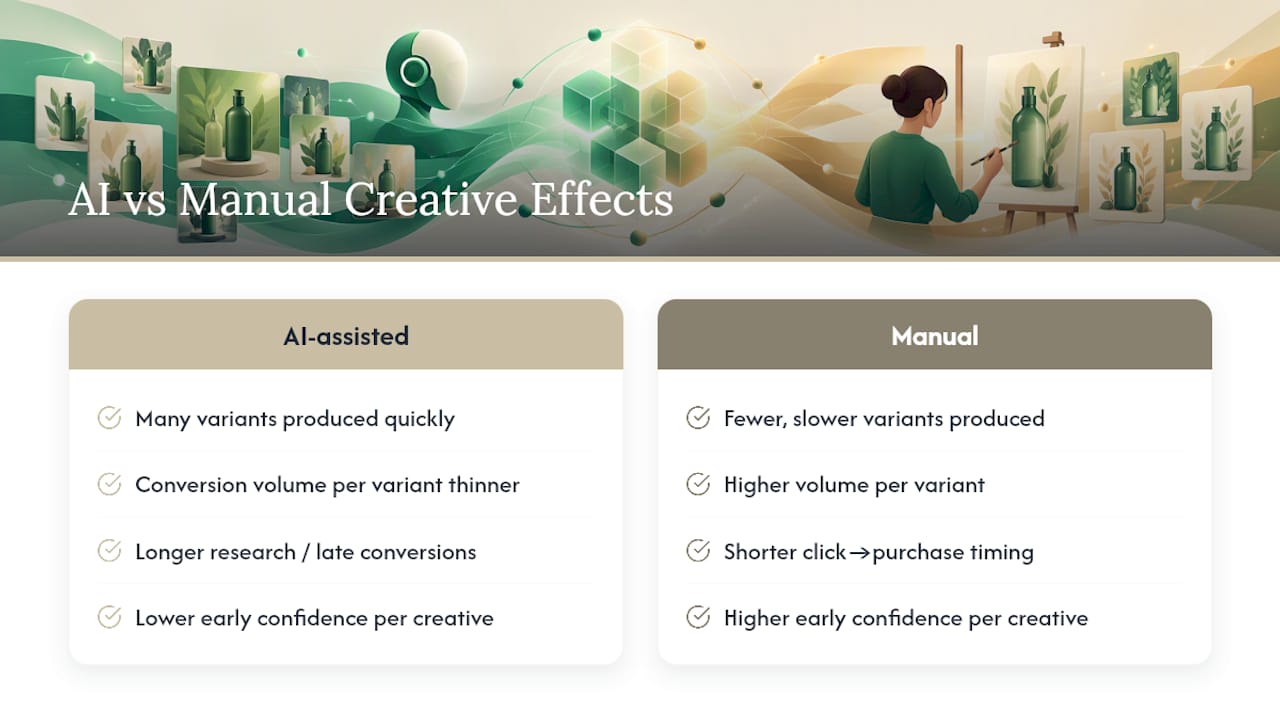
ChatGPT Ads campaigns often run creative generated or heavily assisted by AI tools, and that has a few practical implications for measurement. When creative variants are produced quickly and in volume, you can end up testing far more variations than a manual production process would allow, which spreads your conversion volume thinner across each variant and makes individual creative performance harder to read with confidence.
This also affects attribution timing. AI-generated ad copy sometimes prompts a different research pattern from users, more browsing before a decision, more time between the click and the eventual purchase, which feeds directly into the late-conversion tail problem discussed earlier. If your attribution window is too short, you’ll systematically undercount conversions driven by creative that produces a longer consideration cycle rather than an immediate purchase.
Practically, this means treating creative-level reporting with some caution until you have enough volume per variant to trust the numbers, and it strengthens the case for tracking blended ROAS with a longer conversion tail rather than judging creative purely on click-through conversions inside a narrow window. The instrumentation and event mapping described earlier apply the same way regardless of how the creative was produced, but the interpretation of early results benefits from extra patience when the creative pipeline is AI-assisted and high-volume.
Bias and accuracy risks specific to AI-driven ad content
AI-generated ad content introduces measurement risks that aren’t obvious from the reporting dashboard alone. One is volume bias: when creative generation is cheap and fast, teams often launch more variants than they can properly evaluate, and Ads Manager will still report clean-looking CTR and CPC numbers for each one even when the underlying sample size is too small to be reliable.
A second risk is novelty effects. AI-generated copy or formats that differ noticeably from what users typically see in a feed can produce an initial curiosity-driven click rate that doesn’t hold up over time, inflating early CTR relative to what the campaign will sustain once the format becomes familiar.
A third is homogenization risk: if multiple advertisers lean on similar AI tools and prompting patterns, creative across a category can start to look and read alike, which can suppress differentiation in performance data and make it harder to isolate what’s actually driving results versus what’s simply average performance for the format. None of these are reasons to avoid AI-assisted creative, but they’re reasons to weight early results conservatively and to let the validation and incrementality phases of your measurement framework, not raw CTR, decide what’s working.
Privacy and compliance considerations for measurement setup
Conversion tracking for ChatGPT Ads runs through the same privacy obligations as any other ad platform, and the mechanics of the Pixel and Conversions API make that concrete rather than abstract. Advanced matching hashes customer information such as email addresses with SHA-256 before it’s sent, but per OpenAI’s own guidance, you should only send fields you’re actually permitted to collect and use under applicable law, and the hashing itself doesn’t create a compliance exemption on its own.
This becomes more relevant, not less, with AI-generated creative, since campaigns built around personalized or highly targeted messaging can rely more heavily on customer data to drive relevance, which raises the stakes on getting consent and data handling right at the instrumentation stage. Cookie consent settings also directly affect what you can measure: a user who declines tracking consent won’t generate a browser-side Pixel event, which is one of the common causes of the platform versus analytics discrepancies discussed earlier.
Practically, this means your legal and marketing teams need to agree on what data fields flow into advanced matching before launch, not after a discrepancy shows up in reporting. Treat consent state as a measurement variable in its own right: track what share of your traffic has consented to tracking, because that share sets a ceiling on how complete your conversion data can ever be.
How North Country Consulting operationalizes this framework for clients
Most in-house teams can handle basic Pixel and Conversions API setup, but reconciling ChatGPT Ads against Google Ads and organic channels requires understanding how to optimize for both platforms as described in ChatGPT vs Google SEO – Optimize for Both Search Engines. Where it gets harder is cross-channel measurement, reconciling ChatGPT Ads against Google Ads and organic, and running incrementality tests with enough rigor to hold up in a board meeting.
North Country Consulting brings senior-led oversight to that work rather than handing it to junior account staff. Engagements typically involve rebuilding conversion tracking and attribution from the ground up, restructuring account architecture where the existing setup is leaking data, and setting up the reporting layer so it reflects blended ROAS rather than platform-only numbers. The firm’s free strategy audit is often the starting point, surfacing where measurement gaps exist before any restructuring begins.
If your team is comfortable running geo holdouts and reconciling CSVs monthly, internal execution can work fine. If cross-channel attribution and lift testing are new territory, managed oversight tends to close the gap faster than building the capability from scratch.
— Eric
Get your measurement gaps fixed before you scale spend
Most ChatGPT Ads accounts we review have at least one instrumentation gap, an unpreserved oppref, a missing event_id match, or a Conversions API that was never fully configured, quietly understating real performance. North Country Consulting’s senior-led ChatGPT Ads management covers Pixel and CAPI setup, QA on your existing event tracking, incrementality testing design, and blended ROAS reporting built for a CFO conversation, not a platform screenshot.

Here’s what’s included:
- Pixel and Conversions API setup or QA, with oppref preservation and event_id deduplication checked line by line.
- Incrementality testing design, including geo holdouts and blended ROAS reporting over a realistic conversion tail.
- A free strategy audit that identifies your top measurement gaps and prioritizes fixes by impact.
If you’re spending $10,000 or more a month on ChatGPT Ads and want a second set of senior eyes on your measurement setup, start with a free Google Ads audit or reach out directly through our contact page to discuss your ChatGPT Ads account specifically.
Sources
FAQ
What are the ad specs for ChatGPT Ads?
Ad specifications, including creative formats and size requirements, are set by OpenAI and detailed in its own advertiser documentation rather than in third-party measurement guides. Check OpenAI’s Ads in ChatGPT basics documentation for the current format requirements before building creative.
What do ChatGPT ads look like?
ChatGPT ads appear as sponsored content within the conversational interface rather than as traditional banner or search ads. The exact placement and format are defined in OpenAI’s advertiser documentation, which advertisers should reference directly for current formatting, consulting OpenAI’s official advertiser documentation.
What is the CPM for ChatGPT Ads?
Published CPM benchmarks for ChatGPT Ads are not publicly listed by OpenAI, and pricing varies by account, audience, and competition. Treat early cost metrics as directional, since OpenAI’s own documentation notes a channel learning curve and recommends judging performance over a longer optimization window rather than early CPM alone.
How much does it cost to run ads on ChatGPT?
There is no fixed published minimum spend for ChatGPT Ads, and actual cost depends on your bidding strategy, audience, and campaign goals. Businesses spending $10,000 or more a month on the channel are the typical range where dedicated measurement and incrementality testing start to pay off, and North Country Consulting’s ChatGPT Ads management pricing is available on request.
Why don’t my ChatGPT Ads conversions match my analytics platform?
Mismatches usually come from differing attribution windows, deduplication logic, timezone settings on exports, or cookie consent restrictions that block browser-side events on one platform but not the other. Reconciling Ads Manager CSV exports against your analytics platform on a shared time zone and window is the fastest way to isolate the cause.